


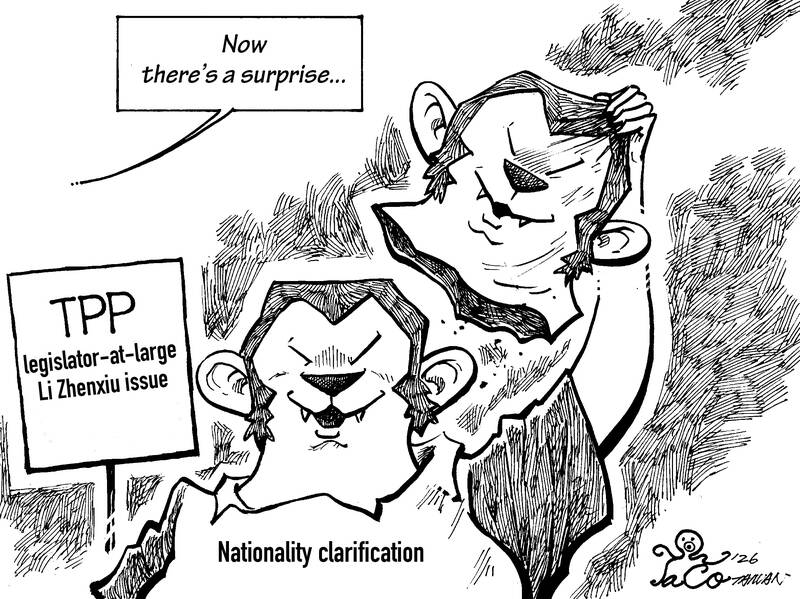
EDITORIAL CARTOON
In the first year of his second term, US President Donald Trump continued to shake the foundations of the liberal international order to realize his “America first” policy. However, amid an atmosphere of uncertainty and unpredictability, the Trump administration brought some clarity to its policy toward Taiwan. As expected, bilateral trade emerged as a major priority for the new Trump administration. To secure a favorable trade deal with Taiwan, it adopted a two-pronged strategy: First, Trump accused Taiwan of “stealing” chip business from the US, indicating that if Taipei did not address Washington’s concerns in this strategic sector, it could revisit its Taiwan
The stocks of rare earth companies soared on Monday following news that the Trump administration had taken a 10 percent stake in Oklahoma mining and magnet company USA Rare Earth Inc. Such is the visible benefit enjoyed by the growing number of firms that count Uncle Sam as a shareholder. Yet recent events surrounding perhaps what is the most well-known state-picked champion, Intel Corp, exposed a major unseen cost of the federal government’s unprecedented intervention in private business: the distortion of capital markets that have underpinned US growth and innovation since its founding. Prior to Intel’s Jan. 22 call with analysts
The Chinese Communist Party (CCP) challenges and ignores the international rules-based order by violating Taiwanese airspace using a high-flying drone: This incident is a multi-layered challenge, including a lawfare challenge against the First Island Chain, the US, and the world. The People’s Liberation Army (PLA) defines lawfare as “controlling the enemy through the law or using the law to constrain the enemy.” Chen Yu-cheng (陳育正), an associate professor at the Graduate Institute of China Military Affairs Studies, at Taiwan’s Fu Hsing Kang College (National Defense University), argues the PLA uses lawfare to create a precedent and a new de facto legal
International debate on Taiwan is obsessed with “invasion countdowns,” framing the cross-strait crisis as a matter of military timetables and political opportunity. However, the seismic political tremors surrounding Central Military Commission (CMC) vice chairman Zhang Youxia (張又俠) suggested that Washington and Taipei are watching the wrong clock. Beijing is constrained not by a lack of capability, but by an acute fear of regime-threatening military failure. The reported sidelining of Zhang — a combat veteran in a largely unbloodied force and long-time loyalist of Chinese President Xi Jinping (習近平) — followed a year of purges within the Chinese People’s Liberation Army (PLA)


 RSS
RSS