


International debate on Taiwan is obsessed with “invasion countdowns,” framing the cross-strait crisis as a matter of military timetables and political opportunity. However, the seismic political tremors surrounding Central Military Commission (CMC) vice chairman Zhang Youxia (張又俠) suggested that Washington and Taipei are watching the wrong clock.
Beijing is constrained not by a lack of capability, but by an acute fear of regime-threatening military failure.
The reported sidelining of Zhang — a combat veteran in a largely unbloodied force and long-time loyalist of Chinese President Xi Jinping (習近平) — followed a year of purges within the Chinese People’s Liberation Army (PLA) and the CMC. These are not mere “anti-corruption” drives; they are decapitation strikes against the PLA’s leadership.
An amphibious invasion requires absolute trust between the commander-in-chief and his generals. The current atmosphere of distrust and internal instability heightens caution rather than confidence. If Xi cannot trust his hand-picked military leadership, he cannot trust them with a high-stakes war where failure could trigger a blame cascade and threaten the Chinese Communist Party’s (CCP) survival.
Amphibious operations are inherently failure-prone. For the CCP, a military defeat on the beaches of Taiwan would be an existential catastrophe, gutting elite divisions and shattering the narrative of “national rejuvenation.”
PLA modernization does not reduce the political costs of defeat; it merely raises the expectations of success and amplifies the shock if operations fail. A “battlefield humiliation” that triggers a domestic collapse remains the most powerful deterrent in the Taiwan Strait.
Because the risks of war are so catastrophic, Beijing has pivoted to “gray zone” coercion — maritime harassment, cyberwarfare and economic leverage. These tactics allow the CCP to impose cumulative costs on Taiwan while controlling the domestic narrative and avoiding the “all-or-nothing” gamble of a full-scale invasion.
The danger is that fixation on “invasion dates” leads policymakers to prioritize military posturing over long-term societal resilience needed to blunt that slow-burn erosion.
Deterrence is not just about preventing a invasion; it is about preventing the gradual collapse of political resolve. A stabilizing strategy should shift focus away from calendar-driven scenarios and toward making all forms of coercion costly and unattractive. This requires several things.
First is hardening civilian infrastructure by investing in energy, communication and supply-chain security.
Second involves operational uncertainty, ensuring Beijing remains convinced that the domestic consequences of military failure are irreversible.
Third is crisis stability: bolstering communication channels to prevent miscalculations from spiraling into the war the CCP fears.
Zhang’s downfall is a reminder that the CCP’s greatest enemy is its own internal fragility. Understanding that fear is the key to designing a deterrence strategy that lasts longer than the next election cycle.
Simon H. Tang, PhD, is a lecturer in international relations at California State University, Fullerton.
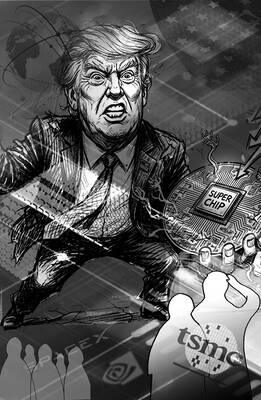
The White House’s decision to take a 9.9 percent stake in Intel Corp is looking like very shrewd business indeed. Since the government bought in at US$20.47 a share last August, the US chipmaker’s surging stock price has delivered the US a US$43 billion return. One of the reasons the investment has so far proved so sound is that the White House has made sure of it. According to The Wall Street Journal, Howard personally pushed deals on Intel’s behalf with some of the most lucrative clients imaginable. They include Nvidia Corp, the company at the heart of the AI
A single photograph can cut through a lot of noise, but it can also be used to misrepresent the truth. At the very least, it can concentrate the mind on something that requires further investigation. On Monday last week, Ma Ying-jeou Foundation CEO Tai Hsia-ling (戴遐齡) and former National Security Council secretary-general King Pu-tsung (金溥聰) held a news conference in which they showed a photograph of former foundation CEO Hsiao Hsu-tsen (蕭旭岑), now Chinese Nationalist Party (KMT) deputy chairman. In the image Hsiao is seated next to Xiamen Taiwan Businessmen Association chairman Han Ying-huan (韓螢煥). The two men were holding
I first met Professor Ray Jiing (井迎瑞) as a film and documentary student at Shih Hsin University’s (SHU) Department of Radio Television and Film in 1988. The following year, he went on to become the director of the Chinese Taipei Film Archive — forerunner of the Taiwan Film and Audiovisual Institute (TFAI). Over his eight-year tenure, Jiing rescued and restored over 200 classic Taiwanese films. In 1997, he established the Graduate Institute of Studies in Documentary and Film Archiving at Tainan National University of the Arts (TNNUA), and I joined the program in his third cohort of students. Beyond a
A recent report concerning a student who is suing his teacher posed the question in its headline: Does failing a student in two subjects constitute bullying? The college student in Chiayi County apparently sought NT$2 million (US$63,603) in state compensation, but a court dismissed the case. The first reaction of many might have been to ask: What has happened to students nowadays? Some say that teachers have lost their authority, while others say students are overindulged. Some even start reminiscing over the days when “whatever the teacher says goes.” However, the real issue might be overlooked if emotional reactions like that are the


 RSS
RSS