


US President Donald Trump rose to power partly by positioning himself as a foil to global elites, but last week, he attended the World Economic Forum (WEF) — the quintessential gathering of the world’s wealthiest and most powerful people — in Davos, Switzerland, as the star guest.
With the largest-ever US delegation in tow, Trump took his aggressive protectionism and transactional diplomacy to the global stage, shifting the debate and, in the process, increasing the risk of irreversible changes to the Earth system.
Instead of discussing issues such as fair taxation, sustainability, social justice and the energy transition, as delegates have done in the past, they kowtowed to Trump.
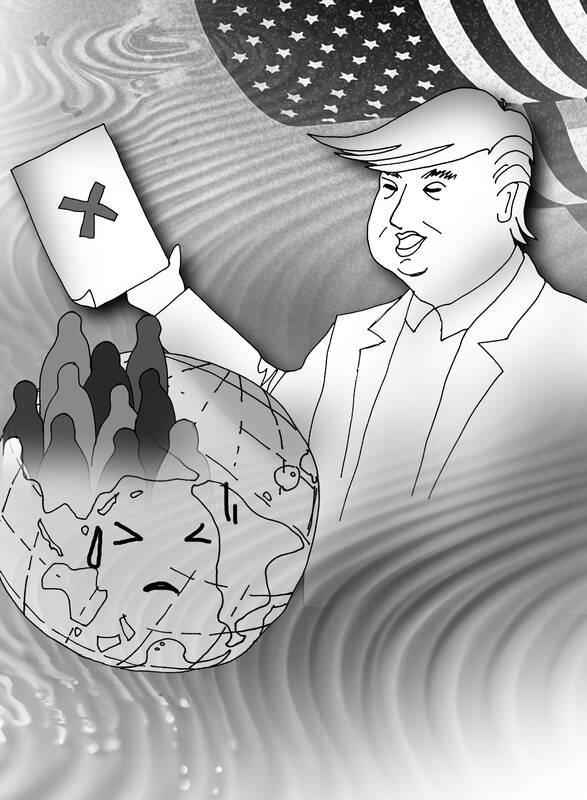
Illustration: Tania Chou
However, Trump’s remarks at Davos should erase any remaining doubt that normalizing his extreme policies and strident positions only encourages him to double down on the geopolitical chaos and uncertainty he is causing. In the past month alone, Trump has withdrawn the US from 66 international organizations, including two of the world’s most important and oldest climate institutions — the 34-year-old UN Framework Convention on Climate Change (UNFCCC), which serves as the primary forum for climate negotiations, and the UN’s 38-year-old Intergovernmental Panel on Climate Change, which leads the science related to climate change.
Just days before his trip to Davos, Trump stunned European leaders by threatening to impose punitive tariffs on allies that oppose his plan to seize Greenland from Denmark.
After more than a year of such wanton destruction and excessive use of unilateral measures to advance his “America first” agenda, trust — the lifeblood of multilateralism — has eroded, raising the risk of fragmentation and fueling instability. To mitigate these effects, sustain global growth and promote shared prosperity, the WEF chose “A Spirit of Dialogue” as the theme for this year’s meeting. It might be one of the best-attended yet, with more than 3,000 delegates from more than 130 countries, including 64 heads of state and government.
Dialogue, of course, is essential to resolve disputes, prevent conflict escalation — especially in a great-power-rivalry world of heightening geopolitical tensions — and prepare for risks.
According to the WEF’s pre-Davos survey, the most severe risks over the next decade all relate to the climate emergency, but, to secure Trump’s participation, the WEF agreed to avoid “woke” topics, including energy transition and climate change.
So much for a spirit of dialogue.
The agenda instead focused on, among other things, improving cooperation in a more contested world, unlocking new sources of growth, investing in people, responsibly deploying innovation at scale and building prosperity within planetary boundaries. Technology — particularly how artificial intelligence, quantum computing, and next-generation biotech and energy systems can drive economic and societal transformation — was a prominent theme.
The silence on climate change is as cynical as it is unsurprising. One of Trump’s first acts in his second term was to withdraw the US from the Paris climate agreement.
His administration later launched a major campaign to reverse US climate policy and expand fossil-fuel production. This has included halting the construction of offshore wind farms, slashing funding for renewable-energy projects, and working to repeal federal limits on greenhouse-gas emissions from power plants and vehicles.
Following Trump’s “drill, baby, drill” mantra, the administration has declared a “national energy emergency” and authorized the expansion of domestic fossil-fuel production. This policy could reverse progress in the transition to renewable energy, which contributed about one-third of global electricity generation in 2024. It also brings the world closer to a climate catastrophe, especially after scientists revealed earlier this month that the goal of limiting global warming to 1.5°C is now on track to be breached by 2030, more than a decade earlier than expected at the time of the 2015 Paris Agreement.
As the world’s largest historical and current emitter, the US economy’s continued reliance on fossil fuels has repercussions for everyone else. It will cause trillions of dollars in damage, disproportionately affecting poorer countries, and could push global warming above the 1.5°C target set by the Paris climate agreement. Crossing this threshold significantly increases the risk of irreversible changes to Earth systems; once climate tipping points are passed, self-reinforcing processes are activated that cannot be reversed, even if temperatures later decline.
One such tipping point is the collapse of the west Antarctic ice sheet, which would eventually raise global sea levels by about 4m. Such a drastic rise would permanently alter coastlines, and threaten low-lying communities and island countries.
Similarly, exceeding the 1.5°C goal accelerates permafrost thaw, releasing large amounts of carbon dioxide and methane into the atmosphere — a process that reinforces global warming and cannot be reversed.
Ecosystems also face irreversible losses if the planet exceeds 1.5°C of warming. Coral reefs are projected to decline by 70 to 90 percent at that temperature, while the Amazon rainforest, one of the world’s largest carbon sinks, risks becoming a carbon source, undermining natural mitigation efforts and further accelerating climate change.
Those changes could also have profound social consequences. Sea-level rise, for example, might wipe out coastal settlements, agricultural land and freshwater resources, displacing communities and erasing cultural heritage.
Perhaps most importantly, surpassing 1.5°C locks future generations into managing a planet with higher climate risks and fewer adaptation options.
More than diversifying energy sources, continuing the energy transition is essential for humanity’s survival; ignoring this reality to appease Trump and humor his oil obsession is a dangerous game with global and intergenerational consequences.
As the window to act on climate change narrows and the global order continues to fragment, dialogue must foster cooperation, strengthen collective problem-solving, and emphasize equity and justice. Decisions on emissions reductions, adaptation and climate finance inherently raise questions of responsibility, fairness, and burden-sharing between countries and within societies, but the WEF has chosen convenience over security and long-term sustainability by allowing Trump to set the terms of the debate.
Hippolyte Fofack, a former chief economist at the African Export-Import Bank, is Parker Fellow at the Sustainable Development Solutions Network at Columbia University, a research associate at Harvard University’s Center for African Studies, a distinguished fellow at the Global Federation of Competitiveness Councils and a fellow at the African Academy of Sciences.Copyright: Project Syndicate
There is a modern roadway stretching from central Hargeisa, the capital of Somaliland in the Horn of Africa, to the partially recognized state’s Egal International Airport. Emblazoned on a gold plaque marking the road’s inauguration in July last year, just below the flags of Somaliland and the Republic of China (ROC), is the road’s official name: “Taiwan Avenue.” The first phase of construction of the upgraded road, with new sidewalks and a modern drainage system to reduce flooding, was 70 percent funded by Taipei, which contributed US$1.85 million. That is a relatively modest sum for the effect on international perception, and
At the end of last year, a diplomatic development with consequences reaching well beyond the regional level emerged. Israeli Prime Minister Benjamin Netanyahu declared Israel’s recognition of Somaliland as a sovereign state, paving the way for political, economic and strategic cooperation with the African nation. The diplomatic breakthrough yields, above all, substantial and tangible benefits for the two countries, enhancing Somaliland’s international posture, with a state prepared to champion its bid for broader legitimacy. With Israel’s support, Somaliland might also benefit from the expertise of Israeli companies in fields such as mineral exploration and water management, as underscored by Israeli Minister of
When former president Tsai Ing-wen (蔡英文) first took office in 2016, she set ambitious goals for remaking the energy mix in Taiwan. At the core of this effort was a significant expansion of the percentage of renewable energy generated to keep pace with growing domestic and global demands to reduce emissions. This effort met with broad bipartisan support as all three major parties placed expanding renewable energy at the center of their energy platforms. However, over the past several years partisanship has become a major headwind in realizing a set of energy goals that all three parties profess to want. Tsai
On Sunday, elite free solo climber Alex Honnold — famous worldwide for scaling sheer rock faces without ropes — climbed Taipei 101, once the world’s tallest building and still the most recognizable symbol of Taiwan’s modern identity. Widespread media coverage not only promoted Taiwan, but also saw the Republic of China (ROC) flag fluttering beside the building, breaking through China’s political constraints on Taiwan. That visual impact did not happen by accident. Credit belongs to Taipei 101 chairwoman Janet Chia (賈永婕), who reportedly took the extra step of replacing surrounding flags with the ROC flag ahead of the climb. Just


 RSS
RSS