


Minister of Agriculture Chen Junne-jih (陳駿季) on Wednesday said that animal welfare groups should be allowed to reach a consensus on the issue of feeding stray animals before regulations are written into law.
Chen’s comments were made prior to an Economics Committee meeting at the legislature in Taipei to review proposed amendments to the Animal Protection Act (動物保護法) that would tighten regulations on placing pets in shelters, raise the maximum fine for pet abandonment and increase penalties for animal killings.
At the center of an increasingly polarized debate over Taiwan’s stray animal issue is whether feeding the animals should be regulated and if people who feed them should bear legal responsibility.
Supporters of implementing restrictions argue that feeding sustains stray populations, while opponents counter that it is a humane act that supports an overstretched state.
In 2017, the government implemented a “no-kill” policy that prohibited the euthanasia of stray animals in public shelters, significantly changing the way they are managed. With shelters no longer permitted to euthanize, trap-neuter-return (TNR) programs — under which animals are captured, sterilized and released — became the primary population control strategy.
While some point to reduced shelter intake in some urban areas as a measure of TNR’s success, others argue that it is ill-suited to Taiwan’s densely populated and ecologically sensitive environment.
Wildlife researchers have documented rising conflicts between stray dogs and protected species, particularly in national parks and wetlands. Free-roaming dogs have been linked to severe declines in native wildlife, including pangolins, leopard cats and muntjacs.
In 2023, residents in Miaoli and Tainan raised alarms over large packs of stray dogs prowling residential areas at night. More tragically, a 76-year-old man died in Kaohsiung last year after being attacked by strays while swimming.
For too long, local governments have relied on fragmented methods. A centralized, data-driven framework is essential if resources are to be allocated effectively.
Thus, the Ministry of Agriculture’s recently launched app to crowdsource sightings of stray dogs is a step in the right direction. By collecting geotagged data, the government aims to build a national risk map to identify hotspots for human-animal conflict.
Such data would allow authorities to allocate limited animal control resources more efficiently, rather than relying on anecdotal reports. However, the app’s effectiveness would rely heavily on public participation.
Data collection alone is also unlikely to resolve the issue. A meaningful solution must be developed to address the problem’s source — irresponsible ownership.
Enforcement of microchip registration, which has been mandatory for years, remains lax. Local governments should be required to maintain accurate records of pets within their jurisdictions, working with borough wardens and veterinarians to ensure compliance. Fines for abandonment — whether or not they are increased — must be imposed consistently, not treated as symbolic deterrents.
Equally important, pets should not be permitted to roam freely, as allowing animals to wander unsupervised blurs the line between ownership and abandonment.
As for the issue of feeding, Chen is right to urge caution. Criminalizing feeding at this stage could be premature and counterproductive. Yet discouraging the practice — particularly in sensitive ecological areas — is reasonable, as it sustains population density, encourages pack formation, and exacerbates environmental and safety risks.
Citizens who regularly spend money feeding strays should instead be encouraged to donate to shelters, support sterilization programs or assist with adoption efforts.
Managing the stray animal population calls for a multifaceted approach grounded in enforcement, data, education and a shared sense of responsibility. The public’s desire to care for local animals is undeniable, but the real challenge lies in transforming goodwill into actions that actually protect animals, people and the surrounding ecosystems.
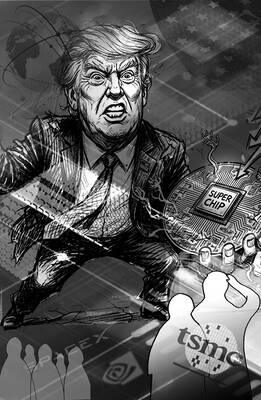
The White House’s decision to take a 9.9 percent stake in Intel Corp is looking like very shrewd business indeed. Since the government bought in at US$20.47 a share last August, the US chipmaker’s surging stock price has delivered the US a US$43 billion return. One of the reasons the investment has so far proved so sound is that the White House has made sure of it. According to The Wall Street Journal, Howard personally pushed deals on Intel’s behalf with some of the most lucrative clients imaginable. They include Nvidia Corp, the company at the heart of the AI

KMT Chairwoman Cheng Li-wun’s (鄭麗文) recent visit to Beijing and her upcoming visit to Washington will serve as a high-level test of her diplomatic mettle. In Beijing, Cheng was received with symbolic gestures, a warm reception, and high-level access. In Washington, she will receive far less pomp and far sharper questions about the KMT’s vision for the future of Taiwan. Her challenge will be to persuade Washington that the KMT’s engagement with China can coexist with strong deterrence. Cheng’s April 7-12 visit to mainland China coincided with an intense period of conflict in Iran. Despite the strategic significance of Cheng’s trip,

The closure of the Strait of Hormuz has sent the vast Asian chemicals industry into a tailspin. Deprived of the likes of Qatari natural gas and Saudi Arabian oil, the region’s fertilizer and plastics plants are slowing production or even shutting down. Everywhere except China, that is. In petrochemicals, China is unique. As well as a traditional industry that uses oil and gas as feedstock, it has parallel output that relies on its abundant domestic coal. Unsurprisingly, India and other regional powers want to copy and paste the Chinese method. This would not be easy — or climate friendly. The
Indonesian President Prabowo Subianto says he knows how to fix the problems facing Indonesia. Yet his economic mismanagement and authoritarian tendencies are steering the nation toward a familiar mix of currency instability and political chaos. The world’s fourth-most populous nation risks reversing the hard-won democratic and business reforms that came after the Asian Financial Crisis in 1997. At that time, the rupiah collapsed and the political upheaval that followed forced former president Haji Mohamed Suharto from power. Prabowo’s administration is ignoring similar warning signs. That disconnect was apparent in a national address on Wednesday, when Prabowo projected the swagger that has


 RSS
RSS