


Pakistan’s defense manufacturing industry is running red hot since its jets, drones and missiles earned the coveted “combat tested” tag in a conflict with India last year, attracting a slew of interested buyers.
Islamabad has held talks with 13 countries, six to eight of which are in an advanced stage, for deals involving JF-17 jets made jointly with China as well as training aircraft, drones and weapons systems, said three Pakistani sources who have knowledge of defense sales.
Pakistan’s military and defense ministry did not provide details on any deals but the country’s defense production minister confirmed that several countries were interested in jets and other military equipment.
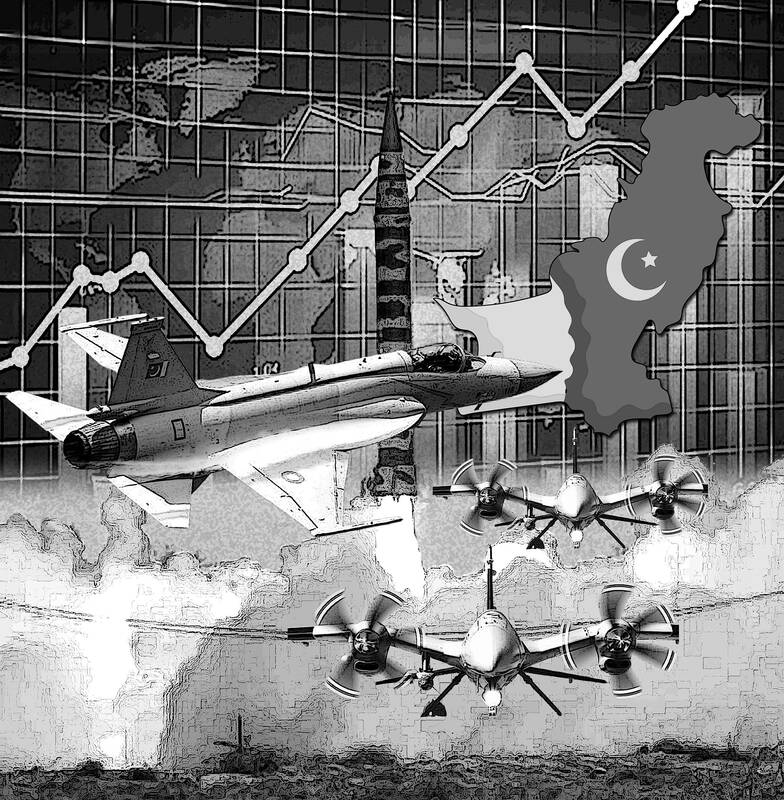
Illustration: Constance Chou
China’s defense ministry did not respond to a request for comment.
Analysts believe countries are searching for new supply chains following disruptions caused by the war in Ukraine and conflict in the Middle East. Pakistan’s weapons have become a viable alternative after they were tested in a massive air battle with India in May last year, in which Pakistan’s air force squadrons flew JF-17s alongside the advanced Chinese-made J-10s.
This is according to information from six sources privy to defense deals, three retired air force officials and a dozen analysts who provided insight into Pakistan’s rising weapons industry, including unreported details of negotiations.
While some expressed skepticism about whether Pakistan could navigate geopolitical pressures and increase production capacity, there was consensus that interest in Pakistani military hardware had surged. However, most analysts cautioned talks would not necessarily lead to signed deals.
“These talks are taking place [but] they can fall through due to international pressures,” Pakistani Defense Production Minister Raza Hayat Harraj said, terming any negotiations “guarded secrets.”
“There are a lot of queries but we are negotiating,” he said, adding interest had been expressed in air force equipment, ammunition and training.
Harraj also stressed the price difference between Pakistani jets and weapons and alternatives made in the US and Europe. While some Western options might be more technologically advanced, they cost more than three times as much as an approximately US$30 million to US$40 million JF-17.
The sources said countries engaged in talks include Sudan, Saudi Arabia, Indonesia, Morocco, Ethiopia and Nigeria as well as the government in eastern Libya led by Khalifa Haftar. Discussions on JF-17s and other weapons with Bangladesh and Iraq have been publicly acknowledged by Pakistan’s military, although more details have not been made public.
Almost all the potential buyers are Muslim-majority nations, like Pakistan. Many are from the predominantly Muslim Middle East, where Pakistan has historically been a security provider.
Asim Suleiman, a retired air marshal who remains briefed on defense sales, said “there are also three African countries lined up” as buyers, which do not include deals with the Libyan National Army and Sudan previously reported.
Three defense sources said among the most advanced talks is a wide-ranging arms, defense cooperation and intelligence-sharing deal with Bangladesh, which gained independence from Pakistan after the 1971 civil war.
The talks include JF-17 Block III multi-role jets, MFI-17 Mushshak aircraft, Pakistani-made drones including the Shahpar reconnaissance and attack UAVs, air defense systems and Mohafiz mine-resistant armored vehicles, two of the sources said.
A key hurdle would be whether Pakistan can scale production of the JF-17, which has become the cornerstone of its weapons production program, with training aircraft and drones also in demand.
Suleiman said that by the end of next year, Pakistan’s jet production rate could increase significantly, even possibly double from the current 20 or so aircraft manufactured annually, due to upgrades and expansions at the main factory.
Analysts said there were few visible constraints on increasing defense manufacturing and with backing from Beijing, Pakistan should be able to overcome most hurdles.
Pakistan “is becoming more relevant as a flexible, mid-tier provider of defense capacity,” said Andreas Krieg, a lecturer at King’s College London’s security studies department. “It can train forces, provide advisers, run joint exercises, support maritime operations and offer a menu of cost-effective platforms. For fragile African partners, that combination can be attractive: It is faster than Western capacity-building, less politically encumbered and often cheaper.”
Partnerships with a rising private sector specializing in defense, particularly drones, could also speed up growth.
At Sysverve Aerospace in the city of Rawalpindi, where Pakistan’s army also has its headquarters, workers build hundreds of kamikaze and reconnaissance drones a year that are primarily supplied to the military.
“The trend in the army is naturally moving toward engaging the private sector,” company director Saad Mir said.
Siemon Wezeman, a senior arms transfer researcher at the Stockholm International Peace Research Institute, said it was unclear how many reported talks over JF-17 sales would firm into hard deals, adding that Beijing could object to sales to certain clients.
While Pakistan was a natural partner for China to market the aircraft across the Middle East and Africa, “it’s the ones to Sudan and Libya that are really problematic.”
Both Libya and Sudan’s Darfur region are subject to UN arms embargoes.
Alongside juggling ties with China, Pakistan is navigating Middle East tensions between allies Saudi Arabia and the United Arab Emirates.
Islamabad has signed a mutual defense pact with Riyadh and is discussing another defense agreement involving Saudi Arabia and Turkey, although details have not been made public.
“On the ideological side, Islamabad is more aligned with Saudis on overall narrative,” said Emadeddin Badi from the Global Initiative Against Transnational Organized Crime. “But where things get murkier is on the business, ports, mineral sides, all those supply chains are very much dominated by UAE, that’s where the battle is playing out and Saudis have to play catch-up.”
A gap appears to be emerging between Washington’s foreign policy elites and the broader American public on how the United States should respond to China’s rise. From my vantage working at a think tank in Washington, DC, and through regular travel around the United States, I increasingly experience two distinct discussions. This divergence — between America’s elite hawkishness and public caution — may become one of the least appreciated and most consequential external factors influencing Taiwan’s security environment in the years ahead. Within the American policy community, the dominant view of China has grown unmistakably tough. Many members of Congress, as
After declaring Iran’s military “gone,” US President Donald Trump appealed to the UK, France, Japan and South Korea — as well as China, Iran’s strategic partner — to send minesweepers and naval forces to reopen the Strait of Hormuz. When allies balked, the request turned into a warning: NATO would face “a very bad” future if it refused. The prevailing wisdom is that Trump faces a credibility problem: having spent years insulting allies, he finds they would not rally when he needs them. That is true, but superficial, as though a structural collapse could be caused by wounded feelings. Something
Former Taipei mayor and Taiwan People’s Party (TPP) founding chairman Ko Wen-je (柯文哲) was sentenced to 17 years in prison on Thursday, making headlines across major media. However, another case linked to the TPP — the indictment of Chinese immigrant Xu Chunying (徐春鶯) for alleged violations of the Anti-Infiltration Act (反滲透法) on Tuesday — has also stirred up heated discussions. Born in Shanghai, Xu became a resident of Taiwan through marriage in 1993. Currently the director of the Taiwan New Immigrant Development Association, she was elected to serve as legislator-at-large for the TPP in 2023, but was later charged with involvement
Out of 64 participating universities in this year’s Stars Program — through which schools directly recommend their top students to universities for admission — only 19 filled their admissions quotas. There were 922 vacancies, down more than 200 from last year; top universities had 37 unfilled places, 40 fewer than last year. The original purpose of the Stars Program was to expand admissions to a wider range of students. However, certain departments at elite universities that failed to meet their admissions quotas are not improving. Vacancies at top universities are linked to students’ program preferences on their applications, but inappropriate admission


 RSS
RSS