


French President Emmanuel Macron issued a rare warning on Jan. 8, accusing the US of turning away from allies and international rules, and warning that the world is sliding back toward an order defined by spheres of influence. He described the trend as a return of “new imperialism” and urged Europe to invest in multilateral institutions before the international system unravels.
The timing of Macron’s remarks gave them particular weight. Only days earlier, Washington had taken coercive steps to intervene in Venezuela’s political and economic arrangements, asserting long-term control over the country’s oil flows. At about the same time, renewed statements suggested that Greenland was being treated as a strategic necessity. Macron’s comments sounded less like abstract rhetoric and more like a response to shifting power realities.
If multilateral institutions still exercised restraint over powerful states, such language would be unnecessary. Macron’s warning instead reflects a concern that international frameworks are losing their ability to shape outcomes, especially when major powers choose to bypass them rather than work through them.
This contradiction became clearer later the same day, when Macron convened more than 30 countries in Paris for a “coalition of the willing” summit to discuss post-ceasefire security arrangements for Ukraine. Despite being described as a declaration or compact, the meeting revealed a reality: All meaningful security commitments were conditional on a ceasefire — an outcome Europe itself does not control.
The reliance on ad hoc coalitions highlights the limits of established institutions. When organizations such as NATO or the EU cannot deliver timely or enforceable results, leaders turn to looser arrangements to fill the gap. While these mechanisms might offer flexibility, they also signal institutional weakness. If multilateral systems were functioning as intended, such substitutes would not be necessary.
The form of “new imperialism” Macron warned against does not resemble traditional colonial rule. Instead of territorial conquest, it operates through control over choices and dependencies. Venezuela remains formally sovereign, yet its economic and energy options are increasingly shaped from the outside. Greenland is not a colony, but it is openly discussed as an indispensable component of another power’s security architecture.
More troubling is the erosion of the institutions meant to regulate such behavior. Early this month, the US announced its withdrawal from several international organizations within the UN system. The accompanying rhetoric framed international law less as a binding obligation than as a matter of discretionary judgement. This marks a departure from the post-World War II logic that sought to restrain power through shared rules rather than unilateral decisions.
The result is a growing imbalance. European leaders continue to defend multilateralism in principle, even as their actions acknowledge its declining effectiveness. The US disengages institutionally while exercising influence more directly and, in many cases, more efficiently. Multilateralism is not being defeated outright; it is being sidelined when it would matter most.
Macron’s warning should therefore be read less as anti-US rhetoric than as a signal of systemic stress. For countries that rely on international rules rather than raw power to maintain their security, this shift is especially consequential. The challenge facing the international order is no longer limited to individual crises, but to whether the system itself can still impose meaningful limits on what the powerful are able to do.
Shiah I-Shin is a psychiatrist and an associate professor appointed by the Ministry of Education. He holds a doctorate from the University of British Columbia.
A gap appears to be emerging between Washington’s foreign policy elites and the broader American public on how the United States should respond to China’s rise. From my vantage working at a think tank in Washington, DC, and through regular travel around the United States, I increasingly experience two distinct discussions. This divergence — between America’s elite hawkishness and public caution — may become one of the least appreciated and most consequential external factors influencing Taiwan’s security environment in the years ahead. Within the American policy community, the dominant view of China has grown unmistakably tough. Many members of Congress, as
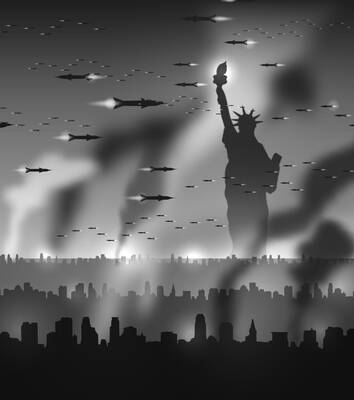
After declaring Iran’s military “gone,” US President Donald Trump appealed to the UK, France, Japan and South Korea — as well as China, Iran’s strategic partner — to send minesweepers and naval forces to reopen the Strait of Hormuz. When allies balked, the request turned into a warning: NATO would face “a very bad” future if it refused. The prevailing wisdom is that Trump faces a credibility problem: having spent years insulting allies, he finds they would not rally when he needs them. That is true, but superficial, as though a structural collapse could be caused by wounded feelings. Something
Former Taipei mayor and Taiwan People’s Party (TPP) founding chairman Ko Wen-je (柯文哲) was sentenced to 17 years in prison on Thursday, making headlines across major media. However, another case linked to the TPP — the indictment of Chinese immigrant Xu Chunying (徐春鶯) for alleged violations of the Anti-Infiltration Act (反滲透法) on Tuesday — has also stirred up heated discussions. Born in Shanghai, Xu became a resident of Taiwan through marriage in 1993. Currently the director of the Taiwan New Immigrant Development Association, she was elected to serve as legislator-at-large for the TPP in 2023, but was later charged with involvement
Out of 64 participating universities in this year’s Stars Program — through which schools directly recommend their top students to universities for admission — only 19 filled their admissions quotas. There were 922 vacancies, down more than 200 from last year; top universities had 37 unfilled places, 40 fewer than last year. The original purpose of the Stars Program was to expand admissions to a wider range of students. However, certain departments at elite universities that failed to meet their admissions quotas are not improving. Vacancies at top universities are linked to students’ program preferences on their applications, but inappropriate admission


 RSS
RSS