


In 1980, neither China nor India had much representation in the global middle class — people who neither belong to the bottom half of the income distribution nor rank among the top 10 percent worldwide. Almost a half-century later, things have changed — but in very different ways. China accounts for a sizable share of the more affluent middle-income earners, while India seems to have faded in relative importance.
This finding, nestled in the annual World Inequality Report, is a puzzle. After all, the only two countries with billion-plus populations are believed to have done well by embracing capitalism and opening their economies after the collapse of the Soviet Union. China became the factory to the world; India became its back office. So why should the outcomes for their citizens be so different?
To unpack this puzzle, start with Indians who are outside the middle class. The top of the pyramid is made up of what Marcellus Investment Managers in Mumbai has termed as the “Octopus Class,” the 1 million super-wealthy individuals whose affluence and disposable incomes are close to first-world levels. This tiny group has earned high returns from financial markets, and grown rich by serving each other and affluent customers around the world as corporate honchos, bankers, lawyers and other top professionals. The bottom is bursting at the seams, particularly since the pandemic when 800 million people came to survive on free food grains from the government. They still do.
Between the bookends of wealth and welfare lies the problematic domain: work and wages.
In China and India, surplus labor in agriculture followed the textbook model of development: It provided the ballast for industrialization, urbanization and creation of a middle class. Unlike in China, where young people of all genders migrated to cities, in India mostly men went; women from landless peasant families found seasonal work at brick kilns and construction sites. Most others stayed back, leaving the most-populous nation with one of the worst rates of female labor force participation in the developing world. After the pandemic, this ratio began to rise, largely because of an increase in work on the farm and self-employment. Those do not pay enough.
The opportunities for men who came to cities were limited by the reach of their caste, a birth-based social identity unique to South Asia. Although upward mobility at the lower end of the hierarchy has improved somewhat, it is still severely restricted. State jobs, where historically discriminated groups could get the benefit of affirmative action, have become rare. Like their fathers before them, a majority of male workers remain trapped in low-productivity, low-income occupations, such as guards, chauffeurs, gardeners and handymen.
Most of these findings are drawn from the State of Working India 2023 report by Amit Basole and his team at the Bengaluru-based Azim Premji University. As the economists have said, India missed out on the expected transfer of labor from subsistence-oriented occupations to profit-led activity. Three out of four nonfarm workers are stuck in the informal sector.
A stunted middle class might be a direct result of this extreme inequality. Folks at the top of the ladder do not see the teeming masses as a meaningful market, except for utilities, soap, short videos and personal loans. Those at the bottom of the pyramid lack the education and skills to manufacture things for the wealthy at home and overseas. A rapidly digitizing economy needs young internal migrants for gig work — like deliveries for 10-minute quick commerce. While it is no stepping stone to a middle-class life, it is all there is for the youth: The return on an additional year of schooling is lower than not just China, but Sub-Saharan Africa, according to the World Inequality Report.
At the top of society, mobility is limited globally. Many in today’s Chinese elite are descendants of those who had prominent roles during the Communist revolution of 1949. India’s business tycoons are mostly a leftover of the mercantile interests that had thrived under pre-1947 British colonial rule. They are guided by short-term returns. Instead of replicating their Chinese counterparts’ aggressive investment in technology, their one brilliant idea for scaling up manufacturing is to lobby for relaxed labor laws — so they can extract a 12-hour workday.
The top 1 percent of Indians own 40 percent of overall personal wealth, but Gen-Z billionaires are bored with business. They would rather park their fortunes in family offices than start new enterprises. In the Soviet-styled planned economy that extended up to the 1980s, their grandparents scrambled for licenses. Nowadays, their parents just fight each other for a favorable government policy and haggle with private-credit firms for refinancing.
An unambitious elite spoiled by finance — plus a working class held back by inadequate education and inequities of caste and gender — are stymying the emergence of a global middle class in India. The social change that can fill the gap is nowhere on the horizon.
Andy Mukherjee is a Bloomberg Opinion columnist covering industrial companies and financial services in Asia. Previously, he worked for Reuters, the Straits Times and Bloomberg News. This column reflects the personal views of the author and does not necessarily reflect the opinion of the editorial board or Bloomberg LP and its owners.
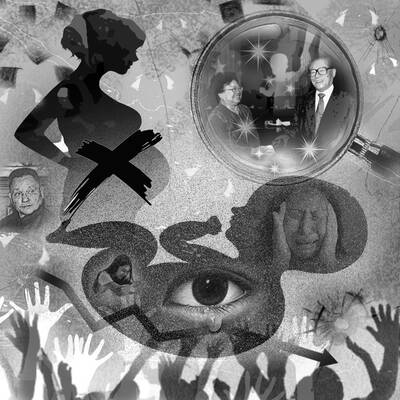
Jan. 1 marks a decade since China repealed its one-child policy. Just 10 days before, Peng Peiyun (彭珮雲), who long oversaw the often-brutal enforcement of China’s family-planning rules, died at the age of 96, having never been held accountable for her actions. Obituaries praised Peng for being “reform-minded,” even though, in practice, she only perpetuated an utterly inhumane policy, whose consequences have barely begun to materialize. It was Vice Premier Chen Muhua (陳慕華) who first proposed the one-child policy in 1979, with the endorsement of China’s then-top leaders, Chen Yun (陳雲) and Deng Xiaoping (鄧小平), as a means of avoiding the
In the US’ National Security Strategy (NSS) report released last month, US President Donald Trump offered his interpretation of the Monroe Doctrine. The “Trump Corollary,” presented on page 15, is a distinctly aggressive rebranding of the more than 200-year-old foreign policy position. Beyond reasserting the sovereignty of the western hemisphere against foreign intervention, the document centers on energy and strategic assets, and attempts to redraw the map of the geopolitical landscape more broadly. It is clear that Trump no longer sees the western hemisphere as a peaceful backyard, but rather as the frontier of a new Cold War. In particular,
As the Chinese People’s Liberation Army (PLA) races toward its 2027 modernization goals, most analysts fixate on ship counts, missile ranges and artificial intelligence. Those metrics matter — but they obscure a deeper vulnerability. The true future of the PLA, and by extension Taiwan’s security, might hinge less on hardware than on whether the Chinese Communist Party (CCP) can preserve ideological loyalty inside its own armed forces. Iran’s 1979 revolution demonstrated how even a technologically advanced military can collapse when the social environment surrounding it shifts. That lesson has renewed relevance as fresh unrest shakes Iran today — and it should

The last foreign delegation Nicolas Maduro met before he went to bed Friday night (January 2) was led by China’s top Latin America diplomat. “I had a pleasant meeting with Qiu Xiaoqi (邱小琪), Special Envoy of President Xi Jinping (習近平),” Venezuela’s soon-to-be ex-president tweeted on Telegram, “and we reaffirmed our commitment to the strategic relationship that is progressing and strengthening in various areas for building a multipolar world of development and peace.” Judging by how minutely the Central Intelligence Agency was monitoring Maduro’s every move on Friday, President Trump himself was certainly aware of Maduro’s felicitations to his Chinese guest. Just


 RSS
RSS