

In deterrence theory, success is not determined by military force alone, but is underpinned by three pillars: capability, credibility and message control.
Message control converts raw military power into psychological and political restraint. Without it, even an overwhelming force can fail to deter.
The US’ latest National Security Strategy (NSS) marked a clear shift in its messaging toward China — and it is precisely that shift that should concern Taiwan most.
Unlike the report under former US president Joe Biden, which designated China as the US’ primary strategic competitor, the new report toned down its language regarding systemic rivalry, ideological confrontation and revisionism. Instead, it focused on trade imbalances, negotiations and transactional bargaining.
To some in Washington, it might look like a step back. To Beijing, it is a highly legible political signal: The relationship is moving away from structural confrontation and toward a space that is negotiable, testable and adjustable. In deterrence terms, it is a rhetorical downgrade that weakens political clarity and erodes perceived resolve.
Even more troubling for Taiwan is how the new strategy treats the Taiwan Strait. While the report still emphasizes maintaining military deterrence, its political commitment to the nation is noticeably diluted. Language about deterring unilateral changes to the “status quo” is more indirect, and Taiwan’s political status is left more ambiguous.
That is consistent with US President Donald Trump’s preference for strategic ambiguity and transactional diplomacy.
The US is preserving military capability while maintaining political flexibility for bargaining. It is a dangerous combination for deterrence stability: Force exists, but the will to use it is kept deliberately opaque.
The new security report has effectively discredited the long-standing claim by some Taiwanese commentators that Trump has a clear and institutionalized “decoupling-from-Europe, protecting-Taiwan” grand strategy. If such a strategy truly existed in a stable and predictable form, it would be codified in the US’ highest-level national security document.
Instead, what appeared is a softer China framework, elastic language on Taiwan and a broad transactional orientation. That leaves optimistic assumptions about Trump’s automatic protection of Taiwan with little institutional foundation.
From a deterrence perspective, ambiguity from the defender benefits the challenger. When message control deteriorates, red lines blur. When red lines blur, the incentive to test boundaries increases. It does not reduce the risk of war, it creates strategic uncertainty. “Gray zone” coercion, political warfare, economic pressure and quasi-blockade tactics thrive in such ambiguous environments.
China places immense weight on political signaling. Beijing does not judge US resolve by weapons alone, but by the consistency and discipline of Washington’s official language. When confrontation is rhetorically softened and commitments are blurred, Chinese leaders infer a preference for risk management over risk absorption and calibrate their pressure accordingly.
For Taiwan, the most dangerous misreading would be to interpret the signals as reassurance. That would reflect a form of “ostrich mentality,” or comfort built on selective perception rather than institutional evidence.
Ultimately, Taiwan’s security does not rest on a US president’s “secret option.” It is based on Taiwan’s defense posture, sustained military investment, social resilience and political preparedness. When great powers deliberately blur their messages and preserve a room for deals, small states must treat the risk as rising, not falling.
Simon Tang is an adjunct professor at California State University, Fullerton, who lectures on international relations.
Taiwan’s democracy and high-tech economy play a crucial role in global affairs and are central to the world’s embrace of a raft of next-generation technologies, including AI. It is underpinned by a security relationship with the United States that’s existed in several iterations since 1949 and the Chinese Nationalist Party’s (KMT) retreat from China. A central pillar of that security relationship is the American willingness to sell arms to Taiwan. Indeed, since 1979 it has been embedded in US law, with the Taiwan Relations Act (TRA) charging the US with helping to improve the island’s ability to deter an attack from
Academia Historica director Chen Tsui-lien (陳翠蓮), speaking at the handover ceremony for her new role on Monday, said that when she accepted the position, she knew that her peaceful life as a history professor was a thing of the past, and that from now on she would have to “wear a helmet.” A specialist in Taiwan’s post-World War II history and the 228 Incident, she has been accused of being politically divisive. A phrase she used in her acceptance speech set headlines alight this week, putting her in the sights of editorials in blue-leaning media. She said opposition figures calling for
When Panama severed diplomatic relations with Taiwan and recognized China in 2017, Beijing achieved one of its most important diplomatic victories in Central America. However, nearly a decade later, Panama is demonstrating that diplomatic recognition does not necessarily eliminate Taiwan from a country’s political system. Panama and Taiwan had diplomatic relations for more than 100 years and the goodwill between the countries was displayed last week when Panama’s National Assembly established an interparliamentary exchange group with the Legislative Yuan. Forty-five of the assembly’s 71 lawmakers joined the group, representing more than 60 percent of the legislature. Its members include National Assembly President Shirley
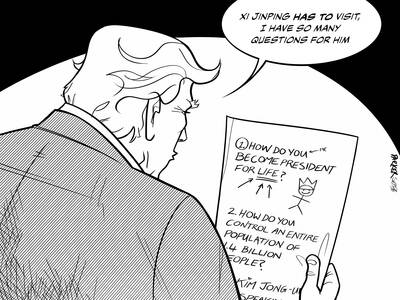
EDITORIAL CARTOON


 RSS
RSS