


A decade ago, China’s government unveiled Made in China 2025 — a bold vision for transforming the country from the world’s assembly line into a global innovation leader. The plan was met with considerable skepticism, particularly in the West, where a robust scholarly consensus held that authoritarianism was fundamentally incompatible with innovation.
With a shaky technological base, middling universities and a shortage of high-skilled talent, China was light-years behind the global frontier. Barring drastic political change, many observers concluded, China would remain a “copycat nation.”
We know how that turned out. However, the misguided belief that innovation depends on political freedom appeared to have a sound analytical and historical basis. As the political scientist Samuel Huntington observed in 1996, the tools that keep authoritarian regimes in power — such as censorship, repression and corruption — can stifle innovation and economic dynamism. Moreover, the conditions that enable innovation, such as greater human mobility and information flows, risk empowering forces that could threaten an authoritarian regime. Mikhail Gorbachev could have attested to that.
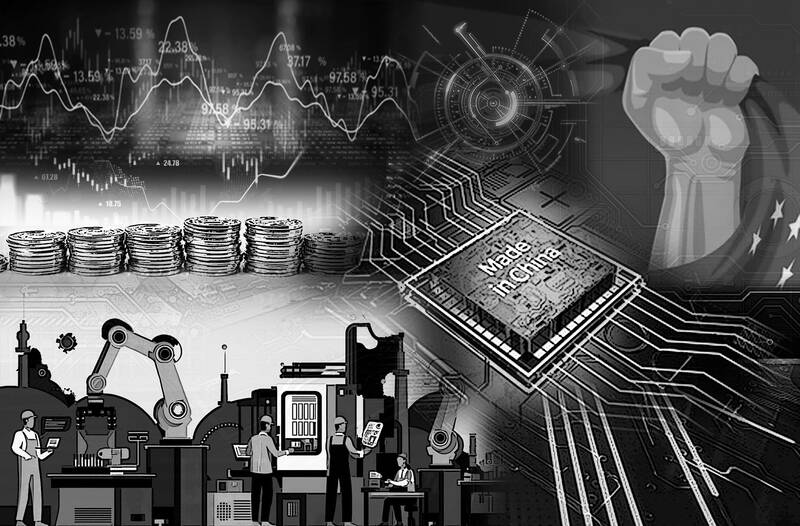
Illustration: Constance Chou
China’s leaders found a way around this “king’s dilemma.” Crafting a model that could be referred to as “smart authoritarianism,” China has blended a novel approach to political control with selective economic openness, building on lessons from high-tech, authoritarian Singapore.
Eschewing heavy-handed repression, the Chinese Communist Party (CCP) pioneered diverse and subtle techniques of information control, which academic Tony Zirui Yang (楊子銳) said “normalized” censorship and “desensitized” the Chinese people to it.
Instead of truncheons and guns, China’s leaders use digital tools such as artificial intelligence, facial recognition and other biometric-data collection to detect, monitor and pre-empt dissent. While violent coercion still occurs, the academic Lynette Ong said that the CCP maintains deniability by outsourcing it to “thugs for hire” — enforcers who intimidate petitioners, disperse protests and carry out forced evictions.
China’s government has pursued a selective opening of certain areas of the economy, including universities and the private sector, and invested heavily in expanding the country’s innovative capacity, such as by funding research and development and promoting human-capital formation. For the past decade, China has drastically improved the quality of its higher education and built a massive high-tech workforce.
China resembles other rising economies, including the 19th-century US. Its bright young people used to study overseas but increasingly could stay home to get a superb education. China produces the most science and engineering doctoral graduates worldwide. The majority of engineers at DeepSeek, which stunned the world in 2023 with its open-source AI model, were trained in China.
Chinese firms lead — and even dominate — several high-tech sectors. China possesses more than 80 percent of the world’s solar manufacturing capability. Chinese firms lead the electric-vehicle and EV-battery industries, and in 2023, China surpassed Japan to become the world’s largest automobile exporter. A single Chinese company, DJI, is the undisputed leader in the commercial drone industry, claiming more than 70 percent of the global market.
China remains a one-party state that disappears dissidents and censors ideas, yet it has vaulted past Japan, Germany, and France — countries long celebrated as global innovation leaders — to become the world’s tenth most-innovative economy in the latest Global Innovation Index. China ranks among (or above) the world’s top innovators, including South Korea, on metrics such as number of patents, production of widely cited science and technology research, and high-value manufacturing. Made in China 2025 might not have hit all its targets, but China has certainly reached the technological frontier.
Some observers still have their doubts. They believe that intensifying repression under Chinese President Xi Jinping (習近平) is eroding China’s innovative capacity, pointing to his crackdown on the tech sector, which began in 2020 and destroyed a huge amount of national wealth. However, smart authoritarianism is not about maximizing growth; it is about balancing economic objectives with the imperative of regime survival. For example, China’s government has eased up considerably on the tech sector since 2023. The smart authoritarian model accounts for periods of political tightening and loosening.
Skeptics say that China faces other powerful growth headwinds, such as adverse demographics, uneven and slowing productivity, massive debts and a troubled real-estate sector. These challenges are real and have already contributed to a significant growth slowdown. By transforming itself into a technology superpower and shifting the global balance of power, China has already achieved something few people believed would be possible.
Acknowledging that smart authoritarians can innovate does not mean that they are better equipped to do so than their democratic counterparts. Democratic countries still boast universities that attract the world’s brightest minds, firms that work at — and push forward — the technological frontier, and transnational networks that foster and facilitate innovation. In 2020, democracies were the first to develop the vaccines that offered the world a way out of the COVID-19 pandemic. They are more than capable of competing with China.
Western democracies can no longer dismiss China’s innovative potential — or the dangers it implies. As a superpower, China poses an increasing military threat to Taiwan, and to future US strategic influence in East Asia. Not only does a successful China provide an appealing model for other smart authoritarians, such as in Saudi Arabia and the United Arab Emirates; its government directly supports dictators by sharing new technologies and strategies of repression.
Xi said: “No force can stop China’s scientific and technological development.” Whether this is true remains to be seen, but one thing is certain: Western democracies cannot simply assume that they are going to come out on top.
Jennifer Lind is associate professor of government at Dartmouth College, associate fellow at Chatham House and the author of Autocracy 2.0: How China’s Rise Reinvented Tyranny.
Copyright: Project Syndicate
When Chinese President Xi Jinping (習近平) sits down with US President Donald Trump in Beijing on Thursday next week, Xi is unlikely to demand a dramatic public betrayal of Taiwan. He does not need to. Beijing’s preferred victory is smaller, quieter and in some ways far more dangerous: a subtle shift in American wording that appears technical, but carries major strategic meaning. The ask is simple: replace the longstanding US formulation that Washington “does not support Taiwan independence” with a harder one — that Washington “opposes” Taiwan independence. One word changes; a deterrence structure built over decades begins to shift.
The cancelation this week of President William Lai’s (賴清德) state visit to Eswatini, after the Seychelles, Madagascar and Mauritius revoked overflight permits under Chinese pressure, is one more measure of Taiwan’s shrinking executive diplomatic space. Another channel that deserves attention keeps growing while the first contracts. For several years now, Taipei has been one of Europe’s busiest legislative destinations. Where presidents and foreign ministers cannot land, parliamentarians do — and they do it in rising numbers. The Italian parliament opened the year with its largest bipartisan delegation to Taiwan to date: six Italian deputies and one senator, drawn from six
Recently, Taipei’s streets have been plagued by the bizarre sight of rats running rampant and the city government’s countermeasures have devolved into an anti-intellectual farce. The Taipei Parks and Street Lights Office has attempted to eradicate rats by filling their burrows with polyurethane foam, seeming to believe that rats could not simply dig another path out. Meanwhile, as the nation’s capital slowly deteriorates into a rat hive, the Taipei Department of Environmental Protection has proudly pointed to the increase in the number of poisoned rats reported in February and March as a sign of success. When confronted with public concerns over young
Taipei is facing a severe rat infestation, and the city government is reportedly considering large-scale use of rodenticides as its primary control measure. However, this move could trigger an ecological disaster, including mass deaths of birds of prey. In the past, black kites, relatives of eagles, took more than three decades to return to the skies above the Taipei Basin. Taiwan’s black kite population was nearly wiped out by the combined effects of habitat destruction, pesticides and rodenticides. By 1992, fewer than 200 black kites remained on the island. Fortunately, thanks to more than 30 years of collective effort to preserve their remaining


 RSS
RSS