


The good news is that Americans have never been richer. The bad news is that most of them do not feel like it.
There has been tremendous growth in income and wealth in the US in the last half century, even for poorer and middle-class households. However, because of the nature of that growth, as well as the changing structure of the national economy, a lot of the people who have benefited believe that the economy is not working for them.
It is true the middle class is shrinking. In the 1960s the income distribution of US households looked like a bell curve with a very thick middle. Today there are fewer Americans in the middle — largely because many have joined the ranks of the upper-middle class. In 1967, a little more than 5 percent of Americans earned or received more than US$150,000 (in 2024 dollars). Now more than 30 percent do. And it is not just the middle class that moved up: In 1967, more than 38 percent earned or received less than US$50,000. Now that figure is 21 percent.
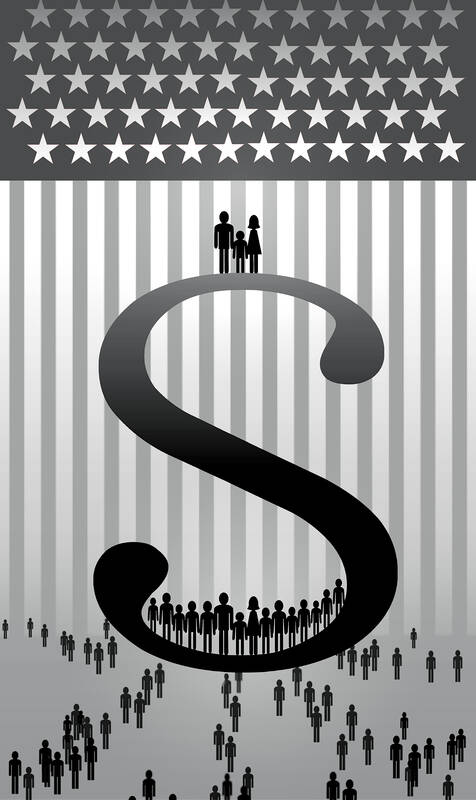
Illustration: Yusha
Income inequality increased. The very rich — the top 5 percent and especially the top 1 percent — got much richer than everyone else, even the top 20 percent. The income distribution curve has flattened as more people have moved into the upper part, with the upper tail moving even further from everyone else.
The result? More Americans than ever are affluent — and more have the sense that something is wrong with the economy.
Americans earned more for several reasons. The first is that neoliberal economic policies worked as intended. In the last 50 years, there have been big increases in productivity, solid GDP growth and, since the 1980s, low and predictable inflation. All this helped make most Americans richer.
There has been a decline in unionization, which helped to compress wages between the upper tail of the income distribution and the middle. More Americans go to college, where they incur debt but increase their lifetime earnings, especially as technology favors people with degrees. Americans are older, and people tend to earn more later in their careers. On the lower end, income grew in part because the figure includes welfare benefits and tax credits.
There are legitimate reasons that many households feel poorer, even if their income is greater. It is a struggle to keep up with the price increases of many critical services in regulated sectors such as health care, education and housing. There is some justified anxiety that the earnings growth and prosperity will not continue. The last 60 years was the Era of the Baby Boomers, when income gains were large for anyone who went to college. The college premium still exists, but it has stopped growing and it comes at a higher cost.
And while technology and trade have made everyone richer, they have made a far smaller group of people much, much richer. It is not just the handful of people who are rich beyond comprehension. There are hundreds of Americans who are worth more than a billion dollars. This is in part because technology changed and a few firms earned more — and paid more — than the rest. Working in certain industries means much higher earnings. And a superstar economy rewards high performers much more than everyone else, whether that superstar is Taylor Swift or a talented manager in a fast-growing corporation.
To be clear, this system helps create economic growth that makes everyone better off. However, in the very top tier of income, it can feel like a zero-sum competition between the merely affluent and the truly rich.
This poses a challenge not just for economic planners but for the very meaning of prosperity. Growth and rising incomes are usually the goal of economic policy, including neoliberal economic policy. However, the last two decades show that rising incomes are not always enough to engender good feelings about the economy.
This intra-top-quartile resentment might help explain why more politicians want higher taxes on super-high earners but do not ask the upper middle class to pay any more. The taxes are not just a way to pay for more middle-class welfare benefits. They are a form of economic retribution.
The catch is that there is a tradeoff between growth and equality. At least some of the growth at the top came from more productivity. Innovative companies, some founded or led by billionaires, help make the American economy (or at least Americans’ stock portfolios) richer. Yes, there is room to increase taxes on the rich, but punitive taxes can harm growth.
The idea that the economy is rigged and zero-sum is leading to a rise in populism in both parties. The result would probably be less trade and more price controls, which would mean a slower-growing economy — or even one that is shrinking. Then Americans would learn that the only thing worse than rising inequality is flat or declining income.
Allison Schrager is a Bloomberg Opinion columnist covering economics. A senior fellow at the Manhattan Institute, she is author of “An Economist Walks Into a Brothel: And Other Unexpected Places to Understand Risk.” This column reflects the personal views of the author and does not necessarily reflect the opinion of the editorial board or Bloomberg LP and its owners.
Taiwan’s higher education system is facing an existential crisis. As the demographic drop-off continues to empty classrooms, universities across the island are locked in a desperate battle for survival, international student recruitment and crucial Ministry of Education funding. To win this battle, institutions have turned to what seems like an objective measure of quality: global university rankings. Unfortunately, this chase is a costly illusion, and taxpayers are footing the bill. In the past few years, the goalposts have shifted from pure research output to “sustainability” and “societal impact,” largely driven by commercial metrics such as the UK-based Times Higher Education (THE) Impact
History might remember 2026, not 2022, as the year artificial intelligence (AI) truly changed everything. ChatGPT’s launch was a product moment. What is happening now is an anthropological moment: AI is no longer merely answering questions. It is now taking initiative and learning from others to get things done, behaving less like software and more like a colleague. The economic consequence is the rise of the one-person company — a structure anticipated in the 2024 book The Choices Amid Great Changes, which I coauthored. The real target of AI is not labor. It is hierarchy. When AI sharply reduces the cost
I wrote this before US President Donald Trump embarked on his uneventful state visit to China on Thursday. So, I shall confine my observations to the joint US-Philippine military exercise of April 20 through May 8, known collectively as “Balikatan 2026.” This year’s Balikatan was notable for its “firsts.” First, it was conducted primarily with Taiwan in mind, not the Philippines or even the South China Sea. It also showed that in the Pacific, America’s alliance network is still robust. Allies are enthusiastic about America’s renewed leadership in the region. Nine decades ago, in 1936, America had neither military strength
The Chinese Nationalist Party (KMT) is often accused of getting close to, and even conspiring with, the Chinese Communist Party (CCP). There are certainly good reasons behind these accusations, yet the confounding truth is that it makes neither historical nor logical sense for it to do so. Whether one believes that the Chinese civil war fought between the KMT and CCP in the previous century has ended or has yet to be resolved, the KMT’s retreat to Taiwan in 1949 resulted in the CCP governing China and the KMT taking root in Taiwan. For years, the KMT refused to even


 RSS
RSS