


US President Donald Trump has announced his eagerness to meet North Korean leader Kim Jong-un while in South Korea for the APEC summit. That implies a possible revival of US-North Korea talks, frozen since 2019. While some would dismiss such a move as appeasement, renewed US engagement with North Korea could benefit Taiwan’s security interests.
The long-standing stalemate between Washington and Pyongyang has allowed Beijing to entrench its dominance in the region, creating a myth that only China can “manage” Kim’s rogue nation. That dynamic has allowed Beijing to present itself as an indispensable power broker: extracting concessions from Washington, Seoul and Tokyo for a chance to engage with Pyongyang, while tightening the noose around Taiwan.
Should Washington reopen a direct channel with Pyongyang, Beijing’s influence monopoly would weaken, and so would its bargaining power. US-North Korea engagement would demonstrate that Washington can conduct diplomacy on its own terms.
The diplomatic leverage Beijing holds over North Korea creates operational risk. Every time Kim fires missiles, Washington, Seoul and Tokyo scramble surveillance aircraft, reposition missile defenses and pour intelligence assets into monitoring the provocations. The hours spent tracking North Korea are hours not spent watching Chinese maneuvers around Taiwan. That imbalance is precisely what Beijing counts on.
It also means that the US would face an impossible choice over how to allocate its resources if contingencies occur in both the Taiwan Strait and on the Korean Peninsula.
Even limited steps to make Pyongyang more predictable, such as through hotlines or humanitarian channels, would free up US attention and resources to strengthen deterrence in the Strait. Lower tensions on the Korean Peninsula would also give Seoul more strategic room to step up in a Taiwan contingency, reinforcing regional deterrence. Washington’s engagement with Pyongyang helps lower the risk of the US and its allies overextending themselves in the region.
Trump’s overture toward Kim should be seen as an expression of his trademark personality-driven diplomacy, perhaps with an eye on the Nobel Peace Prize. Even modest dialogue with Pyongyang would shrink Beijing’s leverage in regional diplomacy and bolster stability from the Korean Peninsula to the Taiwan Strait, a win for peace across northeast Asia.
Alan Jeong is a student at Georgetown University in Washington.
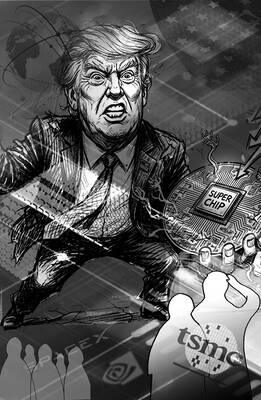
The White House’s decision to take a 9.9 percent stake in Intel Corp is looking like very shrewd business indeed. Since the government bought in at US$20.47 a share last August, the US chipmaker’s surging stock price has delivered the US a US$43 billion return. One of the reasons the investment has so far proved so sound is that the White House has made sure of it. According to The Wall Street Journal, Howard personally pushed deals on Intel’s behalf with some of the most lucrative clients imaginable. They include Nvidia Corp, the company at the heart of the AI
A single photograph can cut through a lot of noise, but it can also be used to misrepresent the truth. At the very least, it can concentrate the mind on something that requires further investigation. On Monday last week, Ma Ying-jeou Foundation CEO Tai Hsia-ling (戴遐齡) and former National Security Council secretary-general King Pu-tsung (金溥聰) held a news conference in which they showed a photograph of former foundation CEO Hsiao Hsu-tsen (蕭旭岑), now Chinese Nationalist Party (KMT) deputy chairman. In the image Hsiao is seated next to Xiamen Taiwan Businessmen Association chairman Han Ying-huan (韓螢煥). The two men were holding
I first met Professor Ray Jiing (井迎瑞) as a film and documentary student at Shih Hsin University’s (SHU) Department of Radio Television and Film in 1988. The following year, he went on to become the director of the Chinese Taipei Film Archive — forerunner of the Taiwan Film and Audiovisual Institute (TFAI). Over his eight-year tenure, Jiing rescued and restored over 200 classic Taiwanese films. In 1997, he established the Graduate Institute of Studies in Documentary and Film Archiving at Tainan National University of the Arts (TNNUA), and I joined the program in his third cohort of students. Beyond a
President William Lai Ching-te’s (賴清德) May 20 second-anniversary address was not just a routine policy review; it was damage control. US President Donald Trump’s remarks — that he did not want to see anyone move toward independence and that the delivery of a major Taiwan arms package could depend on the progress of US-China relations — unsettled Taiwan’s public and created an opening for opposition parties to question whether Taiwan was being treated as a bargaining chip in Washington’s dealings with Beijing. Lai’s speech was designed to close that opening. The address covered the expected ground: sovereignty, cross-strait relations, defense spending,


 RSS
RSS