


Russia is becoming a “puppet state” of China after its invasion of Ukraine on Feb. 24, Israeli historian Yuval Noah Harari told a business forum in Taipei yesterday.
The Sapiens author, who is a professor at the Hebrew University of Jerusalem, delivered the remarks in a pre-recorded video at the forum, which was organized by Taiwan-based Global Views Monthly.
On a geopolitical level, the Kremlin’s war against Ukraine “has basically destroyed Russia’s position as a great power” and is “turning Russia into a puppet state of China,” Harari said.
Moscow is now “in a struggle” with NATO, which has supplied Ukraine in its fight against Russian forces with light and heavy equipment, he said.
As a result, Russia has become “increasingly dependent” on China, he said.
Beijing has refrained from publicly condemning or endorsing Moscow, its strategic partner, for the invasion.
It has called for a “peaceful resolution” to the war while opposing sanctions on Russia by the US and other countries.
At the end of June, Washington blacklisted five companies based in China for allegedly supporting the Russian military.
Harari said that Beijing was “making the biggest profit” out of the invasion in a geopolitical sense and “getting into a stronger position” by staying out of the war.
Russian nationalists should oppose the invasion, as it is undermining Moscow’s own interests, he said.
“Russia is a rich country with very, very poor citizens,” he said. “The sooner this war ends, the better it is for Russia.”
Given that Moscow had waged one war after another over the years, were it to “get away with it” in Ukraine, people would see “more [Russian President Vladimir] Putins all over the world,” he added.
Harari expressed concern that the COVID-19 pandemic and the ongoing war had pushed the world into “an era of deglobalization” with “greater disunity.”
The fact that countries now trust one another less has affected the global economy by disrupting supply chains and fueling inflation, he said.
At the same time, geopolitical tensions have prompted many countries to increase their defense budgets at the expense of healthcare, education, welfare and scientific development to tackle climate change, Harari said.

FUKUOKA SITUATION: Japanese media reported that the pathogen is expected to be identified by the summer, while the CDC downplayed the idea that it was hMPV A “mysterious cold-like illness” reported in Japan’s Fukuoka Prefecture does not seem to be a new disease, but Japanese authorities have been asked about the situation, the Centers for Disease Control (CDC) said yesterday. The Fukuoka Prefectural Medical Association on Wednesday told a news conference that a “mystery cold” that has become a hot topic on social media is “highly likely to be caused by some kind of viral infection,” Japan’s KBC News reported. “Many people are experiencing symptoms starting with a sore throat, followed by a runny nose, phlegm and a severe cough,” KBC News reported, citing association officials. Health authorities are

Nvidia Corp CEO Jensen Huang (黃仁勳) arrived in Taiwan yesterday ahead of upcoming AI and technology events, saying he plans to meet with clients and Taiwan Semiconductor Manufacturing Co Chairman C.C. Wei (魏哲家) during his visit. After landing at Taipei Songshan Airport, Huang posed for photos with fans and handed out Yakult drinks to reporters and supporters waiting at the scene, saying he has “a lot to do” during the trip. Asked about reports that Nvidia’s planned headquarters site in Taipei’s Beitou Shilin Technology Park could break ground on May 27, Huang said that if the company holds an event, he would
Carrefour Taiwan is to begin using a new name from the start of July, but it cannot divulge the name until then, the chairman of the supermarket chain's parent company said today. President Chain Store Co chairman Lo Chih-hsien (羅智先) was asked by reporters after a shareholders' meeting to confirm whether the company has settled on a new name for the supermarket brand. In March, the government-registered name of two Carrefour Taiwan branches was quietly changed to "Le Chia Kang" (樂家康) in Chinese, raising speculation that has been selected as the name. Lo said that because of local regulations and contractual obligations, the
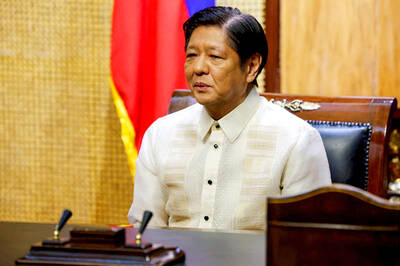
The Philippines would likely be involved in any conflict over Taiwan due to its proximity to the democracy claimed by China, President Ferdinand Marcos Jr said, reiterating a stance that risks angering Beijing. “In the Philippines, we do not have a choice because Taiwan is so close to the Philippines and we have almost 200,000 Filipino nationals living and working in Taiwan,” Marcos said in an interview with Japanese media in Manila on Monday. The Philippine leader’s comments come ahead of a state visit to Japan next week, where he is to meet with Japanese Prime Minister Sanae Takaichi to discuss security


 RSS
RSS