


Los Angeles has been burning for two weeks, and the blame game is in full swing. From diversity, equity and inclusion policies, and artificial-intelligence data centers to the mismanagement of public resources by political leaders, fingers seem to be pointed in every direction. However, the charges being thrown around miss the point: The underlying cause of the conflagration is greenhouse gas (GHG) emissions generated by the burning of fossil fuels.
Even as US President Donald Trump’s nominee for energy secretary, Chris Wright, disputes the scientifically established relationship between climate change and more severe wildfires, the blazes rage on, destroying ecosystems and reducing neighborhoods to ashes across Los Angeles County — where about one-third of residents live within a kilometer of one of the area’s 8,335 active oil wells. This disaster is exceptional only in that it affects a major US city. Similar fires are happening all over the world, and have been for a while — especially since 2016.
Consider the wildfires that engulfed Fort McMurray in Alberta — where pipelines carried more than 300,000 barrels of oil per day — in May of that year. The combination of wind, high temperatures, and plentiful dry brush quickly transformed a few burning embers into a raging inferno. With flying embers igniting numerous new fires, it did not take long for local firefighting capacity to become severely strained, leaving emergency services waiting for outside help to arrive.
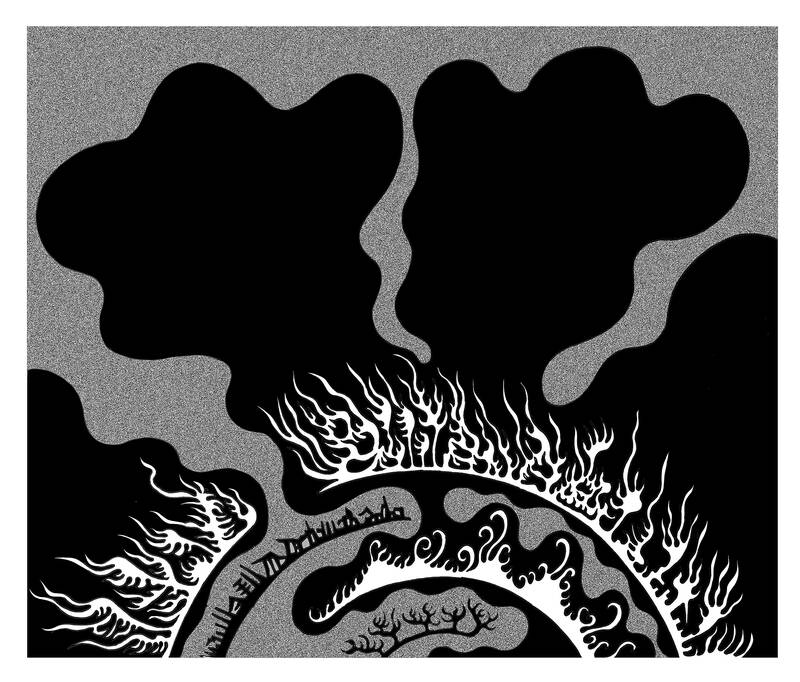
Illustration: Mountain People
Although there was no shortage of water — Fort McMurray is at the convergence of four rivers — extinguishing the fires proved impossible, given the incredible speed of their spread in the parched air. Two days after the embers were first spotted in the brush, the entire city had to be abandoned, in what would become Alberta’s largest-ever wildfire evacuation. Ultimately, the fire destroyed Fort McMurray and its surrounding towns, becoming the most expensive disaster in Canada’s history.
Sound familiar? The oil wells of Los Angeles might be tucked behind Macy’s or Bloomingdale’s, or obscured by walls — out of sight, out of mind — but like any other oil well, they emit carbon dioxide and methane. The rapid and exponential increase in emissions of these GHGs, whether originating in Los Angeles or Lagos, is one of the main causes of observed climate change since the mid-20th century.
Fires happened before. The Santa Ana winds have long blown, and Los Angeles County has burned plenty of times. Moreover, it is difficult to establish GHG emissions as a proximate cause of a particular fire.
However, the blazes of the past few years are qualitatively different from those of the past: They are more intense, more frequent, more destructive and far more difficult to extinguish, even when water is available. These fires can only be called “supercharged.”
California has experienced many of these supercharged infernos in the past few years: the Thomas Fire and the Santa Rosa Tubbs Fire in 2017, the Redding Carr Fire and the Camp Fire in 2018, the Bay Area Fire (which spread to Oregon and Washington) in 2020 and the Dixie Fire in 2021. “Fire weather” has also come to Arizona, Hawaii, New Mexico and Texas, as well as Brazil, Greece, Portugal, Turkey and other countries.
Last year, 15.14 million hectares of the Amazon, so necessary for absorbing GHGs, burned. What used to be a fire season is now a fire age.
Is it insensitive to discuss climate change during this moment of crisis? Should we not be focusing on people’s immediate needs, on the traumatic experiences so many are enduring and on the exhaustion of brave first responders? Some say yes, but it is not too soon to apply the lessons of these supercharged fires. Unless we do, such catastrophes — and the needs, trauma and exhaustion they bring — will proliferate and intensify.
The Los Angeles fires, and other recent blazes, should serve as a wake-up call to everyone, but especially to the US — the world’s largest producer and consumer of oil and natural gas, and historically the highest emitter of GHGs. The US Department of Defense is the world’s largest institutional oil consumer, owing to the US’ involvement in wars around the globe.
To be sure, fighting to eliminate GHG emissions amounts to provoking Goliath — a giant who profits enormously when we burn the fuels that are causing our homes to be gutted by fire.
Fortunately, there are many Davids, like the 6,000 U’wa, an indigenous people who have tirelessly resisted oil development in Colombia’s cloud forests since 1991, when the government granted exploration rights to multinational companies.
It took three decades and an international network of supporters, but last month, the Inter-American Court of Human Rights ruled that Colombia had contravened the rights of the U’wa by authorizing oil, gas and mining projects on their land. Oil development in the area has been halted (at least for now), and an important precedent has been set.
The U’wa believe that oil is the “blood of the mother Earth.” As U’wa spokesperson Berito Kuwaru’wa said: “If you take away her blood, our mother will experience vacillating heat and cold, ferocious winds and terrible fires, destruction like you have never seen.” Eliminating fossil fuels will not be easy, but it is far preferable to watching a prophecy come true.
Terry Lynn Karl is emeritus professor of political science and former director of the Center for Latin American Studies at Stanford University.
Copyright: Project Syndicate
When Chinese President Xi Jinping (習近平) sits down with US President Donald Trump in Beijing on Thursday next week, Xi is unlikely to demand a dramatic public betrayal of Taiwan. He does not need to. Beijing’s preferred victory is smaller, quieter and in some ways far more dangerous: a subtle shift in American wording that appears technical, but carries major strategic meaning. The ask is simple: replace the longstanding US formulation that Washington “does not support Taiwan independence” with a harder one — that Washington “opposes” Taiwan independence. One word changes; a deterrence structure built over decades begins to shift.
The cancelation this week of President William Lai’s (賴清德) state visit to Eswatini, after the Seychelles, Madagascar and Mauritius revoked overflight permits under Chinese pressure, is one more measure of Taiwan’s shrinking executive diplomatic space. Another channel that deserves attention keeps growing while the first contracts. For several years now, Taipei has been one of Europe’s busiest legislative destinations. Where presidents and foreign ministers cannot land, parliamentarians do — and they do it in rising numbers. The Italian parliament opened the year with its largest bipartisan delegation to Taiwan to date: six Italian deputies and one senator, drawn from six
Recently, Taipei’s streets have been plagued by the bizarre sight of rats running rampant and the city government’s countermeasures have devolved into an anti-intellectual farce. The Taipei Parks and Street Lights Office has attempted to eradicate rats by filling their burrows with polyurethane foam, seeming to believe that rats could not simply dig another path out. Meanwhile, as the nation’s capital slowly deteriorates into a rat hive, the Taipei Department of Environmental Protection has proudly pointed to the increase in the number of poisoned rats reported in February and March as a sign of success. When confronted with public concerns over young
Taipei is facing a severe rat infestation, and the city government is reportedly considering large-scale use of rodenticides as its primary control measure. However, this move could trigger an ecological disaster, including mass deaths of birds of prey. In the past, black kites, relatives of eagles, took more than three decades to return to the skies above the Taipei Basin. Taiwan’s black kite population was nearly wiped out by the combined effects of habitat destruction, pesticides and rodenticides. By 1992, fewer than 200 black kites remained on the island. Fortunately, thanks to more than 30 years of collective effort to preserve their remaining


 RSS
RSS