


A motley crew of centrist pundits in Europe, the “Global South,” and, following former US president Donald Trump’s election victory, the US believes that the West is in decline. To be sure, never has so much power been concentrated in the hands of so few people (and postcodes) in the West, but does that alone mean Western power is doomed?
In Europe, there is good reason to embrace the narrative of decline. Just as the Roman Empire shifted its capital to Constantinople to extend its hegemony by another millennium, abandoning Rome to the barbarians, so did the West’s center of gravity shift to the US, abandoning the UK and Europe to the stagnation that is rendering them inert, backward and increasingly irrelevant.
However, there is a deeper reason for the pundits’ gloomy sentiment: the tendency to confuse the decline of the West’s commitment to its own value system (universal human rights, diversity and openness) with the West’s decline. Like a snake shedding its old skin, the West is gaining power by shedding a value system which sustained its ascendancy during the 20th century, but which in the 21st no longer serves that goal.
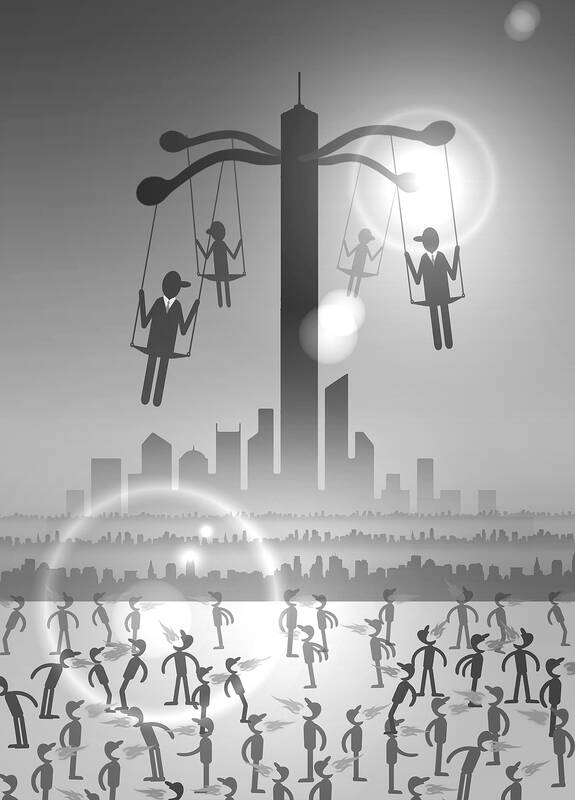
Illustration: Yusha
Democracy was never a prerequisite for the rise of capitalism, and what we now think of as the West’s value system is not a prerequisite for it, either. Western power was built not on humanist principles, but rather on brutal exploitation at home coupled with the slave trade, the opium trade, and various genocides in the Americas, Africa and Australia.
During its ascendancy, Western power went unchecked abroad. Europe sent millions of colonists to subjugate peoples and extract resources. Europeans pretended the natives they saw were not human and declared their land terra nullius, a land without a people for settlers craving that land — the first act of every genocide from the Americas, Africa and Australia to Palestine today.
However, while unassailable abroad, Western power was challenged at home by its wretched lower classes that rose up in response to economic crises caused by the inability of the many to consume enough of the goods they were producing in the factories belonging to the few. Those conflicts spilled over into industrial-scale warfare between Western powers vying for markets, culminating in two world wars.
As a consequence, the West’s elites had to make concessions. Domestically, they acquiesced to public education, health systems and pensions. Internationally, outrage at the West’s cruel wars and genocides led to decolonization, universal declarations of human rights and international criminal courts.
For a couple of decades after World War II, the West basked in the warm glow of distributive justice, the mixed economy, diversity, the rule of law at home and a rules-based international order. Economically, those values were served extraordinarily well by the centrally planned, US-designed global monetary system known as Bretton Woods, which allowed it to recycle its surpluses to Europe and Japan, essentially dollarizing its allies to sustain its own net exports.
Then, by 1971, the US had become a deficit country. Rather than tighten its belt in Germanic style, the US blew up Bretton Woods and blew out its trade deficit. Germany, Japan and later China became net exporters, whose dollar profits were sent to Wall Street to buy US government debt, real estate and shares in companies that the US allowed foreigners to invest in.
Then, the American ruling class had an epiphany: Why manufacture stuff at home when foreign capitalists could be relied upon to dispatch their products and their dollars to the US? So, they exported whole production lines abroad, triggering the deindustrialization of the US’ manufacturing heartlands.
Wall Street was at the heart of that audacious new recycling mechanism. To play its role, it had to be unrestrained. However, wholesale deregulation needed an economics and a political philosophy to support it. Demand created its own supply and neoliberalism was born. Before long, the world was awash in derivatives surfing the tsunami of foreign capital inundating New York’s banks. When the wave broke in 2008, the West nearly broke with it.
Panicked Western leaders authorized the minting of US$35 trillion to refloat the financiers while imposing austerity on their populations. The only part of these trillions that was actually invested in machinery went to building up the cloud capital that gave Big Tech its pervasive power over Western populations’ hearts and minds.
The combination of socialism for financiers, collapsing prospects for the bottom 50 percent and the surrender of our minds to Big Tech’s cloud capital gave birth to a “Brave New West,” whose overweening elites have little use for the past century’s value system. Free trade, anti-trust rules, net zero, democracy, openness to migration, diversity, human rights and the International Court of Justice were treated with the same contempt with which the US treated friendly dictators — its “own bastards” — after their usefulness ended.
With Europe rendered impotent by its inability to federate political power after it had federated its money and the developing world more in debt than ever, only China is left standing in the West’s way. However, the irony is that China does not want to be a hegemon. It just wants to sell its wares unimpeded.
However, the West is now convinced that China poses a lethal threat. Like Oedipus’ father, who died at his son’s hand, because he believed the prophecy that his son would kill him, so the West is working tirelessly to push China to take the plunge and seriously challenge Western power, such as by turning the BRICS into a renminbi-based Bretton-Woods-like system.
This year, the West continued to grow stronger. However, with its value system in the gutter, so did its penchant for engineering its decline.
Yanis Varoufakis, a former finance minister of Greece, is leader of the MeRA25 party and professor of economics at the University of Athens.
Copyright: Project Syndicate
Speaking at the Copenhagen Democracy Summit on May 13, former president Tsai Ing-wen (蔡英文) said that democracies must remain united and that “Taiwan’s security is essential to regional stability and to defending democratic values amid mounting authoritarianism.” Earlier that day, Tsai had met with a group of Danish parliamentarians led by Danish Parliament Speaker Pia Kjaersgaard, who has visited Taiwan many times, most recently in November last year, when she met with President William Lai (賴清德) at the Presidential Office. Kjaersgaard had told Lai: “I can assure you that ... you can count on us. You can count on our support
Denmark has consistently defended Greenland in light of US President Donald Trump’s interests and has provided unwavering support to Ukraine during its war with Russia. Denmark can be proud of its clear support for peoples’ democratic right to determine their own future. However, this democratic ideal completely falls apart when it comes to Taiwan — and it raises important questions about Denmark’s commitment to supporting democracies. Taiwan lives under daily military threats from China, which seeks to take over Taiwan, by force if necessary — an annexation that only a very small minority in Taiwan supports. Denmark has given China a
Many local news media over the past week have reported on Internet personality Holger Chen’s (陳之漢) first visit to China between Tuesday last week and yesterday, as remarks he made during a live stream have sparked wide discussions and strong criticism across the Taiwan Strait. Chen, better known as Kuan Chang (館長), is a former gang member turned fitness celebrity and businessman. He is known for his live streams, which are full of foul-mouthed and hypermasculine commentary. He had previously spoken out against the Chinese Communist Party (CCP) and criticized Taiwanese who “enjoy the freedom in Taiwan, but want China’s money”
A high-school student surnamed Yang (楊) gained admissions to several prestigious medical schools recently. However, when Yang shared his “learning portfolio” on social media, he was caught exaggerating and even falsifying content, and his admissions were revoked. Now he has to take the “advanced subjects test” scheduled for next month. With his outstanding performance in the general scholastic ability test (GSAT), Yang successfully gained admissions to five prestigious medical schools. However, his university dreams have now been frustrated by the “flaws” in his learning portfolio. This is a wake-up call not only for students, but also teachers. Yang did make a big


 RSS
RSS