


What does not kill me makes me stronger. Friedrich Nietzsche’s aphorism has always inspired me as a great life hack for snatching optimism from the jaws of despair. Might it also apply to democracy?
For lovers of freedom and democracy — I am equating the two for these purposes — the news has been grim for at least 18 years, according to Freedom House.
That is how long the world has been in a democratic recession, with more countries each year trampling on, rather than cherishing, civil rights and political liberties.
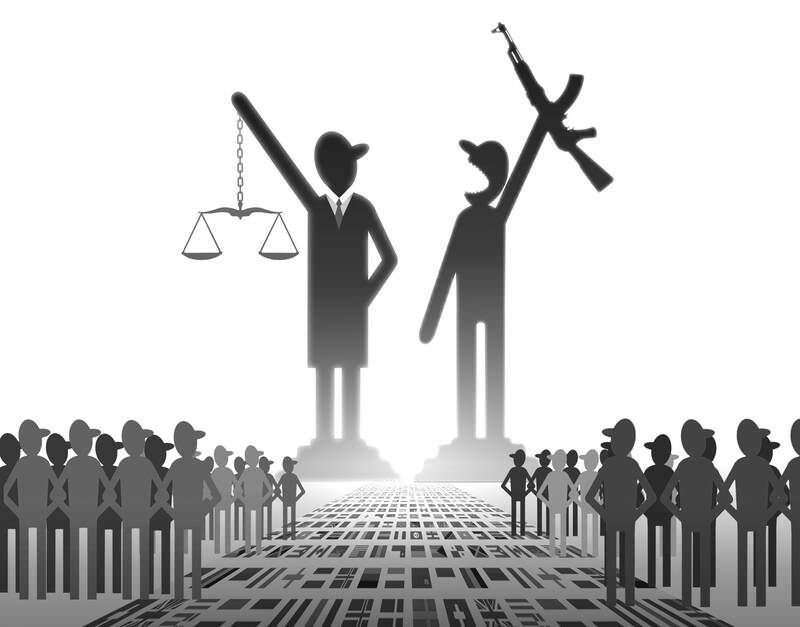
Illustration: Yusha
The downward trend seems to be accelerating, not only in places like coup-wracked Africa but also in the West. In Hungary, Prime Minister Viktor Orban has, during the 14 years of his second stint, methodically subdued checks and balances in the media, courts, universities, parliament and business to turn the country into an autocracy in all but name. That’s made him a role model for US president-elect Donald Trump, who appears bent on doing something similar in his second term.
The strongmen have lots of copycats, of varying degrees of sophistication. South Korean President Yoon Suk-yeol just made a hash of his grasp for authoritarian power. An unpopular incumbent who — like Trump — has described his opposition as domestic “enemies,” he attempted a de facto coup last week by declaring martial law out of the blue. Fortunately, the South Korean parliament, the press and the country rose up in defiance, and the putsch was over in a matter of hours.
Elsewhere, democracies long considered stable and mature keep playing into a populist narrative by showing themselves to be feckless travesties. In eerie synchronization, governments in both France and Germany — once grandly called Europe’s political “tandem” — have recently collapsed while trying to pass a bog-standard budget. The French one lost a parliamentary motion of no confidence last week, the German one would do so in a bit over a week. Democracy, it might appear to cynics, not only fails to solve problems, it sometimes is the problem.
Among the causes for this spreading disenchantment, the easiest to identify is deliberate disinformation spread by the enemies of democracy, above all Russian President Vladimir Putin. His trolls, bots and meme sorcerers have been messing with Western voters’ minds so deviously that many citizens in democracies surrender to the nihilism that, as one author frames Putin’s strategy, “nothing is true, and everything is possible.”
For example, Romania and the US believe that Russian meddling catapulted a Putin-loving, NATO-bashing conspiracy theorist named Calin Georgescu out of obscurity last month to win the first round of Romania’s presidential election.
Others turn their backs on democracy, because it rarely seems to cure the larger banes of life, such as inequality and the resulting alienation and frustration of entire segments of societies. If democracies cannot rectify glaring injustices, why not give your local autocrat a spin or two?
Then, of course, there is that subcutaneous but potent serum which French call ennui. If you have always lived in a democracy and still do not like your life, you might be drawn to charismatic and radical authoritarians out of sheer boredom and disillusionment. Whatever else you think about the Trump-Elon Musk reality show, for instance, it is more entertaining than the current White House.
My point is that pessimism is tempting. It often does seem as if modern democracy is dying a slow death before our eyes, just as the original democracy expired ignominiously in the 5th century BC, when the Athenians gave up on self-rule and ceded power to the Thirty Tyrants, a group of pro-Spartan oligarchs whom I imagine as Putin-lovers in togas.
However, wait, there is still Nietzsche: Our democracies are definitely being tested and battered in the process. However, if they survive, they might yet come out stronger.
Let us take another look at South Korea. Older citizens are still traumatized by their earlier experiences with dictatorship and martial law (last imposed in 1980), and all South Koreans are proud of the vibrant democracy they have built since then. Yoon did not understand that. When he went on television to announce his coup, something clicked and all of society rallied: not only the opposition but also most of Yoon’s own base in parliament, the media and the population. Vox populi gave its veto. Yoon would probably be impeached; in any event, his name and career are ruined.
That episode resembles West Germany’s Spiegel affair in 1962. At that time Americans, Brits and French (that is, the Western Allies from World War II that still chaperoned the young Federal Republic of Germany), and notably Germans themselves, still doubted whether this new German democracy, run largely by people who had let the Weimar Republic fail and Adolf Hitler rise, was reliable and robust.
Then a conservative defense minister did not like an article in the magazine Der Spiegel. Acting on paternalistic and authoritarian instincts from an earlier era, he ordered several journalists to be detained and the editorial offices raided and occupied. However, the West German public had seen this movie before and came out in force on the streets. The defense minister was out, the government took a beating, the curse of Weimar was lifted, and West German democracy became real.
Similar struggles are going on in many democracies nowadays. For almost a decade, a populist and far-right party in Poland emulated Hungary’s Orban and appeared to be succeeding. However, then Poles fired the authoritarians and put democrats back in charge. The tug-of-war is not over, but it is now a fair fight. The same was true of Israel before its collective psyche was hijacked by the terrorist massacre of Oct. 7 last year: For most of that year, Israeli democrats had been marching to resist attempts by their far-right government to undermine judicial independence.
The intuition underneath Nietzsche’s aphorism is that we should view life’s challenges as antigens which provoke an immune response. Remove all antigens, and the immune system might turn on itself and cause autoimmune diseases; in the context of democracy, I call that ennui. Overwhelm the system with a killer bug, and it might fail. Keep it busy, and it would sustain and invigorate us.
Enough small talk; what about the US? Intellectuals are already in the weeds trying to figure out whether its Insurrection Act, say, does or does not resemble South Korea’s martial law, and whether Trump would pull a Yoon. The answer is: If Trump installs enough cronies — he is certainly trying — he could.
The more pertinent question then becomes how the immune system of the oldest continuous democracy would react. Would conservatives — in the media, US Congress and electorate — join with other Americans, even ones they have become accustomed to loathe and resist? Would Republicans in the US Senate and House of Representatives, and Fox News veto the coup as their analogs in South Korea did last week?
Is US democracy Weimar or West Germany? It is an open question. Which is good, because it remains possible that in time freedom in the US, and by extension the world, emerges stronger than ever before.
Andreas Kluth is a Bloomberg Opinion columnist covering US diplomacy, national security and geopolitics. Previously, he was editor-in-chief of Handelsblatt Global and a writer for The Economist. This column does not necessarily reflect the opinion of the editorial board or Bloomberg LP and its owners.
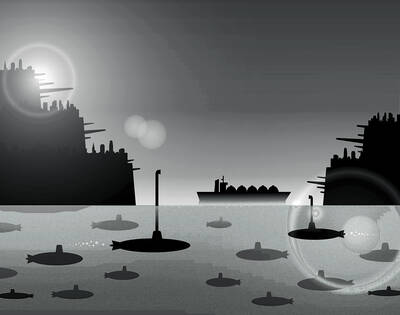
In the event of a war with China, Taiwan has some surprisingly tough defenses that could make it as difficult to tackle as a porcupine: A shoreline dotted with swamps, rocks and concrete barriers; conscription for all adult men; highways and airports that are built to double as hardened combat facilities. This porcupine has a soft underbelly, though, and the war in Iran is exposing it: energy. About 39,000 ships dock at Taiwan’s ports each year, more than the 30,000 that transit the Strait of Hormuz. About one-fifth of their inbound tonnage is coal, oil, refined fuels and liquefied natural gas (LNG),
On Monday, the day before Chinese Nationalist Party (KMT) Chairwoman Cheng Li-wun (鄭麗文) departed on her visit to China, the party released a promotional video titled “Only with peace can we ‘lie flat’” to highlight its desire to have peace across the Taiwan Strait. However, its use of the expression “lie flat” (tang ping, 躺平) drew sarcastic comments, with critics saying it sounded as if the party was “bowing down” to the Chinese Communist Party (CCP). Amid the controversy over the opposition parties blocking proposed defense budgets, Cheng departed for China after receiving an invitation from the CCP, with a meeting with
To counter the CCP’s escalating threats, Taiwan must build a national consensus and demonstrate the capability and the will to fight. The Chinese Communist Party (CCP) often leans on a seductive mantra to soften its threats, such as “Chinese do not kill Chinese.” The slogan is designed to frame territorial conquest (annexation) as a domestic family matter. A look at the historical ledger reveals a different truth. For the CCP, being labeled “family” has never been a guarantee of safety; it has been the primary prerequisite for state-sanctioned slaughter. From the forced starvation of 150,000 civilians at the Siege of Changchun
The two major opposition parties, the Chinese Nationalist Party (KMT) and the Taiwan People’s Party (TPP), jointly announced on Tuesday last week that former TPP lawmaker Chang Chi-kai (張啟楷) would be their joint candidate for Chiayi mayor, following polling conducted earlier this month. It is the first case of blue-white (KMT-TPP) cooperation in selecting a joint candidate under an agreement signed by their chairpersons last month. KMT and TPP supporters have blamed their 2024 presidential election loss on failing to decide on a joint candidate, which ended in a dramatic breakdown with participants pointing fingers, calling polls unfair, sobbing and walking


 RSS
RSS