


US president-elect Donald Trump is inheriting from President Joe Biden a challenging situation for American policy in the Indo-Pacific region, with an expansionist China on the march and threatening to incorporate Taiwan, by force if necessary.
US policy choices have become increasingly difficult, in part because Biden’s policy of engagement with China, including investing in personal diplomacy with President Xi Jinping (習近平), has not only yielded little but also allowed the Chinese military to gain a stronger footing in the South China Sea and the Taiwan Strait.
In Xi’s Nov. 16 Lima meeting with a diminished Biden, the Chinese strongman signaled little interest in softening his aggressive foreign policy or easing China’s coercive pressures on Taiwan. In fact, Xi reportedly singled out President William Lai Ching-te (賴清德) by name and cited not one but four Chinese “red lines” that he said America must not cross if it wanted to maintain peace in the region.
“The Taiwan question, democracy and human rights, China’s path and system, and China’s development right are four red lines for China. They must not be challenged,” Xi cautioned Biden, according to the Chinese readout of the meeting. In other words, the US must not even seek to challenge the Chinese Communist Party-run totalitarian system by promoting democracy and human rights in China.
Meanwhile, Hong Kong’s sentencing of 45 pro-democracy leaders to long prison terms for a non-violent offense marks the final step in Xi’s crushing of all dissent and snuffing out Hong Kong’s autonomy. Like in the South China Sea, where China has changed the geopolitical map by expanding its maritime borders and building 27 military outposts on disputed islands, Xi’s success in Hong Kong has come without incurring any international costs.
All this increases the dangers for Taiwan. Yet, with the wars in Ukraine and the Middle East claiming America’s attention and resources, and draining US stocks of critical munitions and air defense systems, the last thing Biden wanted is greater tensions with China. This explained his conciliatory moves to help ease Chinese concerns. For example, Biden declared while visiting Hanoi in September 2023, “I don’t want to contain China … we’re not looking to hurt China, sincerely.”
The reluctance to tangibly push back against China’s aggressive expansionism, however, has come at the expense of America’s own security and trade interests. It could also make Sino-US conflict more likely in the post-Biden era.
The new Trump administration will have to deal with Xi’s drive to secure strategic dominance for China in Asia, including his willingness to risk conflict to accomplish that.
Xi’s recurring vow to “reunify” Taiwan with China has no basis in international law or history. But it raises the possibility that Xi might make good on his pledge to take control of Taiwan.
In fact, as China takes steps like encroaching on Taiwan’s air-defense zone and encircling the island through large-scale military exercises, it creates the risk of a war that would transform global geopolitics. The military exercises appear to be dress rehearsals for possible aggression, including enforcing a quarantine or military blockade of Taiwan.
While a military blockade would be tantamount to an act of war, an undeclared quarantine of Taiwan to interdict its vital shipments like energy and block access to its ports could be enforced by China’s maritime militias and coast guard — the world’s largest and most militarized — with the People’s Liberation Army playing only a supporting role. In keeping with China’s strategy of camouflaging offense as defense and relying on deception, stealth and surprise to advance its objectives, Beijing could blame aggressive moves by Taiwan or its supporters like the US for provoking China to order “law enforcement” in its “own waters.”
The Trump administration will have to be ready to respond to such a contingency in order to prevent Taiwan’s throttling.
If Trump were to disentangle the US from the wars in Ukraine and the Middle East, America would be able to focus its attention and resources on the Indo-Pacific region, the center of Chinese expansionism. Trump’s reelection represents a powerful mandate to stop the Ukraine war and, in doing so, help revitalize American power and influence. A majority of Ukrainians, according to the latest Gallup poll, now favor a negotiated end to the war as soon as possible.
The new US administration will need to prioritize safeguarding Taiwan’s autonomous status. This is critical not just to international security but also to America’s continued global preeminence.
To be sure, Trump is likely to demand that Taiwan pay the US for helping defend it from China, just as he is expected to seek higher payments from Japan and South Korea to cover the cost of the more than 80,000 American troops deployed on Japanese or South Korean territories. In his first term, though, Trump stepped up weapons sales to Taipei and sent senior officials to visit Taiwan, including his secretary of health and human services.
Today, the key to Taiwan remaining self-governing is America’s focus on dual deterrence — strengthening US-led deterrence in Asia while bolstering Taiwan’s defenses so that it has the capability to thwart an invasion. A robust dual-deterrent posture will also likely prevent a Chinese quarantine or military blockade of Taiwan.
Such a strategy could benefit from an economic component, given Taiwan’s vulnerability to China’s economic coercion. China (including Hong Kong) accounted for 35.2 percent of Taiwan’s exports and 20.3 percent of its imports last year. A US free trade agreement with Taiwan would help Taipei to diversify its outbound and inbound trade flows away from China.
Taipei also needs more concrete US support to beat back China’s efforts to turn Taiwan into an international pariah. The new US administration would do well to assist Taiwan in enlarging its diplomatic footprint internationally.
Brahma Chellaney, professor of strategic studies at the independent Center for Policy Research in New Delhi, is the author of nine books, including the award-winning Water: Asia’s New Battleground (Georgetown University Press).
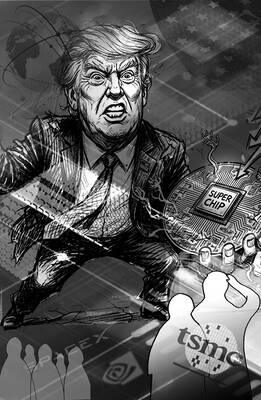
The White House’s decision to take a 9.9 percent stake in Intel Corp is looking like very shrewd business indeed. Since the government bought in at US$20.47 a share last August, the US chipmaker’s surging stock price has delivered the US a US$43 billion return. One of the reasons the investment has so far proved so sound is that the White House has made sure of it. According to The Wall Street Journal, Howard personally pushed deals on Intel’s behalf with some of the most lucrative clients imaginable. They include Nvidia Corp, the company at the heart of the AI
The Ministry of the Interior, working with the navy and coast guard, is organizing Taiwan’s first joint exercise simulating escort tankers carrying liquefied natural gas (LNG) and oil through a Chinese blockade. The drills simulate fuel transport along three maritime corridors leading toward Japan, the Philippines and the US. Deputy Minister of the Interior Sawyer Mars (馬士元) said that a blockade of the Taiwan Strait would amount to “almost a 100 percent blockade of the regional energy supply.” Minister of National Defense Wellington Koo said planning to counter a blockade is standard practice in Taipei. While the exercise is limited in
A single photograph can cut through a lot of noise, but it can also be used to misrepresent the truth. At the very least, it can concentrate the mind on something that requires further investigation. On Monday last week, Ma Ying-jeou Foundation CEO Tai Hsia-ling (戴遐齡) and former National Security Council secretary-general King Pu-tsung (金溥聰) held a news conference in which they showed a photograph of former foundation CEO Hsiao Hsu-tsen (蕭旭岑), now Chinese Nationalist Party (KMT) deputy chairman. In the image Hsiao is seated next to Xiamen Taiwan Businessmen Association chairman Han Ying-huan (韓螢煥). The two men were holding
I first met Professor Ray Jiing (井迎瑞) as a film and documentary student at Shih Hsin University’s (SHU) Department of Radio Television and Film in 1988. The following year, he went on to become the director of the Chinese Taipei Film Archive — forerunner of the Taiwan Film and Audiovisual Institute (TFAI). Over his eight-year tenure, Jiing rescued and restored over 200 classic Taiwanese films. In 1997, he established the Graduate Institute of Studies in Documentary and Film Archiving at Tainan National University of the Arts (TNNUA), and I joined the program in his third cohort of students. Beyond a


 RSS
RSS