


Chinese Nationalist Party (KMT) Chairman Eric Chu (朱立倫) on Oct. 9 made a rebuttal to President William Lai’s (賴清德) Double Ten National Day gala speech, which was given on Oct. 5, saying that “the Republic of China [ROC] is the motherland of Taiwanese” and “every Taiwanese citizen is a Taiwanese, and also a descendant of the [mythological Chinese] Yan (炎帝) and Yellow emperors (黃帝).”
That is just plain nonsense.
Through the most basic understanding of history, Chu’s hometown in Taoyuan’s Bade Township (八德) was originally the Ketagalan settlement of Siaoli (霄裡).
At the beginning of the reign of the Qing Dynasty’s Qianlong Emperor (乾隆帝), Siaoli’s headsman and official interpreter for the Qing, Zhimuliu (知母六), assimilated into Han Chinese culture. He was given a Chinese name: Hsiao Na-ying (蕭那英). His children and grandchildren grew up primarily speaking the Meixian dialect of Hakka, having learned it from settlers who migrated to the Taoyuan foothills from Mei County in China’s Guangdong Province.
Because of this, when the ROC government was exiled to Taiwan, it rewrote the family’s ancestral lineage, grafting Zhimuliu’s ancestors into the “official” lineage of the Hsiao family of Mei County, as it was allegedly recorded.
Zhimuliu’s family were from that point apparently the descendants of Xiao He (蕭何), who was recorded as having helped establish the Han Dynasty.
If Zhimuliu’s “roots” were traced back even further, perhaps his descendants could claim themselves to be the direct descendants of China’s mythological first emperors. With history so easily and brazenly rewritten, what is to stop the revision of other histories?
By the Japanese colonial era, Zhimuliu’s descendants living in Taoyuan’s Dasi Township (大溪) spoke Hoklo (commonly known as Taiwanese). Japanese officials categorized them in the household registry system as belonging to the “civilized [indigenous] Formosan” or “Hoklo” ethnic group.
When one of the descendants worked in a hospital, he saw how the ROC kept up with the lineages charade and publicly shared his family’s Japanese-era family household registry. He is living proof that Pingpu people were assigned three different ethnic ancestries, but only one of those lineages is accurate.
With so many different conflicting lines of “evidence,” it is a massive feat for Taiwanese to do genealogical research and untangle the knots in the tapestry. All Taiwanese share similar stories.
When Chu served as commissioner of what was then Taoyuan County, the county included Siaoli Township and the other historic Ketagalan area of Parricoutsie (南崁社), now Nankan (南崁), and Kulon (龜崙社) — present-day Gueishan District (龜山).
New Taipei City’s recorded indigenous communities, settlements and lands also include Pulauan (武?灣社), which evolved into today’s Sinjhuang (新莊) and Sanchong districts. Peitsie (擺接社) became Banciao District (板橋), while Parrigon (八里坌社) is now Bali District (八里). The village of Sinack (雞柔社) is now Tamsui District’s (淡水) Gueiroushan (圭柔山). Touckenan (屯山社) on the western side of Yangmingshan is now Tunshan Township (屯山). Siaojilong (小雞籠社) is now Sanjhih District (三芝). The Basay settlement of Senar — among other names — is now Tamsui. Quiware (瓦烈社) is also a part of present-day Sinjhuang, and so on.
It should not be hard for Chu to grasp this history since he was once New Taipei City mayor.
Sim Kiantek is a former associate professor of business administration at National Chung Hsing University.
Translated by Tim Smith
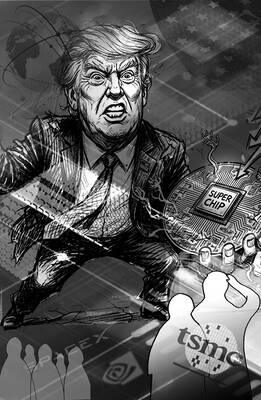
The White House’s decision to take a 9.9 percent stake in Intel Corp is looking like very shrewd business indeed. Since the government bought in at US$20.47 a share last August, the US chipmaker’s surging stock price has delivered the US a US$43 billion return. One of the reasons the investment has so far proved so sound is that the White House has made sure of it. According to The Wall Street Journal, Howard personally pushed deals on Intel’s behalf with some of the most lucrative clients imaginable. They include Nvidia Corp, the company at the heart of the AI
A single photograph can cut through a lot of noise, but it can also be used to misrepresent the truth. At the very least, it can concentrate the mind on something that requires further investigation. On Monday last week, Ma Ying-jeou Foundation CEO Tai Hsia-ling (戴遐齡) and former National Security Council secretary-general King Pu-tsung (金溥聰) held a news conference in which they showed a photograph of former foundation CEO Hsiao Hsu-tsen (蕭旭岑), now Chinese Nationalist Party (KMT) deputy chairman. In the image Hsiao is seated next to Xiamen Taiwan Businessmen Association chairman Han Ying-huan (韓螢煥). The two men were holding
I first met Professor Ray Jiing (井迎瑞) as a film and documentary student at Shih Hsin University’s (SHU) Department of Radio Television and Film in 1988. The following year, he went on to become the director of the Chinese Taipei Film Archive — forerunner of the Taiwan Film and Audiovisual Institute (TFAI). Over his eight-year tenure, Jiing rescued and restored over 200 classic Taiwanese films. In 1997, he established the Graduate Institute of Studies in Documentary and Film Archiving at Tainan National University of the Arts (TNNUA), and I joined the program in his third cohort of students. Beyond a
President William Lai Ching-te’s (賴清德) May 20 second-anniversary address was not just a routine policy review; it was damage control. US President Donald Trump’s remarks — that he did not want to see anyone move toward independence and that the delivery of a major Taiwan arms package could depend on the progress of US-China relations — unsettled Taiwan’s public and created an opening for opposition parties to question whether Taiwan was being treated as a bargaining chip in Washington’s dealings with Beijing. Lai’s speech was designed to close that opening. The address covered the expected ground: sovereignty, cross-strait relations, defense spending,


 RSS
RSS