


President Jimmy Carter, who turned 100 years old this month, has not been highly thought of in Taiwan since his 1978 decision to derecognize Taipei as the seat of the “Republic of China.” But with a half-century’s hindsight, President Carter’s derecognition of the ROC, viewed together with his straightforward diplomacy to preserve the full substance of America’s relations with Taiwan, can now be seen in a far more positive light, especially when compared to his predecessors, Richard Nixon and Gerald Ford.
In considering Carter’s decisions to recognize the People’s Republic of China as the “sole legal government of China” and break relations with the ROC in Taipei, we must remember that the United States on January 5, 1950, ceased to recognize the ROC as the government of “China” while only accepting the ROC’s “exercise of Chinese authority” over Taiwan. Thus, the basis of President Carter’s “derecognition” of Taipei was the ROC regime’s self-identification as “China” and not Taipei’s actual “exercise of authority” on Taiwan. The “Republic of China” still existed after December 31, 1978, and the US did continue relations with the ROC, though not under that name. President Carter instructed the US government to continue relations with an entity called the “governing authority on Taiwan recognized by the United States prior to January 1, 1979 as the Republic of China.” That remains the basis of US relations with Taiwan today. Additionally, Carter directed that all “international agreements and arrangements in force between the United States and Taiwan shall continue in force” after January 1, 1979.” Most surprising, President Carter gained Deng Xiaoping’s (鄧小平) acquiescence to this arrangement.
Why did Deng Xiaoping relent? The short answer is that Deng needed a new relationship with the United States in 1978 to implement his strategy for China’s recovery from two catastrophic decades of Maoism.

Historians have long seen Carter’s extraordinary talent for diplomacy in his Israel-Egypt “Camp David Accords” of September 1978. But his talent was evident as early as June 1977 as the new President Carter reviewed his China-Taiwan options with his National Security Council.
His top aide then, Zbigniew Brzezinski, sketched for him the conditions necessary for normal relations with China. The US, he said, needed “Chinese acceptance of a continued US-Taiwan security relationship which would take the place of the formal mutual defense treaty.” Carter considered Brzezinski’s paper: where Brzezinski wrote “Taiwan would enjoy access to arms,” Carter drew an arrow and wrote “important”; where he wrote the US “would declare a continued American interest in non-use of force,” Carter added “at a minimum.”
Carter’s other advisors weighed in. Treasury secretary Michael Blumenthal urged a “legal basis for continuing US economic relations with Taiwan” and called for Congressional legislation on Taiwan relations. Secretary of State Cyrus Vance warned “the issue of arms sales to Taiwan in the post-normalization era has never been raised with the Chinese … We must raise it.” Carter agreed: “I am for laying it on the line. Use the direct approach.” To temper Carter’s directness, Brzezinski wanted the US to offer China a pledge never to recognize an independent Taiwan. Vance objected, doing so “would be foregoing an option that we could exercise in the event a peaceful solution does not seem in the offing.” Carter agreed.
Finally, during heightened Soviet-China tensions in May 1978, Brzezinski went to Beijing for direct talks with Deng and then-premier Hua Guofeng (華國鋒). Both stressed to Brzezinski that China would give “no pledge of peaceful liberation of Taiwan.” Deng conceded “your side can express its hopes,” but how and when China solves the Taiwan problem is the business of the Chinese themselves. Hua separately spelled it out: on one hand, “if we undertake a commitment that China not liberate Taiwan by arms, then on the other hand, the US side is helping and arming Taiwan with its military equipment, … I think it is the creation of one China, one Taiwan or two Chinas.”
In Washington, Michel Oksenberg, Carter’s top China advisor, logically interpreted this as “the Chinese understand and accept that we intend to sustain an arms sales relationship with Taiwan after normalization.”
Fortuitously for Carter’s bargaining position, in July 1978 Congress passed legislation requiring the President to consult with the Senate before he could terminate the US-Taiwan defense treaty. At this, Carter directed his China negotiators to be in “no hurry” for normalization.
On September 19, President Carter met China’s liaison envoy in Washington and laid out America’s bottom line for relations with Beijing: “we will continue to trade with Taiwan, including the restrained sale of some very carefully selected defensive arms [that will] not endanger the prospects of peace in the region and the situation surrounding China. I recognize this is very sensitive for you.” Beijing’s envoy was impassive. Carter continued, “I would like to make one last point.” When normalization is announced, Carter said, the US will “state our expectations of a settlement of the Taiwan issue through peaceful means” and added “we do not expect you to confirm that statement, but we would expect that the Chinese Government will not contradict us.” The envoy grumbled and said he would report back to Beijing.
While Carter was “in no hurry,” Deng Xiaoping certainly was. October and November came and went, and already Deng had set December 18 as the opening day of the Chinese Communist Party’s “Third Plenum” (三中全會), China’s historic “Reform and Opening” (改革開放) Plenum. For this, diplomatic ties with America were essential. Still the US President had not backed down from either arms sales to Taiwan or demurring on Taiwan as part of “One China.”
In Beijing on December 4, the Chinese side again insisted that the US “affirm that there is only one China and that Taiwan province is a part of the People’s Republic of China, and it pledges that it will never create any variations of two Chinas.” In Washington, Carter underlined this offending sentence and wrote “we have not — stick to the Shanghai language.” Carter sent this instruction to Ambassador Woodcock in Peking and prepared for an impasse. Woodcock delivered the message and told his Chinese counterpart that before proceeding the American President had to “ascertain whether a basis exists to negotiate a joint communique.”
Woodcock’s Chinese interlocutor blasted the American stance and Woodcock saw the talks collapsing. The Chinese diplomat concluded with mock finality: “I am now giving you the [Chinese] draft communique for your study both in Chinese and English versions. I have finished.”
But he wasn’t finished. As Ambassador Woodcock stood up and prepared to leave, he called after him: “Finally, I would like to tell you that Vice Premier [Deng] would like to meet you at an early date. We will let you know the definite time.” At the White House, Carter saw this last sentence and underlined it boldly. The Chinese leader had caved!
President Carter’s personal instruction to be in “no hurry” paid dividends in the normalization endgame. It was now Deng who was under time pressure. December 18 was fast approaching. Deng needed an earth-shaking event to establish the legitimacy of his “Third Plenum” and uncharacteristically put himself under severe time constraint. Deng finally accepted the reality of America’s continuing relations with Taiwan. Carter’s refusal to accept Chinese sovereignty over Taiwan beyond the language of the Shanghai Communique could not be allowed to derail Deng’s plans.
Deng tipped his king quite suddenly. Deng needed the normalization announcement done by 0900 hours on Saturday, December 16, in order to preface the Monday morning opening of the Third Plenum. Woodcock conferred with Deng as late as five p.m. on the 15th and sought President Carter’s instructions. Woodcock’s final talks with Deng had ended only hours before the official announcement.
In the end, Deng accepted Carter’s ambiguous language that the United States “acknowledges the Chinese position that there is but one China and Taiwan is part of China,” a formulation the United States once believed “convey[ed] even less of a sense of US acceptance of the PRC view that the island is Chinese territory.”
More to Vice Premier Deng’s chagrin, the United States side was explicit in the communique language: “… the people of the United States will maintain cultural, commercial, and other unofficial relations with the people of Taiwan.” “Other relations,” the US was clear, included continued US arms sales to Taiwan.
Deng also agreed that the defense treaty could lapse a year later under its own Article X terms and he accepted that all other US treaties and agreements with Taiwan could remain in force.
So magnificent was US-China normalization that for only the second time since the founding of the People’s Republic, the People’s Daily reported it at noon Saturday, December 16, 1978, with a crimson “extra” hao wai (號外) edition (the only previous one in 1964 announced China’s atomic bomb). President Jimmy Carter’s steady diplomacy with China launched a decade of Chinese economic and political reforms and hastened the end of the Cold War. Carter could not have foreseen Tiananmen or the recrudescence of the Chinese Communist Party’s totalitarian instincts post-Tiananmen. And in the process, he conceded nothing on Taiwan which his predecessors had not already given away. His successors would have done well to emulate his “no-hurry” approach to dealing with Beijing. History has already been kind to our Nobel laureate president, not 100 years old, and rightly so.
John J. Tkacik Jr is a retired US foreign service officer who served at US embassies in both Taipei and Beijing. He now directs the Future Asia Project at the International Assessment and Strategy Center and is on the advisory board of the Global Taiwan Institute.
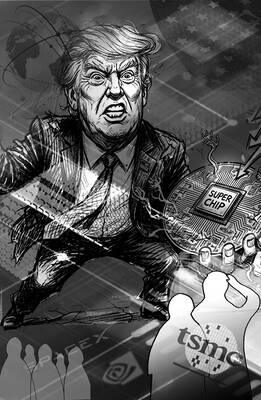
The White House’s decision to take a 9.9 percent stake in Intel Corp is looking like very shrewd business indeed. Since the government bought in at US$20.47 a share last August, the US chipmaker’s surging stock price has delivered the US a US$43 billion return. One of the reasons the investment has so far proved so sound is that the White House has made sure of it. According to The Wall Street Journal, Howard personally pushed deals on Intel’s behalf with some of the most lucrative clients imaginable. They include Nvidia Corp, the company at the heart of the AI
A single photograph can cut through a lot of noise, but it can also be used to misrepresent the truth. At the very least, it can concentrate the mind on something that requires further investigation. On Monday last week, Ma Ying-jeou Foundation CEO Tai Hsia-ling (戴遐齡) and former National Security Council secretary-general King Pu-tsung (金溥聰) held a news conference in which they showed a photograph of former foundation CEO Hsiao Hsu-tsen (蕭旭岑), now Chinese Nationalist Party (KMT) deputy chairman. In the image Hsiao is seated next to Xiamen Taiwan Businessmen Association chairman Han Ying-huan (韓螢煥). The two men were holding
I first met Professor Ray Jiing (井迎瑞) as a film and documentary student at Shih Hsin University’s (SHU) Department of Radio Television and Film in 1988. The following year, he went on to become the director of the Chinese Taipei Film Archive — forerunner of the Taiwan Film and Audiovisual Institute (TFAI). Over his eight-year tenure, Jiing rescued and restored over 200 classic Taiwanese films. In 1997, he established the Graduate Institute of Studies in Documentary and Film Archiving at Tainan National University of the Arts (TNNUA), and I joined the program in his third cohort of students. Beyond a
President William Lai Ching-te’s (賴清德) May 20 second-anniversary address was not just a routine policy review; it was damage control. US President Donald Trump’s remarks — that he did not want to see anyone move toward independence and that the delivery of a major Taiwan arms package could depend on the progress of US-China relations — unsettled Taiwan’s public and created an opening for opposition parties to question whether Taiwan was being treated as a bargaining chip in Washington’s dealings with Beijing. Lai’s speech was designed to close that opening. The address covered the expected ground: sovereignty, cross-strait relations, defense spending,


 RSS
RSS