


Taiwan’s north was barely affected by Typhoon Gaemi, while there was extensive flooding in central and southern regions. The south especially sustained considerable damage. Therefore, it made a lot of sense that the local governments within the stricken areas extended the number of typhoon days.
However, the governments of Taipei, New Taipei City, Keelung and Taoyuan canceled classes and work for two days in a row on Wednesday and Thursday last week. Many residents of the special municipalities and Keelung took this as cause for celebration, and public entertainment venues were packed. This is not exactly what typhoon days are for.
Taipei is the capital of Taiwan and an international financial hub. The cancelation of work can cause serious problems. Not only does it lead to an economic loss of approximately NT$10 billion to NT$20 billion (US$304.54 million to US$609.09 million), but NT$1.5 billion dollars of securities transaction taxes are lost because the stock market is closed.
Taipei, New Taipei City, Keelung and Taoyuan altogether cover a vast geographic area in the north, including cities, townships and mountainous areas. The different terrains are actually affected to different degrees by a typhoon, and yet they are all lumped into one administrative area. This makes the decision of whether to announce a typhoon day problematic for the mayors in those areas.
Moreover, mayors have multiple factors to take into consideration, one of which is voter support, complicating the decision. It is important that when making the decision, they do so sensibly, balancing public safety and economic considerations.
First of all, Taipei should be taken as an exception from the other counties and cities of Taiwan in terms of decisionmaking. If Taipei does not meet the standard, but others do, those who work in the capital, but live outside of Taipei have the right to take the day off or work from home. Taipei residents have to go to work.
Second, the local governments outside of Taipei should also assess and predict potential disaster areas. This way, public safety can be guaranteed and the capital can function properly. The local governments should rise to the occasion and make decisions in a rational and scientific way.
Third, the Central Weather Administration (CWA) should enhance the accuracy of weather predictions with the aid of technology such as artificial intelligence, always with a mind to improving its systems.
Based on the current system, the CWA provides the data for every local government of Taiwan, but the accountability lies with the mayors. It is therefore little wonder that deciding whether to announce a typhoon day becomes a political issue. Mayors’ decisions can easily be swayed by populism. Therefore, the CWA should assume more responsibility for decisionmaking.
The timing and method for issuing a warning can be improved with more reliance on technology. Making good use of the Public Warning System is also important. Through the system, adjustments could be systematically made in urgent situations, so that a better balance between public safety and economic development can be achieved.
If a warning is issued in a more timely manner, the prediction gap would be shortened and decisionmaking would be more efficient and effective.
Whether a typhoon day should be taken is a scientific issue. It should be addressed with the help of technology. Taiwan could learn from how other places, such as Japan and Hong Kong, handle typhoon days.
Chen Yu-hsin is a former Taichung County deputy commissioner.
Translated by Chen Chi-huang
A gap appears to be emerging between Washington’s foreign policy elites and the broader American public on how the United States should respond to China’s rise. From my vantage working at a think tank in Washington, DC, and through regular travel around the United States, I increasingly experience two distinct discussions. This divergence — between America’s elite hawkishness and public caution — may become one of the least appreciated and most consequential external factors influencing Taiwan’s security environment in the years ahead. Within the American policy community, the dominant view of China has grown unmistakably tough. Many members of Congress, as
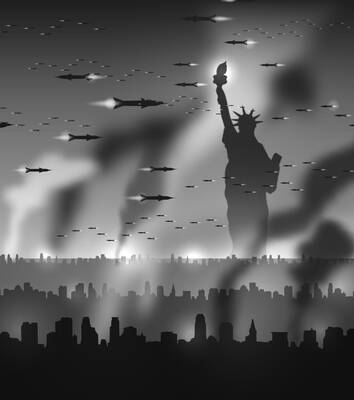
After declaring Iran’s military “gone,” US President Donald Trump appealed to the UK, France, Japan and South Korea — as well as China, Iran’s strategic partner — to send minesweepers and naval forces to reopen the Strait of Hormuz. When allies balked, the request turned into a warning: NATO would face “a very bad” future if it refused. The prevailing wisdom is that Trump faces a credibility problem: having spent years insulting allies, he finds they would not rally when he needs them. That is true, but superficial, as though a structural collapse could be caused by wounded feelings. Something
Former Taipei mayor and Taiwan People’s Party (TPP) founding chairman Ko Wen-je (柯文哲) was sentenced to 17 years in prison on Thursday, making headlines across major media. However, another case linked to the TPP — the indictment of Chinese immigrant Xu Chunying (徐春鶯) for alleged violations of the Anti-Infiltration Act (反滲透法) on Tuesday — has also stirred up heated discussions. Born in Shanghai, Xu became a resident of Taiwan through marriage in 1993. Currently the director of the Taiwan New Immigrant Development Association, she was elected to serve as legislator-at-large for the TPP in 2023, but was later charged with involvement
Out of 64 participating universities in this year’s Stars Program — through which schools directly recommend their top students to universities for admission — only 19 filled their admissions quotas. There were 922 vacancies, down more than 200 from last year; top universities had 37 unfilled places, 40 fewer than last year. The original purpose of the Stars Program was to expand admissions to a wider range of students. However, certain departments at elite universities that failed to meet their admissions quotas are not improving. Vacancies at top universities are linked to students’ program preferences on their applications, but inappropriate admission


 RSS
RSS