


A facile way to frame the future of US foreign policy is to set up two scenarios as a binary choice. If former US president Donald Trump returns to the White House, the US becomes isolationist. If US President Joe Biden wins re-election, the US remains broadly internationalist.
That framing neglects a change that might be less obvious but more consequential for other countries, a shift that would keep playing out no matter who wins in November: For the first time in its two-and-a-half centuries, the US would stop looking at the world through the lens of its own exceptionalism, and behave as just another great power using its awe-inspiring might to serve a narrow self-interest.
The old notion that the US is exceptional was there from the start. It inspired John Winthrop, as governor of the Massachusetts Bay Colony in 1630, to speak of a “city on a hill” and soon-to-be US president Ronald Reagan in 1980 to turn the same phrase into a “shining city upon a hill.”
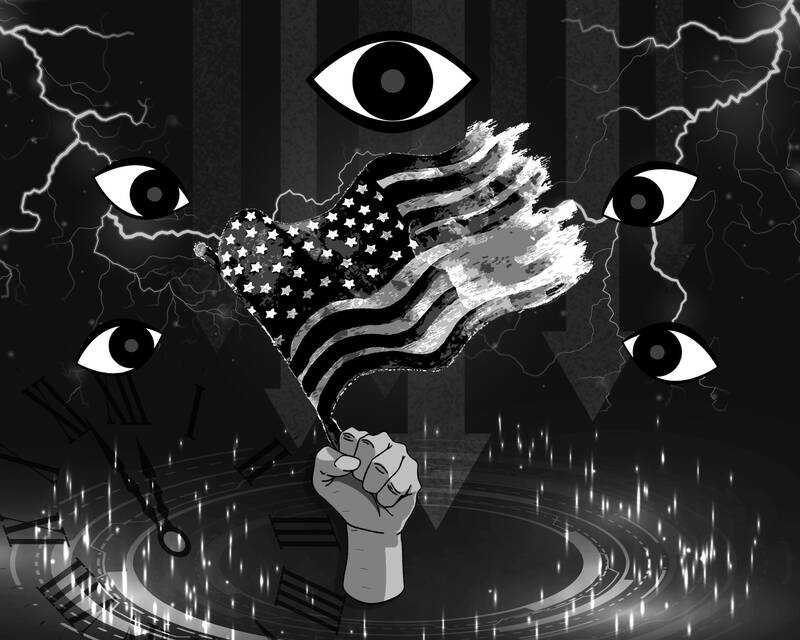
Illustration: Louise Ting
Over the years, this exceptionalism took many forms, from “manifest destiny” to racist “Anglo-Saxonism,” from a belief in the country’s unique theological calling to pride in its civic virtues. One way or another, most policymakers agreed with Herman Melville: “We Americans are the peculiar, chosen people — the Israel of our time; we bear the ark of the liberties of the world … The rest of the nations must soon be in our rear. We are the pioneers of the world, the advance guard.”
This shared sense of exceptionalism was also the common factor in the country’s two otherwise contradictory foreign-policy traditions, as former US secretary of state Henry Kissinger said in 1994, at a moment of unipolar US primacy. Isolationists saw the US as perfecting its democracy at home and shining its light as a “beacon” to the rest of humanity, but otherwise leaving the world alone. Internationalists understood exceptionalism as an obligation to spread the US’ values worldwide as “crusaders” or “missionaries.”
Each tradition has at different times served the US and the world well and also ill. Until the Spanish-American War of 1898, isolationism largely kept the US out of the old world’s balance-of-power machinations and imperialist adventurism; that was good. Between the two World Wars, an isolationist US abdicated its responsibility when it could have preserved international order; that was bad.
After World War II, an internationalist and quasi-messianic US built and policed a new world order, at least in much of the non-communist or “free” world. Good. In time, US confidence became hubris, as when then-US president George W. Bush proclaimed in 2002 that “today, humanity holds in its hands the opportunity to further freedom’s triumph,” and promised that “the United States welcomes our responsibility to lead in this great mission.” A few months later, he gave orders for a misguided and disastrous war in Iraq.
Whether shining as a beacon or conquering and preaching as a crusader, US leaders largely agreed that the US’ self-government — its democracy — was exceptional. Far from complete, especially before the civil rights movement, it seemed to be forever climbing toward its destiny on that shining hill, a work in progress that showcased a narrative of freedom to people everywhere — and that is what has changed.
The eschatology of US democracy first became dubious during the first Trump term, especially with the attack on the US Capitol on Jan. 6, 2021. If the country had subsequently rallied in defense of its republican ideals — during the congressional hearings on the assault on the Capitol, for example — the next chapter could have reaffirmed the narrative of perennial self-correction. That did not happen.
Instead, the Big Lie (that the last election was “stolen” from Trump) lives on, alongside other conspiracy theories. Preparations are underway to use a second Trump turn to weaponize the US Department of Justice against political enemies, even as Trump’s minions pretend that this has already happened under Biden. The neutrality of more than one US Supreme Court justice is in doubt. Left and right alike, for different reasons, fear that the rule of right is yielding to a rule of might and are losing faith in US elections, institutions and exceptional virtue. The film that captures the mood this year is Civil War, a haunting tale of Americans killing one another for no fathomable reason.
The outside world is paying incredibly close attention. Foreigners certainly no longer see the US as a beacon of republicanism. Nor would they, whether allies or adversaries, tolerate any more of the US’ crusading. The Pew Research Center surveyed people in 34 countries, and found that an average of 69 percent had no confidence in Trump doing the right thing in world affairs; a still unflattering plurality of 46 percent said the same about Biden.
What arguably matters even more is what Americans believe nowadays. I doubt many beyond the capital’s Beltway would still subscribe to a phrase that former US secretary of state Madeleine Albright coined and many Republicans and Democrats subsequently adopted, which sees the US as the “indispensable” nation. Exceptionalism in its old form is dead, and with it notions about the US’ role as either beacon or crusader.
What will replace it? The new approach to world affairs would resemble the one Kissinger studied as an academic and tried to practice as the US’ top diplomat. It leaves less space for idealism and more for realism, places less emphasis on values and more on interests. It is neither inherently good nor self-evidently bad, just very different in outcome for almost every other country.
For example, Ukraine, which is defending its national sovereignty and survival against Russia, and Taiwan, which might yet have to fight for its democracy and freedom against China, have been called “the new West Berlin.” But would any future US president risk war, including the nuclear kind, by pledging that “Ich bin ein Kyiver”?
A US that refuses to be a crusader could also reject any role as white knight. A country that does not see itself as a beacon would care less about acting high-minded toward others. US economic policy is already turning protectionist and nationalist. It would also become more transactional, pocketing deals that leaders can sell to their base at home rather than upholding lofty principles of global governance.
US hegemony in guarding the liberal — or “rules-based” — international order would die from lack of interest long before expiring from lack of resources. Washington’s support for international law, from the UN to The Hague, would fade.
US leaders would instead approach their foreign counterparts much as the Austrian statesman Prince Metternich (a Kissinger favorite) dealt with Europe’s monarchs in the 19th century. They would try to arrange a new balance of power and negotiate spheres of influence, even at the expense of friendly but small nations. Beijing already speaks this language in the South China Sea, and Moscow in eastern Europe. In the coming years as in Metternich’s time, that style of diplomacy would occasionally use war as an instrument, albeit (one hopes) the limited kind.
Some students of US statecraft would mourn this shift. Others, irate about the hypocrisy that often accompanied both the beacon and the crusader personas, would shrug and say good riddance. In a sense, the world, inside the US and beyond, is merely reverting to the historical norm, in which values mattered less and power more. The US’ friends and foes alike should be aware.
Andreas Kluth is a Bloomberg Opinion columnist covering US diplomacy, national security and geopolitics. Previously, he was editor-in-chief of Handelsblatt Global and a writer for The Economist. This column does not necessarily reflect the opinion of the editorial board or Bloomberg LP and its owners.
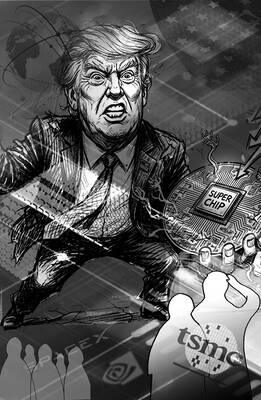
The White House’s decision to take a 9.9 percent stake in Intel Corp is looking like very shrewd business indeed. Since the government bought in at US$20.47 a share last August, the US chipmaker’s surging stock price has delivered the US a US$43 billion return. One of the reasons the investment has so far proved so sound is that the White House has made sure of it. According to The Wall Street Journal, Howard personally pushed deals on Intel’s behalf with some of the most lucrative clients imaginable. They include Nvidia Corp, the company at the heart of the AI
A single photograph can cut through a lot of noise, but it can also be used to misrepresent the truth. At the very least, it can concentrate the mind on something that requires further investigation. On Monday last week, Ma Ying-jeou Foundation CEO Tai Hsia-ling (戴遐齡) and former National Security Council secretary-general King Pu-tsung (金溥聰) held a news conference in which they showed a photograph of former foundation CEO Hsiao Hsu-tsen (蕭旭岑), now Chinese Nationalist Party (KMT) deputy chairman. In the image Hsiao is seated next to Xiamen Taiwan Businessmen Association chairman Han Ying-huan (韓螢煥). The two men were holding
I first met Professor Ray Jiing (井迎瑞) as a film and documentary student at Shih Hsin University’s (SHU) Department of Radio Television and Film in 1988. The following year, he went on to become the director of the Chinese Taipei Film Archive — forerunner of the Taiwan Film and Audiovisual Institute (TFAI). Over his eight-year tenure, Jiing rescued and restored over 200 classic Taiwanese films. In 1997, he established the Graduate Institute of Studies in Documentary and Film Archiving at Tainan National University of the Arts (TNNUA), and I joined the program in his third cohort of students. Beyond a
President William Lai Ching-te’s (賴清德) May 20 second-anniversary address was not just a routine policy review; it was damage control. US President Donald Trump’s remarks — that he did not want to see anyone move toward independence and that the delivery of a major Taiwan arms package could depend on the progress of US-China relations — unsettled Taiwan’s public and created an opening for opposition parties to question whether Taiwan was being treated as a bargaining chip in Washington’s dealings with Beijing. Lai’s speech was designed to close that opening. The address covered the expected ground: sovereignty, cross-strait relations, defense spending,


 RSS
RSS