


India’s weeks-long election is drawing to a close. Between now and next Saturday, the remaining 164 of 543 constituencies in the lower house of India’s parliament is to vote. Much attention to date has focused on how India’s religious and caste divides have become political fodder. In fact, tensions between Indian states might be even more dangerous.
Those divisions would be on full display in these last few days of campaigning. Only three states vote in every single one of the seven phases of India’s election, which began on April 19: Giants Uttar Pradesh and Bihar, which with a combined population of 350 million would together be the third-largest country in the world, and smaller West Bengal, which since the 1970s has always been ruled by a different party from that in power in New Delhi.
If the two behemoths have staggered elections, because they are so large, West Bengal’s voting is spread over seven days to limit the risk of riots. Political violence has become a major electoral issue in the state in recent years, exploited by all sides of the political spectrum.
As Indian Prime Minister Narendra Modi’s Bharatiya Janata Party (BJP) has emerged as a challenger to the dominant regional party, the All India Trinamool Congress, it has accused the incumbents of overseeing a decline in law and order.
Violence is the “biggest challenge” the state faces, Modi has said.
Meanwhile, the Trinamool Congress has stoked local fears, blaming a 2019 riot on Kolkata’s streets on “outsiders” that the BJP had bused in from neighboring states. Much was made of the toppling of a statue of revered Bengali social reformer Ishwar Chandra Vidyasagar.
The message to Bengalis: The BJP is a north Indian party with no respect for our culture, and they would bring violent ways of life from other Indian states to our door.
India’s southern states are also wary of an overbearing north. Regional parties lead opposition to the BJP in the south, as in eastern states such as West Bengal, and they, too, are increasingly designing their politics around “outsiders” and threats to federalism.
“States would cease to exist” if the BJP won another election, Tamil Nadu Chief Minister M.K. Stalin said during his campaign.
For his part, Modi last week said the southern politicians were insulting the north and Hinduism.
Real world trends would only exacerbate these divisions, my Bloomberg Opinion colleague Andy Mukherjee has said. The southern state of Kerala has a human development index approaching that of China, Brazil or Mexico, while many north Indian states score closer to the poorer parts of sub-Saharan Africa.
The economies of states such as Tamil Nadu are growing much faster than the national average; they give far more to federal coffers than they receive. Much of the difference flows to poorer northern states such as Uttar Pradesh.
The north could gain even more political power as its population expands.
West Bengal’s population would hover at about 100 million over the next few decades, official projections show. By contrast, Uttar Pradesh and Bihar would add that many people over the same period. Bihar’s population would grow by 25 percent in two decades, Tamil Nadu’s by 2 percent. The next government would preside over a redistricting exercise in 2026 that could expand the north’s representation in the Parliament of India, fueling concerns that the south and east would be permanently locked out of power in New Delhi.
For decades, multiethnic India has enjoyed healthy political competition at the state and federal levels, as well as messy political alliances between north, west, south and east. In the past, population weights and economic power were more evenly balanced, and powerbrokers from the south and the east were pivotal members of India’s ruling coalitions. Big moves such as tax and fiscal reforms were only approved after buy-in from all parts of the country.
Managing these growing regional tensions — whether through expanded internal migration, more inclusive growth or greater autonomy for states — is going to be the most important task facing Indian leaders over the next decade. On the evidence of this campaign, they are not likely to handle it with grace or wisdom.
The BJP aims to crush regional opposition. The party has developed a reputation for bringing the full power of the federal government to bear on local leaders. The chief minister of one of the states going to the polls this week is in jail on federal charges; another was just released by the courts.
Meanwhile, the various sub-nationalist narratives regional parties have been promoting could take on a life of their own. Already, activists in some states have started demanding jobs be reserved for locals and have attacked shops that failed to put up signs in regional languages.
For decades, as in the US, the scope and strength of states’ rights has helped knit together a huge and diverse nation. If federalism itself becomes the subject of divisive partisan politics, then this long compromise would end — and India would be in real trouble.
Mihir Sharma is a Bloomberg Opinion columnist. A senior fellow at the Observer Research Foundation in New Delhi, he is author of Restart: The Last Chance for the Indian Economy.

A gap appears to be emerging between Washington’s foreign policy elites and the broader American public on how the United States should respond to China’s rise. From my vantage working at a think tank in Washington, DC, and through regular travel around the United States, I increasingly experience two distinct discussions. This divergence — between America’s elite hawkishness and public caution — may become one of the least appreciated and most consequential external factors influencing Taiwan’s security environment in the years ahead. Within the American policy community, the dominant view of China has grown unmistakably tough. Many members of Congress, as
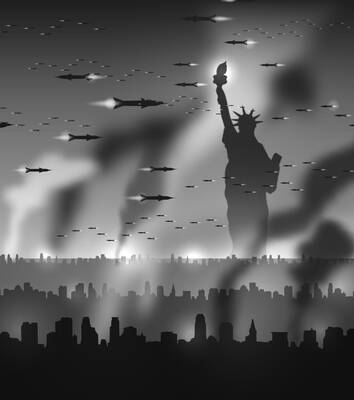
After declaring Iran’s military “gone,” US President Donald Trump appealed to the UK, France, Japan and South Korea — as well as China, Iran’s strategic partner — to send minesweepers and naval forces to reopen the Strait of Hormuz. When allies balked, the request turned into a warning: NATO would face “a very bad” future if it refused. The prevailing wisdom is that Trump faces a credibility problem: having spent years insulting allies, he finds they would not rally when he needs them. That is true, but superficial, as though a structural collapse could be caused by wounded feelings. Something
Former Taipei mayor and Taiwan People’s Party (TPP) founding chairman Ko Wen-je (柯文哲) was sentenced to 17 years in prison on Thursday, making headlines across major media. However, another case linked to the TPP — the indictment of Chinese immigrant Xu Chunying (徐春鶯) for alleged violations of the Anti-Infiltration Act (反滲透法) on Tuesday — has also stirred up heated discussions. Born in Shanghai, Xu became a resident of Taiwan through marriage in 1993. Currently the director of the Taiwan New Immigrant Development Association, she was elected to serve as legislator-at-large for the TPP in 2023, but was later charged with involvement
Out of 64 participating universities in this year’s Stars Program — through which schools directly recommend their top students to universities for admission — only 19 filled their admissions quotas. There were 922 vacancies, down more than 200 from last year; top universities had 37 unfilled places, 40 fewer than last year. The original purpose of the Stars Program was to expand admissions to a wider range of students. However, certain departments at elite universities that failed to meet their admissions quotas are not improving. Vacancies at top universities are linked to students’ program preferences on their applications, but inappropriate admission


 RSS
RSS