


The Cabinet on Thursday approved several bills on fraud, including a proposed fraud prevention act and amendments, that would raise the penalty for convicted scammers, hold online platforms more accountable for fraudulent content and increase police surveillance powers.
The fraud prevention bill proposes a sentence of three to 10 years in prison and a fine of up to NT$30 million (US$925,555) for those found guilty of severe fraud and tougher sentences for main offenders if the crime involved three or more coconspirators, as well as repeat offenders.
Proposed amendments to existing laws include requiring foreign-based online platforms, such as Facebook, Google and TikTok, to register with the government and have a legal representative in Taiwan, disclose their advertising clients and remove scam content or face heavy fines.
On the same day the bills were sent to the legislature for review and passed, a woman surnamed Li (李) wrote on Facebook that “Taiwan is a scammer’s heaven,” sparking wide discussions.
Her 76-year-old father, who was living alone in Taiwan, had joined a stock group chat on the messaging app Line and was tricked into transferring the ownership of a house worth NT$30 million to a scammer, Li said, adding that the police were cold and told her father to be mentally prepared that he might not get his money back.
She was “confused and disappointed at Taiwan’s law-based society,” Li said. “Facing the rampant fraud syndicates using technology and the Internet to scam elderly people, does the government not care at all?”
Li’s post was widely shared, sparking a range of comments, including speculation that it was fake and part of “cognitive warfare” to undermine trust in the government, condemnation that Li was blaming society for her father’s greed and ignorance and did not care enough for her father, and criticism of the government’s anti-fraud efforts and light penalties for offenders. Only a few comments were sympathetic toward her family and urged care for the elderly.
Regardless of the authenticity of her claims, Li was too quick to decry Taiwan as a “scammer’s heaven,” as data from many countries show that scams are rising globally and rapidly as technology changes.
Taiwanese lost more than NT$8.8 billion to fraud in 37,823 cases reported last year, a significant increase from the NT$4.25 billion lost in 23,054 cases in 2020, National Police Agency data showed.
The US Federal Trade Commission received 2.6 million fraud reports, with losses of more than US$10 billion last year, the agency said.
Meanwhile, people in the UK lost more than £1.2 billion (US$1.5 billion) to fraud in 2022 and it has become the most common crime in the country, UK Finance said.
In many countries, including Taiwan, victims are unwilling to report fraud, because they are ashamed, are angry with themselves, feel stupid or worry that they would be blamed, studies have shown.
Scams that target older people are also on the rise, as their social isolation, lack of tech literacy, diminishing cognitive capacity and higher monetary resources can make them vulnerable prey, it added.
While laws are being amended and new technology is being used to curb fraud and pursue fraudsters, private businesses and individuals should also come together and build an anti-fraud ecosystem to fight against progressively sophisticated fraud organizations. Companies should be committed to enhancing security, sharing scam information and protecting customers’ personal data, while people should show empathy and stop victim blaming — so that open and positive discussions of people’s experiences can help expose the scope and methods of fraudsters — raise public awareness and support other individuals in getting help.
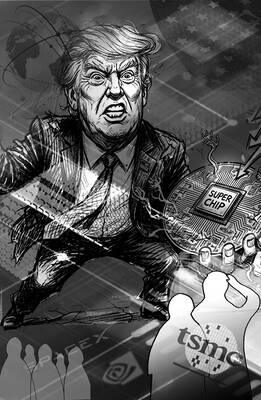
The White House’s decision to take a 9.9 percent stake in Intel Corp is looking like very shrewd business indeed. Since the government bought in at US$20.47 a share last August, the US chipmaker’s surging stock price has delivered the US a US$43 billion return. One of the reasons the investment has so far proved so sound is that the White House has made sure of it. According to The Wall Street Journal, Howard personally pushed deals on Intel’s behalf with some of the most lucrative clients imaginable. They include Nvidia Corp, the company at the heart of the AI
A single photograph can cut through a lot of noise, but it can also be used to misrepresent the truth. At the very least, it can concentrate the mind on something that requires further investigation. On Monday last week, Ma Ying-jeou Foundation CEO Tai Hsia-ling (戴遐齡) and former National Security Council secretary-general King Pu-tsung (金溥聰) held a news conference in which they showed a photograph of former foundation CEO Hsiao Hsu-tsen (蕭旭岑), now Chinese Nationalist Party (KMT) deputy chairman. In the image Hsiao is seated next to Xiamen Taiwan Businessmen Association chairman Han Ying-huan (韓螢煥). The two men were holding
I first met Professor Ray Jiing (井迎瑞) as a film and documentary student at Shih Hsin University’s (SHU) Department of Radio Television and Film in 1988. The following year, he went on to become the director of the Chinese Taipei Film Archive — forerunner of the Taiwan Film and Audiovisual Institute (TFAI). Over his eight-year tenure, Jiing rescued and restored over 200 classic Taiwanese films. In 1997, he established the Graduate Institute of Studies in Documentary and Film Archiving at Tainan National University of the Arts (TNNUA), and I joined the program in his third cohort of students. Beyond a

President William Lai Ching-te’s (賴清德) May 20 second-anniversary address was not just a routine policy review; it was damage control. US President Donald Trump’s remarks — that he did not want to see anyone move toward independence and that the delivery of a major Taiwan arms package could depend on the progress of US-China relations — unsettled Taiwan’s public and created an opening for opposition parties to question whether Taiwan was being treated as a bargaining chip in Washington’s dealings with Beijing. Lai’s speech was designed to close that opening. The address covered the expected ground: sovereignty, cross-strait relations, defense spending,


 RSS
RSS