


The prime minister of one of the larger Caribbean countries travels to east Africa to secure a police deployment that would help address runaway gang violence back home, where a recent attack on the national penitentiary freed 4,000 prisoners. Failing in his endeavors, he flies back across the Atlantic Ocean, but is unable to land because the gangs have seized the airport.
After a neighboring country denies him landing rights, he ends up in a third country, while the notoriously bloodthirsty chief of one of the leading gangs demands his resignation. Foreign powers voice their concerns, but the hapless prime minister is left twisting in the wind.
Fears of widespread famine grow as the breakdown of the state and deepening civil disorder hamper even the most basic activities.
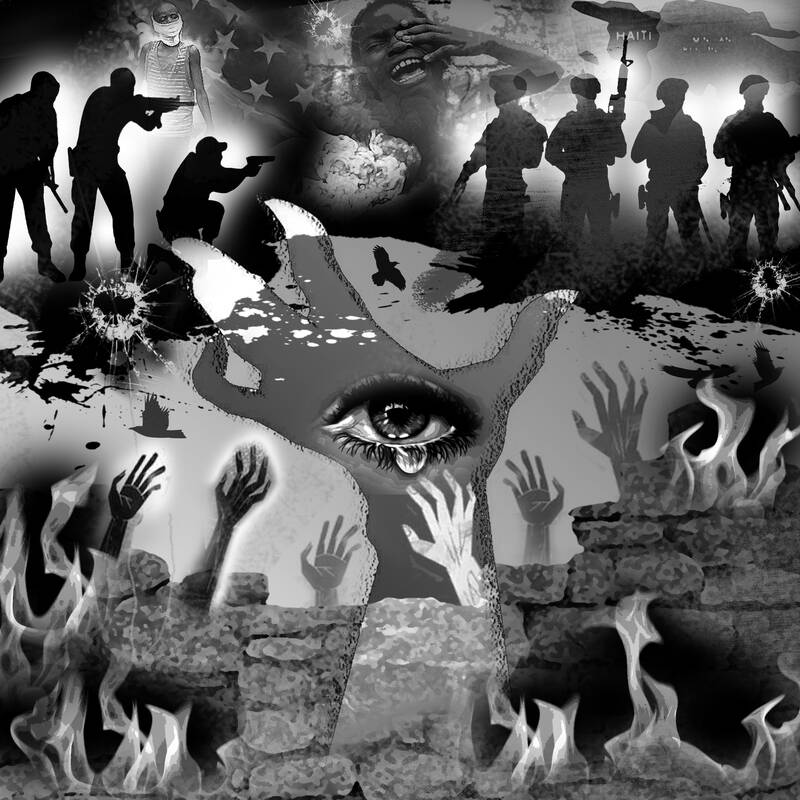
Illustration: Kevin Sheu
Eventually, the stranded prime minister agrees to resign once a transition council has been established. However, gang leaders are now demanding a continued role in any new government.
Though this might sound like the unlikely plot of a cheap telenovela, it is exactly what is happening in Haiti — the world’s first black republic, the first independent country in Latin America and the site of the New World’s first successful slave rebellion (1791-1804).
Since the assassination of former Haitian president Jovenel Moise in July 2021, the poorest country in the western hemisphere (and among the poorest in the world) has been mired in chaos, with the government unable to impose any kind of order. Elections have not been held for many years and the unelected prime minister, Ariel Henry, lacks legitimacy.
However, he had been able to count on the US government’s full backing — until now.
Haitian authorities did make a serious effort to establish a professional police force some years ago, but the Haitian National Police, decimated in battles with the gangs and demoralized by a lack of government support, has become a shadow of its former self. The armed forces — better known for their propensity for overthrowing governments than for their military prowess — have long since been dissolved.
The Haitian government has been desperately seeking assistance from the international community for more than a year now, to no avail.
The UN estimates that 4,000 people were killed in gang-related violence last year alone, while another 3,000 were kidnapped. And yet no country in the western hemisphere has been willing to become directly involved.
The US, for its part, offered US$200 million to cover the costs of a 1,000-strong Kenyan police force deployment, a proposal greenlighted by the UN Security Council. The idea that it should fall to an east African country to intervene in the Caribbean stretches credulity, but such is the absurdity of Haiti’s plight.
In any case, the deployment has been derailed by domestic opposition, with the Kenyan High Court ruling against the plan.
While Haiti burns, reporters and pundits have been holding forth on all the reasons that the international community should not intervene. Such arguments draw on memories of the US occupation of Haiti between 1915 and 1934, and on the more recent crisis of the 1990s, when the US stepped in to remove a military junta led by General Raoul Cedras.
As US President Joe Biden, then a senator, said at the time: “If Haiti — a God-awful thing to say — just quietly sunk into the Caribbean, or rose up 300 feet, it wouldn’t matter a whole lot in terms of our interests.”
Other commentators emphasize the perceived failures of MINUSTAH, the UN mission that was sent to stabilize Haiti from 2004 to 2017.
However, much of this bad press is unjustified. From 2004 to 2010 — when a devastating earthquake hit Haiti — MINUSTAH had stabilized the country and helped it to regain a sense of purpose following the somewhat traumatic transition to democracy after the fall of the Duvalier dynasty in 1986.
The US and Canada are not the only ones refusing to do what is needed in Haiti. The same goes for the Latin American countries that previously played a central role in MINUSTAH: Brazil, Chile, Argentina and Uruguay. In fact, MINUSTAH was the first-ever UN operation in which Latin American troops comprised a majority.
At a time when the region is becoming less relevant on the international stage, it has much to gain by stepping in to address the most urgent crisis in its own neighborhood. Who better to rescue millions of innocent Haitians from another downward spiral into violence, dysfunction and famine?
If the moral case for helping the hemisphere’s poorest, most crisis-ridden country does not carry much weight in today’s international political climate, perhaps sheer self-interest will do the trick.
Letting Haitians “stew in their own juice” (my paraphrase of the current situation) is not only cynical and morally indefensible; it is simply foolish. Failed states have a way of becoming centers of international organized crime, terrorism and drug trafficking.
Do we really want a Somalia in the Caribbean?
Jorge Heine, a research professor at the Frederick S. Pardee School of Global Studies at Boston University, is the editor of Fixing Haiti: MINUSTAH and Beyond.
Copyright: Project Syndicate

The Chinese Communist Party (CCP) continues to bully Taiwan by conducting military drills extremely close to Taiwan in late May 2024 and announcing a legal opinion in June on how they would treat “Taiwan Independence diehards” according to the PRC’s Criminal Code. This article will describe how China’s Anaconda Strategy of psychological and legal asphyxiation is employed. The CCP’s People’s Liberation Army (PLA) and Chinese Coast Guard (CCG) conducted a “punishment military exercise” against Taiwan called “Joint Sword 2024A” from 23-24 May 2024, just three days after President William Lai (賴清德) of the Democratic Progressive Party (DPP) was sworn in and
Former US president Donald Trump’s comments that Taiwan hollowed out the US semiconductor industry are incorrect. That misunderstanding could impact the future of one of the world’s most important relationships and end up aiding China at a time it is working hard to push its own tech sector to catch up. “Taiwan took our chip business from us,” the returnee US presidential contender told Bloomberg Businessweek in an interview published this week. The remarks came after the Republican nominee was asked whether he would defend Taiwan against China. It is not the first time he has said this about the nation’s
In a recent interview with the Malaysian Chinese-language newspaper Sin Chew Daily, former president Ma Ying-jeou (馬英九) called President William Lai (賴清德) “naive.” As always with Ma, one must first deconstruct what he is saying to fully understand the parallel universe he insists on defending. Who is being “naive,” Lai or Ma? The quickest way is to confront Ma with a series of pointed questions that force him to take clear stands on the complex issues involved and prevent him from his usual ramblings. Regarding China and Taiwan, the media should first begin with questions like these: “Did the Chinese Nationalist Party (KMT)
The Yomiuri Shimbun, the newspaper with the largest daily circulation in Japan, on Thursday last week published an article saying that an unidentified high-ranking Japanese official openly spoke of an analysis that the Chinese People’s Liberation Army (PLA) needs less than a week, not a month, to invade Taiwan with its amphibious forces. Reportedly, Japanese Prime Minister Fumio Kishida has already been advised of the analysis, which was based on the PLA’s military exercises last summer. A Yomiuri analysis of unclassified satellite photographs confirmed that the PLA has already begun necessary base repairs and maintenance, and is conducting amphibious operation exercises


 RSS
RSS