


A stabbing incident involving a junior-high school student in New Taipei City shocked the community, prompting much debate, primarily focused on legislative changes.
While preventive measures are undoubtedly essential, education is about personal engagement, so does defining the authority of schools and parents through laws affect the respect and trust between teachers and parents?
The Chinese idiom “if a child is not raised properly, it is the fault of the father; if they are not disciplined, it is the dereliction of the teacher” seems out of touch with today’s emphasis on respecting students’ rights.
However, safeguarding students’ rights should not be a boundless endeavor. It should not compromise the dignity of teachers, undermine their enthusiasm for teaching or neglect the values, sense of responsibility and law-abiding principles that should be instilled during schooling.
In the US, a police officer responded to a domestic violence case reported by a 10-year-old boy. The boy’s mother told the officer that a teacher told her he always skips class and when she confronted him, he lied, so, she spanked him with a belt.
The officer asked the boy if he reported his mother because she disciplined him for skipping school?
“She abuses children, and I have my rights,” the boy responded vehemently.
“Who told you that?” the police officer asked.
“My friend,” the boy responded.
The officer stared at the boy and then scolded him.
“You’re not allowed to report your mother again,” he said. “If you skip class again, I’ll use this thick belt to give you a spanking personally. Understood? Now go inside immediately.”
The boy scuttered back into the house.
This child abuse case was handled by the police with reasonableness and lawfulness, while maintaining “law enforcement dignity,” resolving it with just a few words.
The response addressed the issue of false complaints by the child. It defused the parent-child confrontation, offering the child an educational opportunity to correct his “misguided understanding of rights” and teaching him accountability for his actions.
Consider three questions.
First, is using a belt to discipline a child accepted disciplinary action or abuse?
Second, should a child’s assertion of “having rights” be protected, or should the situation be carefully considered and deeper understanding be provided to prevent misunderstandings?
Third, was the police officer’s stern response to the boy regarding skipping class and reporting his mother a correction of wrongdoing or unwarranted intimidation?
For adolescents just beginning to develop a sense of “rights consciousness,” safeguarding their interests might overshadow the earnest expectations and self-reflective abilities of parents and teachers.
The law must balance emotional reasoning, consider reality and not let “law” be a talisman for rebellious children.
Discipline remains necessary for students whose mental and behavioral maturity has not fully developed.
However, cumbersome regulations often target adults, making educators and parents cautious in disciplinary actions and hindering the holistic development of children.
Merely relying on the law is insufficient. Rebuilding ethical standards in schools and reviving the spirit of “respecting teachers and valuing principles” might be the fundamental solution.
Shiao Fu-song is a lecturer at National Taitung University.
Translated by Shelby Tang
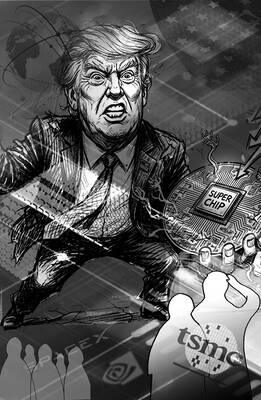
The White House’s decision to take a 9.9 percent stake in Intel Corp is looking like very shrewd business indeed. Since the government bought in at US$20.47 a share last August, the US chipmaker’s surging stock price has delivered the US a US$43 billion return. One of the reasons the investment has so far proved so sound is that the White House has made sure of it. According to The Wall Street Journal, Howard personally pushed deals on Intel’s behalf with some of the most lucrative clients imaginable. They include Nvidia Corp, the company at the heart of the AI
In a Taiwanese university classroom, a lecturer asks in English: “Can anyone give me an example from Taiwan?” Students look down. No one answers. After class, one student writes on the course platform in Mandarin: “I understood the concept, but I didn’t know how to answer in English.” That moment highlights a key issue in Taiwan’s English-medium instruction (EMI) reform: It is not just about more English-taught courses, but whether students can learn, participate and belong. EMI expansion is part of the Bilingual 2030 policy and the Ministry of Education’s BEST Program, aiming to improve English ability, support EMI teaching
A single photograph can cut through a lot of noise, but it can also be used to misrepresent the truth. At the very least, it can concentrate the mind on something that requires further investigation. On Monday last week, Ma Ying-jeou Foundation CEO Tai Hsia-ling (戴遐齡) and former National Security Council secretary-general King Pu-tsung (金溥聰) held a news conference in which they showed a photograph of former foundation CEO Hsiao Hsu-tsen (蕭旭岑), now Chinese Nationalist Party (KMT) deputy chairman. In the image Hsiao is seated next to Xiamen Taiwan Businessmen Association chairman Han Ying-huan (韓螢煥). The two men were holding
The Ministry of the Interior, working with the navy and coast guard, is organizing Taiwan’s first joint exercise simulating escort tankers carrying liquefied natural gas (LNG) and oil through a Chinese blockade. The drills simulate fuel transport along three maritime corridors leading toward Japan, the Philippines and the US. Deputy Minister of the Interior Sawyer Mars (馬士元) said that a blockade of the Taiwan Strait would amount to “almost a 100 percent blockade of the regional energy supply.” Minister of National Defense Wellington Koo said planning to counter a blockade is standard practice in Taipei. While the exercise is limited in


 RSS
RSS