


A record number of people are heading to the polls around the world this year, including in Asia. This is particularly significant for the region because, with the exception of Japan, South Korea and Taiwan, the Asia-Pacific is seeing a significant increase in populism and authoritarianism, harking back to an era when national leaders ruled with an iron fist. Hundreds of millions of votes would not necessarily mean more democracy.
There are a few reasons for this:
We have already seen the rise of less democratic leaders in the Netherlands and Italy, and there is a corresponding trend in Asia. China’s model of governance, which prioritizes economic development over civil liberties, looks increasingly appealing. Many voters have become disenchanted with Western democracies in a post-Brexit, post-Trump world and are actively looking for something else. Combine that with social media amplifying the message of candidates who could now bypass a press struggling to keep them accountable, and it helps explain the allure of authoritarian leadership. Artificial intelligence tools would only make things worse, as the proliferation of fake news, misinformation and disinformation inundate the timelines of a largely young and often unquestioning voter demographic.
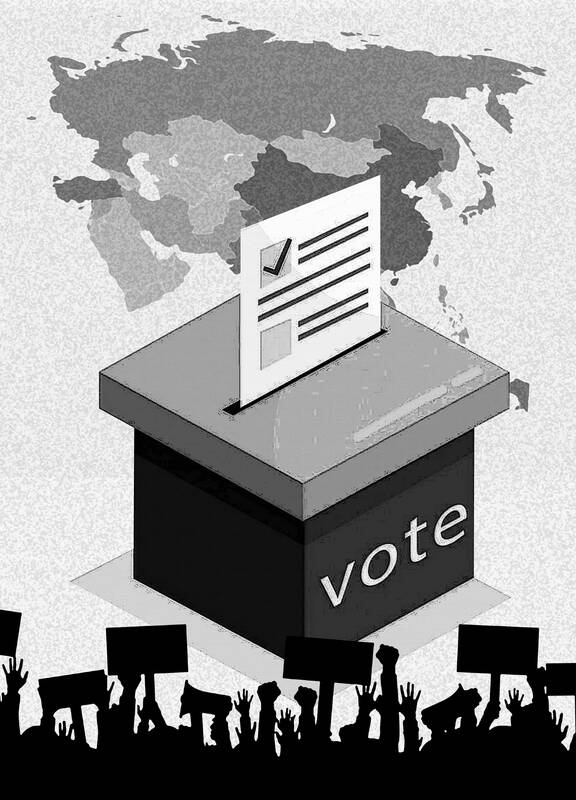
Illustration: Constance Chou
Asia’s liberal credentials are under significant pressure, International IDEA’s Global State of Democracy Initiative figures show. Only a tiny minority live in a high-performing democracy, with institutions appearing stuck.
From Bangladesh today to Pakistan and Sri Lanka toward the end of this year, voters are to have their say. Three of the most consequential elections are to be held in Taiwan, Indonesia and India. Their outcomes might determine the region’s future and democratic trajectory in years to come.
TAIWAN
Taiwan is a bright spot among less democratic neighbors. Taiwanese are to elect their next president and legislature on Saturday. For the most part, they are expected to be vibrant, free and fair, with an engaged electorate. Voters want a new administration that would manage issues such as the economy and jobs, but also navigate the difficult and tricky relationship with China. Taiwan regularly scores well on the annual Freedom House report on the state of liberties in countries around the world. Threats to its democracy are mainly external. Beijing poses the biggest existential risk and concerns have been building in the past few years over the Chinese government’s efforts to influence Taiwan’s policymaking, media and its democratic infrastructure.
It was not always like this. For several decades, Taiwan was ruled by a dictatorship, harshly regulated by 38 years of martial law that was finally lifted in 1987.
Southeast Asia in the 1990s and early 2000s seemed to be the beacon for a golden age of democratization, serving as a model for other developing countries. At that time, Indonesia, which is to hold presidential elections on Feb. 14, was just beginning its experiment with democracy and decentralization after the toppling of dictator and former president Suharto. The rest of the region was also in relatively good shape.
Today, however, as Council for Foreign Relations senior fellow for Southeast Asia Joshua Kurlantzick wrote, it is a long way from that promising period. Timor-Leste is the only fully free democracy in the region despite its poverty and isolation, Freedom House’s rankings show.
INDONESIA
Indonesians are almost certain to elect the former general and alleged human rights violator Prabowo Subianto as their next president, along with the eldest son of Indonesian President Joko Widodo as vice president. Many have questioned why in a country of 270 million people, the man most likely to lead is a throwback to the old authoritarian era — the Orde Baru as it was called — the 32-year rule under Suharto that was marked as one of the most corrupt and dictatorial regimes in Southeast Asia’s history.
Those who fought against the old order are asking themselves what Prabowo’s ascendancy means for Indonesia’s democracy and whether it implies a fresh role for the military in politics. That Prabowo’s past has failed to make a dent in his popularity is a testament to his social media game, which has seen him use the image of a cute and cuddly grandfather figure to appeal to younger voters. In another ominous sign, the choice of Gibran Rakabuming Raka as his running mate has raised concerns that nepotism and cronyism — hallmarks of the Suharto era — are making a comeback.
INDIA
Over several weeks in April and May, India is to hold elections for over 600 million registered voters to determine whether Prime Minister Narendra Modi’s ruling Bharatiya Janata Party (BJP) would govern the world’s most populous nation for five more years. All signs point toward another Modi victory. The BJP is playing up his personal popularity, what is often referred to as the “Modi factor.”
The BJP is celebrating the results of the Dec. 3 state polls that gave it huge wins in the Hindi belt states of Chattisgarh, Madhya Pradesh and Rajasthan. The opposition Indian National Congress party won in the southern state of Telangana. There is no denying Modi’s pull — he regularly ranks as the most popular leader in the world. It is true that India has become more globally significant under his governance, and has enjoyed impressive economic growth.
However, minorities feel less welcome and safe than ever before, with one report saying that the ruling party and affiliated groups were behind most hate speech incidents against India’s Muslim population during the first half of last year. Laws are passed quickly through a parliament, which meets less and less, and a once vibrant and free press has largely been muzzled or accommodates the BJP and Modi’s hardline Hindu message.
It would be understandable then to feel dispirited and demoralized by the state of Asia’s democracies this year. Indeed, simply writing this column has made me wonder whether the experiment with this system of government has failed in the region. Still, it would be churlish to begin the new year with limited optimism, and it is in the very mechanisms of democracy that I keep faith. Ultimately, voters must and should decide on whether their elected officials are delivering on promises. It would be wise for those in office and those who put them there to remember that the real power rests with the people. Another election is hopefully just one term away.
Karishma Vaswani is a Bloomberg Opinion columnist covering Asian politics with a special focus on China. Previously, she was the BBC’s lead Asia presenter and worked for the BBC across Asia for two decades. This column does not necessarily reflect the opinion of the editorial board or Bloomberg LP and its owners.
A gap appears to be emerging between Washington’s foreign policy elites and the broader American public on how the United States should respond to China’s rise. From my vantage working at a think tank in Washington, DC, and through regular travel around the United States, I increasingly experience two distinct discussions. This divergence — between America’s elite hawkishness and public caution — may become one of the least appreciated and most consequential external factors influencing Taiwan’s security environment in the years ahead. Within the American policy community, the dominant view of China has grown unmistakably tough. Many members of Congress, as
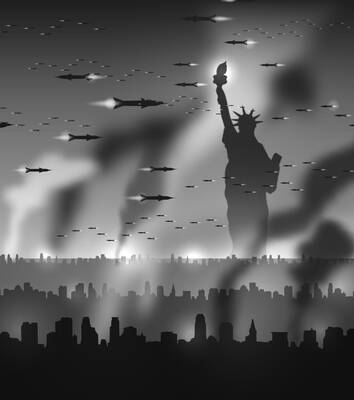
After declaring Iran’s military “gone,” US President Donald Trump appealed to the UK, France, Japan and South Korea — as well as China, Iran’s strategic partner — to send minesweepers and naval forces to reopen the Strait of Hormuz. When allies balked, the request turned into a warning: NATO would face “a very bad” future if it refused. The prevailing wisdom is that Trump faces a credibility problem: having spent years insulting allies, he finds they would not rally when he needs them. That is true, but superficial, as though a structural collapse could be caused by wounded feelings. Something
Former Taipei mayor and Taiwan People’s Party (TPP) founding chairman Ko Wen-je (柯文哲) was sentenced to 17 years in prison on Thursday, making headlines across major media. However, another case linked to the TPP — the indictment of Chinese immigrant Xu Chunying (徐春鶯) for alleged violations of the Anti-Infiltration Act (反滲透法) on Tuesday — has also stirred up heated discussions. Born in Shanghai, Xu became a resident of Taiwan through marriage in 1993. Currently the director of the Taiwan New Immigrant Development Association, she was elected to serve as legislator-at-large for the TPP in 2023, but was later charged with involvement
Out of 64 participating universities in this year’s Stars Program — through which schools directly recommend their top students to universities for admission — only 19 filled their admissions quotas. There were 922 vacancies, down more than 200 from last year; top universities had 37 unfilled places, 40 fewer than last year. The original purpose of the Stars Program was to expand admissions to a wider range of students. However, certain departments at elite universities that failed to meet their admissions quotas are not improving. Vacancies at top universities are linked to students’ program preferences on their applications, but inappropriate admission


 RSS
RSS