


Black-hearted blue and white
In 1885, just 10 years before Taiwan was ceded to Japan, French writer Emile Zola published his novel, Germinal. Depicting a coal miners’ strike in northern France in the 1860s, the novel was serialized from Nov. 26, 1884, in the periodical Gil Blas.
In 1906, when Taiwan was a Japanese colony, coal miner Lai Wan-fa (賴萬發) asked the coal mine owner to let him build a hut. Along with his fellow miners, Lai started the construction of a hut in Chungfu in Wanli District (萬里). These workers gathered materials from trees, bamboo and thatch, and completed the hut by themselves. Lai was the grandfather of Democratic Progressive Party presidential candidate Vice President William Lai (賴清德).
After years, the hut was dilapidated and torn up due to typhoons. William Lai’s father, Lai Chao-chin (賴朝金), renovated and reconstructed the hut with more solid materials. The hut became a brick house. On Feb. 15, 1958, this house was registered as “No. 7, Fifth Neighborhood, Chungfu,” with Lai’s occupation recorded as “coal miner.” The entire neighborhood consisted of coal miners’ houses. Those buildings were legitimate and later registered as houses on “No. 85, Chungfu Road.”
On Jan. 8, 1960, Lai Chao-chin was working in Wanli’s Chungfu coal mine when an accident happened. He died from carbon monoxide poisoning. He was only 33 years old. When Lai Chao-chin passed away, William Lai was only 95 days old. Lai had lived on Chungfu Road since he was born. After passing his college entrance exam, he moved away and lived in a National Taiwan University dormitory.
In 1975, Taiwanese agencies started using zoning in urban planning and land management. The area where Lai’s old house sits was listed as a “mining area.” Meanwhile, the Mining Act (礦業法) was not revised. As a result, more than 2,000 houses in that “mining area” and their owners have been left in a legal gray area. No existing law or mechanism could be applied to manage those buildings. On the other hand, in military dependents’ villages, the same situation happened in the 1960s and 1970s, when the residents there were accused of having occupied public land for years. The government helped them out with taxpayer money. Military dependents’ village residents were able to receive subsidies and reconstruct their houses in densely populated metropolitan areas. The coal miners were in an entirely different bind. The government, be it blue or green, did not care much about their houses and livelihood.
Zola’s Germinal is about the strike in the French coal mining town of Montsou. In February 1884, a coal miners’ strike was launched in Anzin. On the third day of the strike, Zola visited the coal mining town, recording what happened in detail, paying great attention to all the incidents occurring in relation to the strike. Zola also joined in the workers’ union and meetings, getting to know union leaders and living in miners’ shabby houses. He drank gin with workers and went down into the mining areas to get a glimpse of the miners’ working conditions.
Zola returned to Paris to write Germinal. The most common adjective used in the novel was “black.” He described that due to the coal and ash, there was an utter blackness inside and outside the mines; miners are black all over; their spit is black and so is their blood when they die. Zola illustrated the hardship and misery of coal miners in Germinal, which he used to accuse capitalists and the government of brutal exploitation.
Today in Taiwan, coal miners are experiencing exploitation for the second time. They were exploited by capitalists and the government 117 years ago and are now being bullied by blue and white camp politicians. Those politicians, out of their own interests, are demanding that the son of a coal miner demolish a building left by his father and grandfather. Justice is yet to come.
Liu Chien-lin
Taipei
A gap appears to be emerging between Washington’s foreign policy elites and the broader American public on how the United States should respond to China’s rise. From my vantage working at a think tank in Washington, DC, and through regular travel around the United States, I increasingly experience two distinct discussions. This divergence — between America’s elite hawkishness and public caution — may become one of the least appreciated and most consequential external factors influencing Taiwan’s security environment in the years ahead. Within the American policy community, the dominant view of China has grown unmistakably tough. Many members of Congress, as
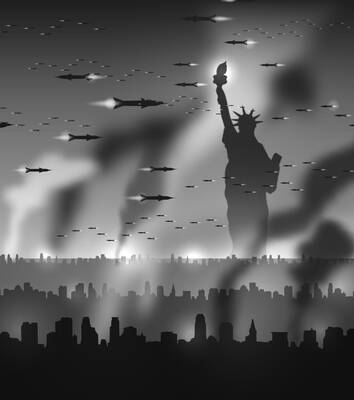
After declaring Iran’s military “gone,” US President Donald Trump appealed to the UK, France, Japan and South Korea — as well as China, Iran’s strategic partner — to send minesweepers and naval forces to reopen the Strait of Hormuz. When allies balked, the request turned into a warning: NATO would face “a very bad” future if it refused. The prevailing wisdom is that Trump faces a credibility problem: having spent years insulting allies, he finds they would not rally when he needs them. That is true, but superficial, as though a structural collapse could be caused by wounded feelings. Something
Former Taipei mayor and Taiwan People’s Party (TPP) founding chairman Ko Wen-je (柯文哲) was sentenced to 17 years in prison on Thursday, making headlines across major media. However, another case linked to the TPP — the indictment of Chinese immigrant Xu Chunying (徐春鶯) for alleged violations of the Anti-Infiltration Act (反滲透法) on Tuesday — has also stirred up heated discussions. Born in Shanghai, Xu became a resident of Taiwan through marriage in 1993. Currently the director of the Taiwan New Immigrant Development Association, she was elected to serve as legislator-at-large for the TPP in 2023, but was later charged with involvement
Out of 64 participating universities in this year’s Stars Program — through which schools directly recommend their top students to universities for admission — only 19 filled their admissions quotas. There were 922 vacancies, down more than 200 from last year; top universities had 37 unfilled places, 40 fewer than last year. The original purpose of the Stars Program was to expand admissions to a wider range of students. However, certain departments at elite universities that failed to meet their admissions quotas are not improving. Vacancies at top universities are linked to students’ program preferences on their applications, but inappropriate admission


 RSS
RSS