


While Taiwan People’s Party (TPP) Chairman and presidential candidate Ko Wen-je (柯文哲) recalls his eight years as Taipei mayor, the Chinese Nationalist Party (KMT) has been missing those good old days during the eight years of former president Ma Ying-jeou’s (馬英九) rule. If the TPP and the KMT do not cooperate, neither can win the presidential election in January. They are hypnotized by the public opinion polls supporting a power transfer, hoping to join hands with their political rivals just to gain power.
Ko and his mother regard New Taipei City Mayor Hou You-yi (侯友宜), the KMT’s presidential candidate, to be no more than a policeman-turned-politician and less knowledgeable than Ko. Ko is the man who loves touting his high IQ. How could he serve as Hou’s running mate?
The KMT regard the TPP as a upstart that cannot be compared to its more than a century of history. How could Hou serve as Ko’s running mate?
Still, in their minds, a “blue-white (KMT-TPP)” ticket would be a “winning move.” Although it is a “risky move,” if they do not play the game this way, they are sure to lose. However, will there be a backlash from their supporters if they were to cooperate with each other for power?
Rumor has it that if a Ko-Hou ticket is formed and elected, the KMT would appoint the premier and form the Cabinet for the first term. If the KMT and TPP can win more than half of the legislative seats, a KMT lawmaker would serve as the legislative speaker. Who would not be drooling over the chance of acquiring such power?
Unfortunately for them, Article 84 of the Presidential and Vice Presidential Election and Recall Act (總統副總統選舉罷免法) states: “Anyone who makes a candidate or a person qualified for a candidate agree to abandon the campaign or to perform certain campaign activities by asking for expected promises or delivering bribes or other undue benefits to the aforesaid party shall be imprisoned and fined.”
Do Ko and Hou think that judges and prosecutors are dummies? If someone makes a presidential hopeful a running mate by secretly promising them to be the one to appoint the premier or legislative speaker, they can hardly conceal the secret. It is a classic example of a “quid pro quo” arrangement.
We should not look at today’s judiciary with the party-state mentality of the past: former presidents Lee Teng-hui (李登輝), Chen Shui-bian (陳水扁) as well as Ma were all prosecuted.
If Ko and Hou test the law in the election, will both of them be detained, resulting in an electoral duel between Vice President William Lai (賴清德), the Democratic Progressive Party’s candidate, and Terry Gou (郭台銘)? Let us wait and see as the election drama unfolds.
Chuang Sheng-rong is a lawyer.
Translated by Eddy Chang
A gap appears to be emerging between Washington’s foreign policy elites and the broader American public on how the United States should respond to China’s rise. From my vantage working at a think tank in Washington, DC, and through regular travel around the United States, I increasingly experience two distinct discussions. This divergence — between America’s elite hawkishness and public caution — may become one of the least appreciated and most consequential external factors influencing Taiwan’s security environment in the years ahead. Within the American policy community, the dominant view of China has grown unmistakably tough. Many members of Congress, as
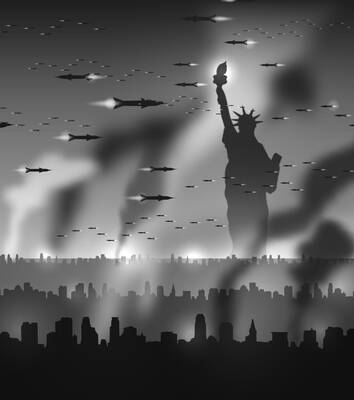
After declaring Iran’s military “gone,” US President Donald Trump appealed to the UK, France, Japan and South Korea — as well as China, Iran’s strategic partner — to send minesweepers and naval forces to reopen the Strait of Hormuz. When allies balked, the request turned into a warning: NATO would face “a very bad” future if it refused. The prevailing wisdom is that Trump faces a credibility problem: having spent years insulting allies, he finds they would not rally when he needs them. That is true, but superficial, as though a structural collapse could be caused by wounded feelings. Something
Former Taipei mayor and Taiwan People’s Party (TPP) founding chairman Ko Wen-je (柯文哲) was sentenced to 17 years in prison on Thursday, making headlines across major media. However, another case linked to the TPP — the indictment of Chinese immigrant Xu Chunying (徐春鶯) for alleged violations of the Anti-Infiltration Act (反滲透法) on Tuesday — has also stirred up heated discussions. Born in Shanghai, Xu became a resident of Taiwan through marriage in 1993. Currently the director of the Taiwan New Immigrant Development Association, she was elected to serve as legislator-at-large for the TPP in 2023, but was later charged with involvement
Out of 64 participating universities in this year’s Stars Program — through which schools directly recommend their top students to universities for admission — only 19 filled their admissions quotas. There were 922 vacancies, down more than 200 from last year; top universities had 37 unfilled places, 40 fewer than last year. The original purpose of the Stars Program was to expand admissions to a wider range of students. However, certain departments at elite universities that failed to meet their admissions quotas are not improving. Vacancies at top universities are linked to students’ program preferences on their applications, but inappropriate admission


 RSS
RSS