


The funds distributed recently in the Forward-looking Infrastructure Development Program (FLIDP) have sparked a wide debate in political circles. The FLIDP was established in 2017 to build infrastructure in Taiwan over the next 30 years. It includes eight funding categories: railway projects, water infrastructure resistant to climate change, green energy and digital infrastructure, urban and rural projects to balance overall development, childcare facilities, and food safety and human resources infrastructure. According to the special budget review report for phase three of the FLIDP plan, Kaohsiung received NT$126.5 billion (US$4 billion), the highest amount out of the six special municipalities. In particular, Cianjhen Fishing Port, which originally applied for NT$30 million for renovation, was given NT$8.1 billion.
The budget, which was “bloated” 270 times, was heavily criticised by opposition parties. Chinese Nationalist Party (KMT) Taipei City councilors accused the Democratic Progressive Party (DPP) of “splurging” and playing “favoritism”: allocating more resources to DPP-governed cities while neglecting KMT-governed cities. Others complained of “unfairness,” demanding to know why Taipei only received NT$18.4 billion.
Kaohsiung Mayor Chen Chi-mai (陳其邁) hit back remarking that regional development should be encouraged by all, regardless of political affiliations, and that Kaohsiung fishers’ lives deserve improvement.
The controversy unveils several issues, but most importantly, the gap between rural-urban development gap and the north-south divide in Taiwan.
Since relocating its headquarters to Taipei in 1949, the KMT has in power for a total of more than 60 years. Owing to its long-standing bias, the social and economic development gap between the north and the south gradually widened. While the KMT relishes in concentrating investment in technology in its base in northern Taiwan, investment in Taiwan’s south mainly focused on heavy industries, which resulted in serious air pollution.
To address this gap, the DPP government launched the FLIDP to give all 22 cities and counties in Taiwan extra infrastructure and development funding — an opportunity to catch up with Taipei. As the most developed city benefiting from vested interests, Taipei is the last city that should be complaining about “not getting enough.” For example, Taipei’s MRT system has been fully developed for years, while Kaohsiung and Taichung still struggle with funding, building and planning new lines.
Taiwan is one of the top three countries that have invested in pelagic fisheries. Kaohsiung’s Cianjhen Fishing Port, the largest base for pelagic fishing vessels in the country, brings in NT$30 billion annually and takes up 60 percent of Taiwan’s pelagic fishing, but has not had a proper makeover for more than 50 years.
For one, fishers returning from fishing have no facilities to shower after disembarking and are forced to bathe in public. Dilapidated facilities and a dirty environment also need urgent attention. For example, fish and other products are still placed on the ground with no protection, an issue other countries have long addressed. As a suitable drainage system is also lacking, salt water and wastewater are often clogged in ditches and flow to nearby residences.
With so much still in need of renewal, is it too much to ask to have NT$8.1 billion for a port that has been significantly contributing to Taiwan’s pelagic fishing industry and putting most of the fresh catch on the Taiwanese public’s table? Furthermore, the funding is a promising investment that would bring in more revenue as the number of vessels that it can harbor increases and new tourism is established.
If Taipei wishes to lose its label of Tian Long Guo (天龍國), a phrase used to mock a perceived sense of superiority among Taipei residents toward other areas, it should start by letting other cities have equal access to resources and funding. After all, closing the gap between the north and south of Taiwan is long overdue.
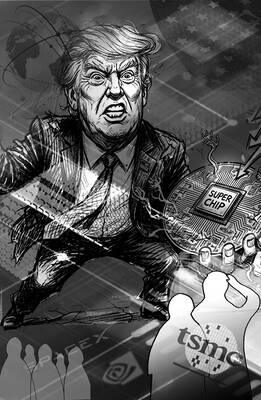
The White House’s decision to take a 9.9 percent stake in Intel Corp is looking like very shrewd business indeed. Since the government bought in at US$20.47 a share last August, the US chipmaker’s surging stock price has delivered the US a US$43 billion return. One of the reasons the investment has so far proved so sound is that the White House has made sure of it. According to The Wall Street Journal, Howard personally pushed deals on Intel’s behalf with some of the most lucrative clients imaginable. They include Nvidia Corp, the company at the heart of the AI
A single photograph can cut through a lot of noise, but it can also be used to misrepresent the truth. At the very least, it can concentrate the mind on something that requires further investigation. On Monday last week, Ma Ying-jeou Foundation CEO Tai Hsia-ling (戴遐齡) and former National Security Council secretary-general King Pu-tsung (金溥聰) held a news conference in which they showed a photograph of former foundation CEO Hsiao Hsu-tsen (蕭旭岑), now Chinese Nationalist Party (KMT) deputy chairman. In the image Hsiao is seated next to Xiamen Taiwan Businessmen Association chairman Han Ying-huan (韓螢煥). The two men were holding
I first met Professor Ray Jiing (井迎瑞) as a film and documentary student at Shih Hsin University’s (SHU) Department of Radio Television and Film in 1988. The following year, he went on to become the director of the Chinese Taipei Film Archive — forerunner of the Taiwan Film and Audiovisual Institute (TFAI). Over his eight-year tenure, Jiing rescued and restored over 200 classic Taiwanese films. In 1997, he established the Graduate Institute of Studies in Documentary and Film Archiving at Tainan National University of the Arts (TNNUA), and I joined the program in his third cohort of students. Beyond a
President William Lai Ching-te’s (賴清德) May 20 second-anniversary address was not just a routine policy review; it was damage control. US President Donald Trump’s remarks — that he did not want to see anyone move toward independence and that the delivery of a major Taiwan arms package could depend on the progress of US-China relations — unsettled Taiwan’s public and created an opening for opposition parties to question whether Taiwan was being treated as a bargaining chip in Washington’s dealings with Beijing. Lai’s speech was designed to close that opening. The address covered the expected ground: sovereignty, cross-strait relations, defense spending,


 RSS
RSS