


I was interested to see Rain Newton-Smith’s sudden promotion to boss of the Confederation of British Industry — so “toxic” with “unchecked misogyny” that both main parties have broken off contact and there is some doubt it will survive at all — celebrated in various quarters as a victory for women.
This particular route to female promotion is, after all, rather common, and I always feel it could be better represented in film: The captain of the flooding submarine, busted bank or exploding Death Star announcing chivalrously over the Tannoy that some “brilliantly qualified” woman will now be taking charge; he has “every confidence” she is up to the “steep climb ahead of her.” (Cue stirring ambition in the hearts of young female maintenance droids throughout the ship, for its final few moments.)
Does every appointment of a female leader need to be a “breakthrough moment” for women? We hear this story endlessly — Jacinda Ardern, prime minister of New Zealand until January; Sanna Marin, the outgoing prime minister of Finland; and Natalia Gavrilia, prime minister of Moldova until February, were all profiled as pathbreakers who would herald a new generation of female politicians.
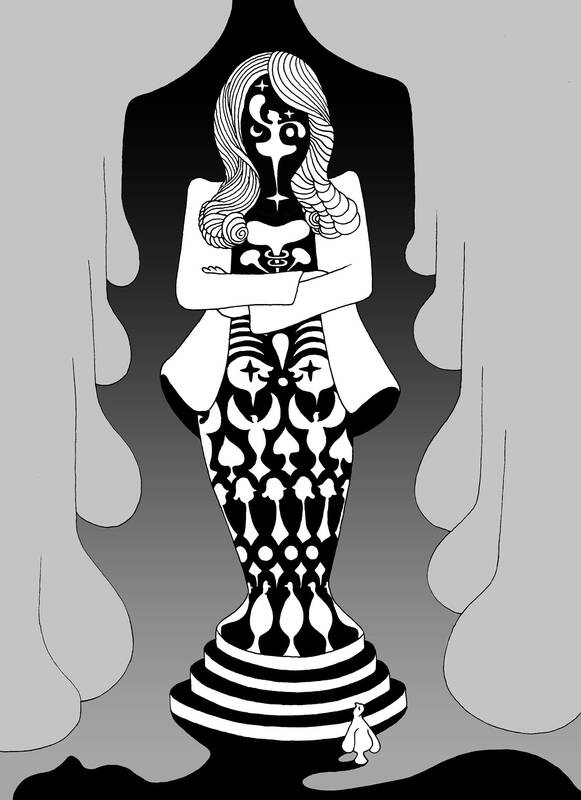
Illustration: Mountain People
Yet, as women — including British female lawmakers — limp away from office, demoralized by abuse and succeeded by men, one wonders just how much inspiration their stories offer to younger people. In the past two decades, the number of women in global politics has risen dramatically. Now growth is plateauing. Meanwhile, women are flooding out of tech, just as they flooded in a few years ago.
There is an unexamined assumption — or perhaps a mantra — at the heart of this: The idea that representation is everything when it comes to female advancement. If you want young women to succeed, the logic goes, the best thing you can do is supply them with as many role models as possible.
This is certainly the message of International Women’s Day — which last month brought us endless lists of “kickass female role models” — the key, the footnotes read, to female aspiration.
The more brilliant women girls get to hear about, the wider their horizons. If you can see it, you can be it.
Well, not always. Sometimes the opposite happens. Take, for example, the story of Coya Knutson — a brilliant, pathbreaking woman, if you ever saw one. In 1955, she became the first woman elected to the US Congress from Minnesota. She was effective in office, but faced vicious scorn for being a “career woman” who was neglecting her family. It would be another 40 years before Minnesota elected another female member of Congress.
Knutson was not the only woman to find herself inadvertently double-glazing the glass ceiling while she was up there. Joyce Banda became Malawi’s first female president in 2012; but in the 2014 elections, where she was defeated, the number of female lawmakers went from 43 to 33.
There is a similar element to Julia Gillard’s legacy. A survey of young Australian women with political aspirations found eight out of 10 were less likely to enter politics as a consequence of the negative media treatment Gillard suffered.
Does female representation bring about social change? Not according to a large and wide-ranging study of Indian state elections by Lakshmi Iyer of the University of Notre Dame, who found female electoral victories had no effect on the numbers of aspiring female politicians (a 2013 study found the same to be true in the US). In the most misogynistic Indian states, the election of a woman heralded a significant decline in new female candidates at the next election.
Women who dared to work in Zambia were derided as prostitutes, according to research by Alice Evans at King’s College London, which put others off, until that changed.
Simply placing women in high-ranking jobs is not enough. Social attitudes matter. If these prominent women are treated with social disdain — if derision and hostility lower their status, despite their title — following in their footsteps becomes unappetizing. Women are actively deterred from the job.
This makes sense — after all, the idea that “role models” are central to female aspiration is patronizing, as if the only limit to female success is their own self-confidence and imagination. Can’t women think themselves into an astronaut suit or corner office unless someone called Emily has done it before them? Is this really the problem?
This is of a piece, I think, with the messages pumped out by a recent rash of “feminist” period films and books with titles like “brilliant historical women you should know about.” These mean well, but, in a bid to emphasize the achievements of their chosen pathbreakers, often end up with the unwittingly sexist thesis that all it takes to overcome centuries of entrenched misogyny is one woman with a bit of gumption and ideas above her station. (Which begs the question: Why didn’t any other women think of that?)
No, women are not suffering from some internal confidence “issue,” or failure of imagination. They are rational actors. They know a cautionary tale when they see one.
If the rewards of becoming a politician or tech CEO are outweighed by an unsurvivable hit to social status or career prospects, they might quite rationally choose to pour their energies into something else. As men would.
I have often wondered what would happen to female aspiration if they were encouraged to believe (as men sometimes are, often rather groundlessly) that their romantic prospects would hugely expand if they attained some elevated career position. Rather than told the opposite.
Patriarchy is a system of rewards and deterrents, in which the punishment of overachieving women is just as important as the praise of submissive ones. Which is to say that handing a woman a poisoned chalice of a job is not quite the feminist victory some might think it is.
Martha Gill is an Observer columnist

The White House’s decision to take a 9.9 percent stake in Intel Corp is looking like very shrewd business indeed. Since the government bought in at US$20.47 a share last August, the US chipmaker’s surging stock price has delivered the US a US$43 billion return. One of the reasons the investment has so far proved so sound is that the White House has made sure of it. According to The Wall Street Journal, Howard personally pushed deals on Intel’s behalf with some of the most lucrative clients imaginable. They include Nvidia Corp, the company at the heart of the AI
The Ministry of the Interior, working with the navy and coast guard, is organizing Taiwan’s first joint exercise simulating escort tankers carrying liquefied natural gas (LNG) and oil through a Chinese blockade. The drills simulate fuel transport along three maritime corridors leading toward Japan, the Philippines and the US. Deputy Minister of the Interior Sawyer Mars (馬士元) said that a blockade of the Taiwan Strait would amount to “almost a 100 percent blockade of the regional energy supply.” Minister of National Defense Wellington Koo said planning to counter a blockade is standard practice in Taipei. While the exercise is limited in
A single photograph can cut through a lot of noise, but it can also be used to misrepresent the truth. At the very least, it can concentrate the mind on something that requires further investigation. On Monday last week, Ma Ying-jeou Foundation CEO Tai Hsia-ling (戴遐齡) and former National Security Council secretary-general King Pu-tsung (金溥聰) held a news conference in which they showed a photograph of former foundation CEO Hsiao Hsu-tsen (蕭旭岑), now Chinese Nationalist Party (KMT) deputy chairman. In the image Hsiao is seated next to Xiamen Taiwan Businessmen Association chairman Han Ying-huan (韓螢煥). The two men were holding
I first met Professor Ray Jiing (井迎瑞) as a film and documentary student at Shih Hsin University’s (SHU) Department of Radio Television and Film in 1988. The following year, he went on to become the director of the Chinese Taipei Film Archive — forerunner of the Taiwan Film and Audiovisual Institute (TFAI). Over his eight-year tenure, Jiing rescued and restored over 200 classic Taiwanese films. In 1997, he established the Graduate Institute of Studies in Documentary and Film Archiving at Tainan National University of the Arts (TNNUA), and I joined the program in his third cohort of students. Beyond a


 RSS
RSS