


Artificial Intelligence (AI) systems are evolving at lightspeed these days. They can help robots perform amazing acrobatics and slick dances. They can beat the world’s top chess and go players. They can also help students do their work. This is sending shockwaves that are rattling the education sector around the English-speaking world. And soon in Taiwan.
Despite the sensationalist international news coverage of ChatGPT since OpenAI made it available to everyone in November, there has been relative silence in local Chinese-language media and complete silence in Taiwan’s education sector. This is because ChatGPT works best in English, as it is a large language model that uses an English training dataset of 10 billion words.
However, the commercial AI arms race has begun and soon Taiwan’s students and teachers will have access to Chinese versions of AI chatbots: Google introduced Bard last week, and Baidu is to release a Chinese AI chatbot Ernie in a few weeks.
AI chatbots will impact educators and students in Taiwan, because they can solve math problems and write essays in seconds. AI technology is transforming cognitive work flows like no other tool in history. If you have played around with ChatGPT, you will know this is not an understatement.
The great fear in English-speaking countries is that students will offload their cognitive work and effort to this technology. They will cheat, copy and plagiarize. They will not learn. They will not be able to realize their own potential and will not be able to contribute to society when they leave school.
When Baidu releases its Mandarin-speaking AI chatbot Ernie, more Taiwanese teachers will become aware of how powerful chatbots are to students, who will likely be the first to realize and fully exploit its applications for doing schoolwork.
However, Pandora’s box has opened and there is no putting that AI power back in.
We need to understand the pitfalls and accept the fact that lazy and unscrupulous people will exploit AI technology for the worse. Like previous technologies. Students will use it to do homework and find the path of least resistance to do their work. This is human nature.
However, we should also understand that AI chatbots can be leveraged to enhance productivity, learning and especially teaching in Taiwan.
When Taiwanese students enter high schools, they are put on the same factory line to prepare them for senior-high entrance exams and finally university entrance exams. Perhaps a better analogy is a treadmill that increases its angle of elevation and speed at unforgiving rates. Unfortunately, many students fall off the treadmill, and most who stay on it, hold on for dear life. They barely keep up with the latest math formulas, historical events and English vocabulary. If they are lucky, they remember the information and pass their daily or weekly tests, only to get ready for the next round of formulas, historical events and vocabulary sets, and the next round of daily or weekly tests.
Moreover, the treadmill gets faster with the approach of senior-high and college exams.
This is not the work of learning. This is non-stop high-intensity interval training for the working memory. We all have the experience of studying hard for an exam, passing it, then forgetting most of the content after a couple of weeks.
My daughter has struggled through Taiwan’s pre-university system and I have entered master’s and doctoral programs in Taiwan. I have witnessed the full range of education in Taiwan, and feel true pangs of sympathy for students here.
Taiwanese students spend more time in classrooms and devote more hours to studying than probably any other country in the world. They prepare for one test after another, like Sisyphus cursed to an eternity of pushing a boulder to the top of a mountain only to always have it roll back down and never reach the summit. The summit, of course, is learning.
The tragedy is that for all the time and effort studying, Taiwanese students are no smarter than students from other countries. This is especially clear to me with Taiwanese graduate students. Many seem to get stuck at Bloom’s lowest level educational objective — “remember.” They struggle with the higher levels of “understand,” “apply,” “synthesize,” “evaluate” and “create.” This is how they have been trained. “Remember” is the default focus of Taiwan’s examination-based education system. The few students able to achieve Bloom’s educational objectives tend to be naturally gifted learners, come from learning-centered families, or have been blessed to have learning-passionate teachers and mentors. Learning requires time and practice. More specifically, if there is any hope of knowledge and skill going from short-term memory into long-term memory, then we need the necessary conditions of curiosity, interest, understanding and appropriate level practice.
And this is where AI chatbots can be valuable.
With access to hundreds, and soon, thousands of gigabytes of Internet text and knowledge in any language, AI chatbots can become AI tutors, helping students understand what step in that math solution was incorrect, why grammar or word choices are wrong or inappropriate, and which people were the key actors in that historical period and why.
I wish I could have had access to an AI tutor/chatbot when I was younger doing math. I remember making mistakes and going back to the textbook explanation and worked-out sample exercises to try and figure out what I did wrong. About 90 percent of the time I gave up after a few frustrating minutes.
If I had had a tutor chatbot, it could have looked at my mistake and not just told me where I had gone wrong, but also shown me the right way while I was still curious about why I made a mistake. I would have found it much easier to understand. I would have been more interested in doing more practice with this patient, all-knowing guide. Perhaps I would have enjoyed studying like I enjoyed playing a video game instead of trying to keep up on a treadmill going way too fast.
Imagine if all children could comfortably do homework by themselves without so much stress and frustration. Imagine if all children — or anybody — could find studying satisfying and enjoyable.
This is when “studying” would become “learning.” This is the promise of AI tech for education.
With Mandarin-speaking AI chatbots like Ernie soon to be released, Taiwanese school administrators and teachers will undoubtedly become worried about students cheating. However, this is the wrong attitude. They should be thankful for these new tools to better help them do their real mission — help students learn.
If teachers can learn how to train their students to use AI chatbots, studying can start to become less like interval training for the working memory and more like curiosity-driven video game playing that allows the student-players to level up their learning with a chatbot learning partner at their side.
When this happens, more Taiwanese students will finally be able to “learn,” and more people will be able to fully realize their potential and contribute more to society.
Nigel P. Daly has a doctorate in TESOL from National Taiwan Normal University and is a published researcher in language learning technology.
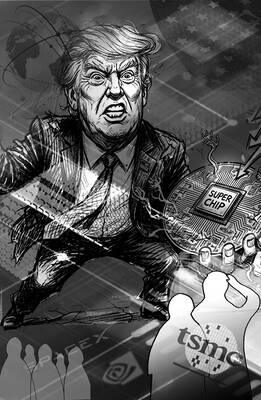
The White House’s decision to take a 9.9 percent stake in Intel Corp is looking like very shrewd business indeed. Since the government bought in at US$20.47 a share last August, the US chipmaker’s surging stock price has delivered the US a US$43 billion return. One of the reasons the investment has so far proved so sound is that the White House has made sure of it. According to The Wall Street Journal, Howard personally pushed deals on Intel’s behalf with some of the most lucrative clients imaginable. They include Nvidia Corp, the company at the heart of the AI
A single photograph can cut through a lot of noise, but it can also be used to misrepresent the truth. At the very least, it can concentrate the mind on something that requires further investigation. On Monday last week, Ma Ying-jeou Foundation CEO Tai Hsia-ling (戴遐齡) and former National Security Council secretary-general King Pu-tsung (金溥聰) held a news conference in which they showed a photograph of former foundation CEO Hsiao Hsu-tsen (蕭旭岑), now Chinese Nationalist Party (KMT) deputy chairman. In the image Hsiao is seated next to Xiamen Taiwan Businessmen Association chairman Han Ying-huan (韓螢煥). The two men were holding
The Ministry of the Interior, working with the navy and coast guard, is organizing Taiwan’s first joint exercise simulating escort tankers carrying liquefied natural gas (LNG) and oil through a Chinese blockade. The drills simulate fuel transport along three maritime corridors leading toward Japan, the Philippines and the US. Deputy Minister of the Interior Sawyer Mars (馬士元) said that a blockade of the Taiwan Strait would amount to “almost a 100 percent blockade of the regional energy supply.” Minister of National Defense Wellington Koo said planning to counter a blockade is standard practice in Taipei. While the exercise is limited in
In a Taiwanese university classroom, a lecturer asks in English: “Can anyone give me an example from Taiwan?” Students look down. No one answers. After class, one student writes on the course platform in Mandarin: “I understood the concept, but I didn’t know how to answer in English.” That moment highlights a key issue in Taiwan’s English-medium instruction (EMI) reform: It is not just about more English-taught courses, but whether students can learn, participate and belong. EMI expansion is part of the Bilingual 2030 policy and the Ministry of Education’s BEST Program, aiming to improve English ability, support EMI teaching


 RSS
RSS