


When Russia last week announced that it would cut oil production by half a million barrels a day in retaliation against Western sanctions, there was skepticism about whether it was really doing so by choice.
Russia is entangled in a tightening web of economic restrictions, from prohibitions on exports of technology to the country to a recent EU ban on most imports of its oil. As far as the West is concerned, Moscow is buckling under the weight of sanctions.
“It wasn’t voluntary, it was forced on them,” European Commissioner for Energy Kadri Simson said in an interview in Cairo. “They don’t have the ability to keep up the production volumes, because they don’t have access to necessary technology.”
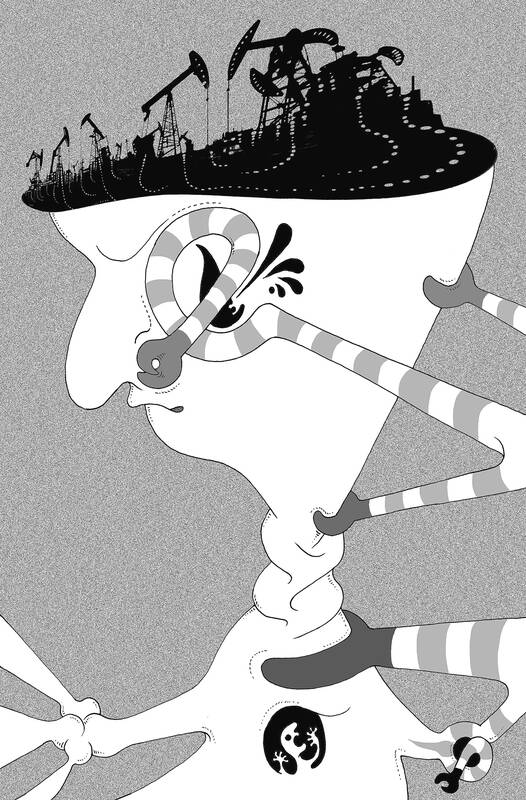
Illustration: Mountain People
Yet data from within Russia tell a different story.
Russian companies did the most drilling at their oil fields in more than a decade last year, with little sign that international sanctions or the departure of some major Western firms directly harmed so-called upstream operations. This helps explain how the nation’s oil production rebounded in the second half of last year even as further restrictions were imposed on its exports.
“The industry largely continues working just like before,” said Vitaly Mikhalchuk, head of the research center at Business Solutions and Technologies (BST), formerly the Russian unit of consultant Deloitte & Touche LLP. “Russia has been able to retain most oil-service competencies, assets and technologies.”
Since Russian President Vladimir Putin’s decision to invade Ukraine almost a year ago, Russia’s oil industry has undergone the most dramatic change in political circumstances since the collapse of the Soviet Union.
Western majors including BP PLC, Shell PLC and Exxon Mobil Corp walked away from multibillion-dollar investments in the country. Some of the major international service providers followed them. Europe also introduced “comprehensive exports restriction on equipment, technology and services for the energy industry in Russia.”
Yet Russian oil rigs drilled a total depth of more than 28,000km last year, the highest in more than a decade, according to industry data seen by Bloomberg. The total number of wells started rose nearly 7 percent to more than 7,800, with most key oil companies beating their results of the previous year, the data showed.
Several factors have helped Russia keep its oil industry ticking over.
First, top international providers accounted for only 15 percent of the country’s total oil-services segment in 2021, data from Vygon Consulting showed. The in-house units of domestic producers such as Rosneft PJSC, Surgutneftegas PJSC and Gazprom Group make up the bulk of the market, the data showed. Those companies did not respond to requests for comment.
“Russian companies attract foreign contractors if they need high-tech services and equipment,” as well as advanced software, a report of the Moscow-based consultant said. However, such things are not generally needed to keep the oil flowing from established fields.
Second, some of the most significant Western oil-service providers did not leave the country. SLB and Weatherford International PLC continue Russian operations, with some limitations.
SLB chief executive officer Olivier Le Peuch in July last year said that his company’s unique corporate structure gives it flexibility to work in Russia while fully complying with US and EU sanctions. The company did not respond to a request for comment from Bloomberg.
Weatherford last year said that it had halted “any new investments or deploying new technology in Russia,” but its most recent quarterly report still lists the nation among the regions where it operates.
The oil-services provider declined to comment on its Russian operations in response to a request by Bloomberg.
Third, the two oil-service giants that did depart Russia — Halliburton Co and Baker Hughes Co — sold off their in-country businesses to the local management. This allowed the units to retain personnel and expertise, Kper crude analyst Victor Katona said.
BurService, the successor of Halliburton in Russia, did not respond to written requests for comments. OFS Technologies, formerly the Russian unit of Baker Hughes, could not provide an immediate comment.
The main issue for Russia’s domestic oil industry has been obtaining Western high-tech equipment, BST said.
Yet “these problems are resolved thanks to imports through intermediaries in friendly states or by finding alternative suppliers in China,” Mikhalchuk said.
Since hitting a post-invasion low of 10.05 million barrels a day in April last year, Russian oil production rebounded to about 10.9 million barrels a day at the end of last year and stayed close to that level last month.
While the upstream impact of sanctions has been limited, Russia’s oil industry faces other challenges. The country does not have the capacity to store oil on a large scale, so if companies cannot sell what they produce because of Western restrictions, the system can quickly become backed up.
That is what happened in the weeks immediately after the invasion of Ukraine last year, when a buyers’ strike swelled crude inventories to such an extent that the country was forced to cut output by about 500,000 barrels a day.
There is no evidence that the Dec. 5 EU ban on crude imports has caused comparable problems, with Russian production holding steady in the two months since then. It is still early to be assessing the full impact of Europe’s Feb. 5 prohibition on buying Russia’s refined fuels including diesel — for which it was the largest market.
Processing rates at Russian refineries in the first eight days of this month were about 2 percent above January levels, at more than 5.8 million barrels a day, industry data seen by Bloomberg showed. Spare capacity in the country’s oil inventories was above 25 million barrels as of Friday last week, compared with 20 million barrels last year when it was forced to cut production.
While Western technology sanctions probably will not have a short-term impact on Russia’s upstream oil industry, the effects might be visible in the long term, Rystad Energy A/S vice president Swapnil Babele said.
“Performance of some oil services may decline, while losses and risks will be growing,” Mikhalchuk said. “A deficit of technologies for development of offshore and some hard-to-recover reserves may become a problem.”
After Moscow’s seizure of Ukraine’s Crimea Peninsula in 2014, an international ban was brought in on providing services for oil projects in Russia’s shale formations, arctic and deep water. Those measures stymied Rosneft’s plans to tap offshore fields in the northerly Kara Sea.
However, since then, Russian companies have shown they can develop in-house expertise in some of those areas, Katona said.
Gazprom Neft PJSC actually increased its drilling in a major shale formation in west Siberia last year, he said.
“Although delayed by many years, Russia’s domestic technological know-how to tap into shale has been progressing,” Katona said.
Even if technology sanctions restrict activity in more challenging reservoirs, right now Russia has enough traditional reserves to keep the oil flowing. Assuming output were to remain close to current levels, by 2027, just 3 percent of it would depend on technologies the country has difficulty accessing now, Mikhalchuk said.
“Russian production could be maintained around current output levels for at least four to five years” on a technical basis, Katona said.
A gap appears to be emerging between Washington’s foreign policy elites and the broader American public on how the United States should respond to China’s rise. From my vantage working at a think tank in Washington, DC, and through regular travel around the United States, I increasingly experience two distinct discussions. This divergence — between America’s elite hawkishness and public caution — may become one of the least appreciated and most consequential external factors influencing Taiwan’s security environment in the years ahead. Within the American policy community, the dominant view of China has grown unmistakably tough. Many members of Congress, as
After declaring Iran’s military “gone,” US President Donald Trump appealed to the UK, France, Japan and South Korea — as well as China, Iran’s strategic partner — to send minesweepers and naval forces to reopen the Strait of Hormuz. When allies balked, the request turned into a warning: NATO would face “a very bad” future if it refused. The prevailing wisdom is that Trump faces a credibility problem: having spent years insulting allies, he finds they would not rally when he needs them. That is true, but superficial, as though a structural collapse could be caused by wounded feelings. Something
Former Taipei mayor and Taiwan People’s Party (TPP) founding chairman Ko Wen-je (柯文哲) was sentenced to 17 years in prison on Thursday, making headlines across major media. However, another case linked to the TPP — the indictment of Chinese immigrant Xu Chunying (徐春鶯) for alleged violations of the Anti-Infiltration Act (反滲透法) on Tuesday — has also stirred up heated discussions. Born in Shanghai, Xu became a resident of Taiwan through marriage in 1993. Currently the director of the Taiwan New Immigrant Development Association, she was elected to serve as legislator-at-large for the TPP in 2023, but was later charged with involvement
Out of 64 participating universities in this year’s Stars Program — through which schools directly recommend their top students to universities for admission — only 19 filled their admissions quotas. There were 922 vacancies, down more than 200 from last year; top universities had 37 unfilled places, 40 fewer than last year. The original purpose of the Stars Program was to expand admissions to a wider range of students. However, certain departments at elite universities that failed to meet their admissions quotas are not improving. Vacancies at top universities are linked to students’ program preferences on their applications, but inappropriate admission


 RSS
RSS