


The Chinese People’s Liberation Army Air Force (PLAAF) has been harassing Taiwan by encroaching on its northern airspace with multiple sorties by aircraft flying at different altitudes.
In addition to drawing international attention, such actions are making Taiwanese seriously consider immediately bolstering the air defenses in northern Taiwan. One way of dealing with this urgent problem would be to restore the strategic role of the Taoyuan Air Base.
The Republic of China Air Force built Chiang Kai-shek International Airport in the 1970s as one of Taiwan’s “10 Major Construction Projects.” It was renamed Taiwan Taoyuan International Airport in 2006.
The airport’s strategic position is as important as ever amid military tensions across the Taiwan Strait. The government could consider adding a dedicated zone for warplanes within the airport, or it could partly revive the former Taoyuan Air Base, depending on defense requirements. This would have major positive significance for the strategic deployment of Taiwan’s national security.
Northern Taiwan is the nation’s strategic heartland. Following the 2010 administrative adjustment that raised the number of special municipalities from two to six, the five northern municipalities and counties, namely Taipei, New Taipei City, Taoyuan, Keelung and Yilan County, whose population adds up to nearly 13 million people, were left with no airports for fighters to take off and land.
The region has launch sites for missiles, but not for fighter jets. This situation highlights a serious imbalance in military deployment, as well as the resulting strategic weakness of Taiwan’s political and economic heartland.
Ever since the Taoyuan Air Base was closed, northern Taiwan’s air defense has depended on air-defense missile systems deployed around its periphery, so if PLAAF aircraft intrude Taiwan’s northern airspace, the region would have to rely on warplanes flying up from air bases in Hsinchu County or the more distant Hualien County to respond to and intercept the Chinese planes.
When it comes to air defense, every second counts, but despite Taiwan’s intrinsic geographical and defensive advantages, northern Taiwan depends on bringing in fighter jets from far away, which leaves too wide a strategic gap.
Whenever Japan detects Chinese or Russian warplanes near its air defense identification zone, it immediately dispatches early warning aircraft to respond to them and track their movements. On Dec. 21 last year, when a US Air Force Boeing RC-135V Rivet Joint electronic reconnaissance aircraft flew close to an “international air route” in the South China Sea, China immediately dispatched a Shenyang J-11 fighter jet armed with air-to-air missiles to chase it away.
These responses involved planes taking off from the closest air bases. In contrast, at a time when more Chinese fighter planes are approaching Taiwan’s airspace, Taiwan is relatively powerless to deter them. The nation’s fighter pilots are exhausted from their missions, as they do twice the work to achieve half the results. Facing such a situation, the nation should revive the Taoyuan Air Base and its important role in the air defense of northern Taiwan.
The base played a pivotal role in air defense during the years of confrontation between the two sides of the Taiwan Strait. It made a big contribution to cross-strait stability and consolidated the nation’s air control advantage over northern Taiwan for 50 years.
Under the current geographical constraints of lack of strategic depth over the Strait, the concept that “no air defense means no defense at all” has become a strategic principle of modern warfare. Under such conditions, a combination of fighter planes and missiles acts like a pair of iron fists, each being indispensable for air defense.
Taoyuan airport, including the original Taoyuan Air Base, is being expanded to create the Taoyuan Aerotropolis. Until such time as the military standoff between the two sides of the Strait is resolved, it is necessary to adjust the situation by integrating the functions of the air base into the Taoyuan airport expansion plan, along the lines of the air force fighter squadron permanently stationed on the Penghu islands.
When Taiwan receives its order of new F-16V jets, a combat squadron could be sent to Taoyuan airport. Other combat aircraft could also be stationed there on a rotational basis to reinforce the air defense of the capital and its surrounding area.
A glance at the modern air-defense deployment in European countries and the US shows that there are many joint-use military and civilian airports.
In Singapore, although Changi Airport is close to the Paya Lebar Air Force Base, military and civil aviation operate smoothly without getting in each other’s way, ensuring the air base can protect the city-state.
Taiwan’s Taichung, Chiayi, Tainan and Hualien airports all function smoothly as civilian-military joint-use airports. Considering the weak air defense in northern Taiwan and recognizing that national defense is critical for the nation’s existence, the government should seriously consider the strategic value of reviving the Taoyuan Air Base.
Chang Yan-ting is a retired air force lieutenant general and an honorary emeritus professor at National Tsing Hua University.
Translated by Julian Clegg
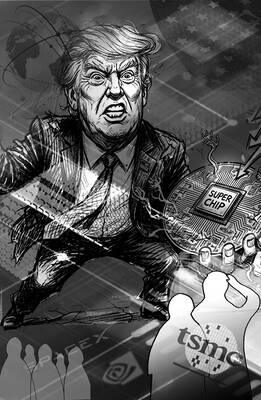
The White House’s decision to take a 9.9 percent stake in Intel Corp is looking like very shrewd business indeed. Since the government bought in at US$20.47 a share last August, the US chipmaker’s surging stock price has delivered the US a US$43 billion return. One of the reasons the investment has so far proved so sound is that the White House has made sure of it. According to The Wall Street Journal, Howard personally pushed deals on Intel’s behalf with some of the most lucrative clients imaginable. They include Nvidia Corp, the company at the heart of the AI
A single photograph can cut through a lot of noise, but it can also be used to misrepresent the truth. At the very least, it can concentrate the mind on something that requires further investigation. On Monday last week, Ma Ying-jeou Foundation CEO Tai Hsia-ling (戴遐齡) and former National Security Council secretary-general King Pu-tsung (金溥聰) held a news conference in which they showed a photograph of former foundation CEO Hsiao Hsu-tsen (蕭旭岑), now Chinese Nationalist Party (KMT) deputy chairman. In the image Hsiao is seated next to Xiamen Taiwan Businessmen Association chairman Han Ying-huan (韓螢煥). The two men were holding
I first met Professor Ray Jiing (井迎瑞) as a film and documentary student at Shih Hsin University’s (SHU) Department of Radio Television and Film in 1988. The following year, he went on to become the director of the Chinese Taipei Film Archive — forerunner of the Taiwan Film and Audiovisual Institute (TFAI). Over his eight-year tenure, Jiing rescued and restored over 200 classic Taiwanese films. In 1997, he established the Graduate Institute of Studies in Documentary and Film Archiving at Tainan National University of the Arts (TNNUA), and I joined the program in his third cohort of students. Beyond a
President William Lai Ching-te’s (賴清德) May 20 second-anniversary address was not just a routine policy review; it was damage control. US President Donald Trump’s remarks — that he did not want to see anyone move toward independence and that the delivery of a major Taiwan arms package could depend on the progress of US-China relations — unsettled Taiwan’s public and created an opening for opposition parties to question whether Taiwan was being treated as a bargaining chip in Washington’s dealings with Beijing. Lai’s speech was designed to close that opening. The address covered the expected ground: sovereignty, cross-strait relations, defense spending,


 RSS
RSS