


Government decisionmaking is never easy, and the hardest part is choosing between what the public demands and what is in the best interests of the nation. The decision to reinstate one-year conscription was one such choice.
Former presidents Chen Shui-bian (陳水扁) and Ma Ying-jeou (馬英九) since 2000 worked toward shortening the mandatory service period while transitioning to an all-volunteer military. President Tsai Ing-wen (蔡英文) has decided to restore the mandatory service period to one year and modify the structure of the nation’s military.
This is a reform as much as a renovation. Her decision is an act of valor — she has done what many men dared not do. For many of us, Tsai has cleaned up a mess created by her male predecessors.
Tsai’s two years of competent preparation was on full display at a Presidential Office news conference on Tuesday. Soon after Tsai was re-elected in 2020, she established a special program to recruit members from the National Security Council and the Ministry of Defense to comprehensively review the strategic environment in the Indo-Pacific region and carefully assess challenges in the Taiwan Strait. The goal was to establish a plan catering to the nation’s security and defense.
The team met at least twice a month to discuss operations in the Taiwan Strait. What would be counted as asymmetric warfare, and what would be the role of of the national defense apparatus? How should Taiwan cooperate with neighboring countries in terms of geopolitical strategy, especially with those that deal with similar security concerns? How can problems be solved together to establish collaborative procedures and work toward mutual goals in peacetime and in wartime? Should challenges be met with the restructuring of armed forces? Should military training be enhanced, and how can it be optimized?
These were some of the critical issues the team deliberated.
The team also discussed many problems facing the armed forces. From 2013, only four months of military training had been required, a decrease implemented by Ma’s administration. The team determined that much of that training was redundant and ineffective, and had become more of a burden to the military.
Since 1997, when the Armed Forces Reform Program (精實案) was implemented, the reserve forces has been gradually hollowed out. Another long-term issue has been Taiwan’s defense apparatus, which has remained inadequate and deficient. These problems have plagued the military for decades while reproducing an increasing number of mistakes from within.
Presidents before Tsai did not try to resolve these issues. Perhaps they valued winning elections for their parties above solving such problems, or they failed to communicate well with the military.
However, Tsai is a Virgo who pays attention to details. She refused to accept these problems as a “status quo,” and tackled them one by one.
Tsai undertook each task with systematic thinking. For the reserve forces, she proposed a joint structure that would combine compulsory and voluntary military service. The volunteer forces would constitute the main offenses, while conscripts would serve for one year, as would defense forces.
The nation’s security is better ensured, and cities and towns protected, with military and civilian defenses integrated. Taiwan is enhancing military capacity from the grassroots level while securing defense with advanced logistics.
Reinstating one-year conscription is politically sensitive. Tsai worked with her team for a substantial amount of time, repeatedly checking and confirming ways of assigning each task and establishing a comprehensive training system.
Having participated in the entire process, Tsai understands how new training models are to be conducted, and grasps the process conscripts undergo from recruitment to stationing to training. She has also devoted herself to communicating sincerely and transparently with the public.
The moment the new plan was concluded, Tsai determined that Taiwanese should be informed immediately. She began the news conference by describing present international security concerns, after which she reviewed systems of military service around the world.
She then discussed Taiwan’s compulsory military service. She explained how the restoration of one-year conscription would be integrated with volunteer forces to enhance Taiwan’s homeland security apparatus. She also illustrated the configuration and deployment of troops in detail.
As the commander-in-chief of the armed forces, Tsai successfully demonstrated her mastery and capability. The transformation of a crude concept into a pragmatic plan was witnessed. For the plan to be realized, Taiwanese should work together to overcome the difficulties that lie ahead.
Tsai insisted on leading Taiwan along a remarkable path despite the Democratic Progressive Party’s losses in the local elections. History is certain to remember her for putting the nation’s security above political concerns.
Tzou Jiing-wen is the editor-in-chief of the Liberty Times, the Taipei Times’ sister newspaper.
Translated by Liu Yi-hung
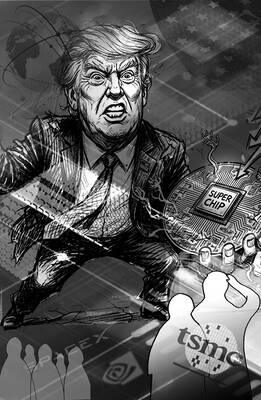
The White House’s decision to take a 9.9 percent stake in Intel Corp is looking like very shrewd business indeed. Since the government bought in at US$20.47 a share last August, the US chipmaker’s surging stock price has delivered the US a US$43 billion return. One of the reasons the investment has so far proved so sound is that the White House has made sure of it. According to The Wall Street Journal, Howard personally pushed deals on Intel’s behalf with some of the most lucrative clients imaginable. They include Nvidia Corp, the company at the heart of the AI
KMT Chairwoman Cheng Li-wun’s (鄭麗文) recent visit to Beijing and her upcoming visit to Washington will serve as a high-level test of her diplomatic mettle. In Beijing, Cheng was received with symbolic gestures, a warm reception, and high-level access. In Washington, she will receive far less pomp and far sharper questions about the KMT’s vision for the future of Taiwan. Her challenge will be to persuade Washington that the KMT’s engagement with China can coexist with strong deterrence. Cheng’s April 7-12 visit to mainland China coincided with an intense period of conflict in Iran. Despite the strategic significance of Cheng’s trip,
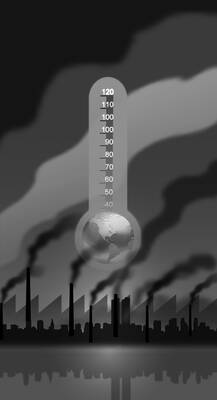
The closure of the Strait of Hormuz has sent the vast Asian chemicals industry into a tailspin. Deprived of the likes of Qatari natural gas and Saudi Arabian oil, the region’s fertilizer and plastics plants are slowing production or even shutting down. Everywhere except China, that is. In petrochemicals, China is unique. As well as a traditional industry that uses oil and gas as feedstock, it has parallel output that relies on its abundant domestic coal. Unsurprisingly, India and other regional powers want to copy and paste the Chinese method. This would not be easy — or climate friendly. The
Indonesian President Prabowo Subianto says he knows how to fix the problems facing Indonesia. Yet his economic mismanagement and authoritarian tendencies are steering the nation toward a familiar mix of currency instability and political chaos. The world’s fourth-most populous nation risks reversing the hard-won democratic and business reforms that came after the Asian Financial Crisis in 1997. At that time, the rupiah collapsed and the political upheaval that followed forced former president Haji Mohamed Suharto from power. Prabowo’s administration is ignoring similar warning signs. That disconnect was apparent in a national address on Wednesday, when Prabowo projected the swagger that has


 RSS
RSS