


Hualien County native Tseng Sheng-kuang (曾聖光), also known as Jonathan Tseng and his Amis name, Diway, was killed in combat in Ukraine last week. When news of his death emerged, many people paid tribute, but many others said that his sacrifice was not worth making, and asked why he fought and died for a country that in the past sold weapons to the Chinese military.
They also asked why he did not stay in Taiwan, where he could fight to the death for his own country. Someone even said that Tseng had debt of NT$1 million (US$31,345) or more, implying that he went abroad to fight as a volunteer to avoid paying back his debt. Could debt collection gangs really be more ferocious than the Russian army?
I have never met Tseng, so I cannot answer such questions for him. Instead, I will talk about the meaning of death in battle.
Philosopher Hu Shih (胡適) wrote that whenever one studies a culture, one must look at how people live under that culture and, even more, how they die.
How many years have passed since the last time a Taiwanese died on the battlefield? In today’s Taiwan, almost everyone wants to live in the security of an “iron rice bowl” — a job for life. No topics are more popular than “food” and “sex,” and if someone scolds you online, it is called “being conscripted.”
Now that someone has really been recruited, never to return, it strikes a sharp contrast with the way the rest of Taiwanese live and die.
Seeking death is often seen as a selfish way of evading problems, but it is a different story when someone dies in war. Those who die in battle are always approved of, no matter what people imagine happens after death.
Tseng might have been a Christian, judging by his given name, Sheng-kuang, which means “holy light” in Chinese. So, no doubt, were many of his European comrades. Believing in God, they volunteered to join the International Legion of Territorial Defense of Ukraine and, if need be, to die for what is right.
Looking back to ancient China’s Warring States period, subjects of the state of Chu (楚), who were said to be in awe of ghosts, also sang the praises of fallen soldiers, as Qu Yuan (屈原) did in his poem Death of the State (國殤): “Though you have died, your spirit is never gone; Of souls and ghosts, you are the bravest one.”
Those who kill themselves and those who keep themselves alive at any cost might be thinking of themselves, but those who die in battle are protecting others to the end. No wonder they are mourned by ghosts and gods alike.
It is hard to agree with the comments made by some of Tseng’s online friends. Would they dare to sacrifice themselves for a more worthy country, beliefs or people, or are they just ashamed to have been shown up by Tseng?
Jimway Chang has a master’s degree in history from National Tsing Hua University and teaches history at a high school.
Translated by Julian Clegg
A gap appears to be emerging between Washington’s foreign policy elites and the broader American public on how the United States should respond to China’s rise. From my vantage working at a think tank in Washington, DC, and through regular travel around the United States, I increasingly experience two distinct discussions. This divergence — between America’s elite hawkishness and public caution — may become one of the least appreciated and most consequential external factors influencing Taiwan’s security environment in the years ahead. Within the American policy community, the dominant view of China has grown unmistakably tough. Many members of Congress, as
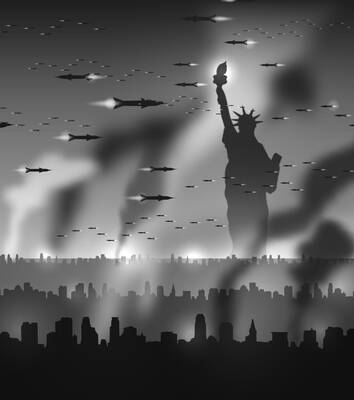
After declaring Iran’s military “gone,” US President Donald Trump appealed to the UK, France, Japan and South Korea — as well as China, Iran’s strategic partner — to send minesweepers and naval forces to reopen the Strait of Hormuz. When allies balked, the request turned into a warning: NATO would face “a very bad” future if it refused. The prevailing wisdom is that Trump faces a credibility problem: having spent years insulting allies, he finds they would not rally when he needs them. That is true, but superficial, as though a structural collapse could be caused by wounded feelings. Something
Former Taipei mayor and Taiwan People’s Party (TPP) founding chairman Ko Wen-je (柯文哲) was sentenced to 17 years in prison on Thursday, making headlines across major media. However, another case linked to the TPP — the indictment of Chinese immigrant Xu Chunying (徐春鶯) for alleged violations of the Anti-Infiltration Act (反滲透法) on Tuesday — has also stirred up heated discussions. Born in Shanghai, Xu became a resident of Taiwan through marriage in 1993. Currently the director of the Taiwan New Immigrant Development Association, she was elected to serve as legislator-at-large for the TPP in 2023, but was later charged with involvement
Out of 64 participating universities in this year’s Stars Program — through which schools directly recommend their top students to universities for admission — only 19 filled their admissions quotas. There were 922 vacancies, down more than 200 from last year; top universities had 37 unfilled places, 40 fewer than last year. The original purpose of the Stars Program was to expand admissions to a wider range of students. However, certain departments at elite universities that failed to meet their admissions quotas are not improving. Vacancies at top universities are linked to students’ program preferences on their applications, but inappropriate admission


 RSS
RSS