


More than one month after US House of Representatives Speaker Nancy Pelosi’s visit to Taiwan, it is time to evaluate what lessons can be learned from the turmoil and aftermath of the trip.
Taiwan now faces a severely worsened security environment, with some enhancement to its informal international legitimacy thanks to extensive global media coverage. Has President Tsai Ing-wen’s (蔡英文) hearty reception of the speaker paid off in light of Taiwan’s national interests? Most probably, it did not.
In the structure of US-China strategic rivalry, Pelosi’s visit posed significant risks of domestic political backlash in the two countries. Given the separation of powers, US President Joe Biden’s administration vainly attempted to dissuade the speaker from making the trip by publicly saying it might not be a good idea.
However, once international media got hold of the story, both the president and the speaker could not back down. They have to maintain a hardline policy against China, especially as the US midterm elections are approaching. Chinese President Xi Jinping (習近平) also had to stand firm against the US, as he faces a sensitive political season at home on the run-up to the extension of his presidency, so let off steam by intensifying popular nationalism.
Both Washington and Beijing needed to have a face-off without risking escalation into war.
In hindsight, the crisis management over Pelosi’s visit was a put-up game. Shortly before the visit, on July 28, Biden and Xi had a telephone conference presumably for strategic communication.
Xi surely conveyed his plan to carry out large-scale military drills, but no armed retaliation against the visit, with China’s bellicose rhetoric primarily aimed at a domestic audience. China carried out drills before and after the visit, but none during it.
In response, the US deployed significant numbers of naval and air force missions in the Taiwan region to prepare for any contigencies, demonstrating its commitment to the defense of Taiwan. Even before the end of the post-Pelosi drills, US Deputy Secretary of Defense Colin Kahl on Aug. 8 told a news conference that he thought there would not be a Chinese invasion of Taiwan within a year or two.
However, the unprecedented large-scale drills after Pelosi’s visit offer a solid base on which to infer the magnitude of such an invasion.
They were concurrently conducted in six areas designed to encircle Taiwan, together with amphibious assault exercises ashore of Dalian and the Shandong Peninsula. Beijing also sequentially executed drills that focused on missile attacks with preceding or concurrent cyberattacks, ensuring air and sea superiority, and preparation of amphibious assaults. Beijing rehearsed an invasion of Taiwan.
Most importantly, Beijing did not at all shrink from confronting the US’ large power projection forces, in sharp contrast to the Third Taiwan Strait Crisis of 1996, when Washington sent two aircraft carrier battle groups into the Taiwan theater of operations.
Beijing appeared very confident of its own military power — especially in joint operation and long-range precision strike capabilities — that it had built up steadily since then.
Consequently, China has vastly increased its military posture against Taiwan, involving a considerably higher level of cross-strait tensions. Beijing for the first time launched missiles over Taiwan proper and canceled its longtime implicit acknowledgement of the median line of Taiwan Strait as a de facto boundary.
The circumstances imply that Beijing has practically succeeded in altering the military status quo over Taiwan theater of operations in its favor. This would inevitably exhaust Taiwan’s military due to the sharply increased need to scamble jets and intensify its surveillance activities in the air and at sea, and eventually jeopardize its national security.
Taiwan will have to accelerate its arms buildup, while shouldering much heavier fiscal and related burdens. To avoid falling into similar pitfalls, Taipei has to be more prudent about how to respond to the dynamics of US domestic politics, especially those temporal and partisan phenomena that might harm its mid and long-term security interests.
Taipei has inadvertently given Beijing a good pretext to carry out game-changing military drills that it had planned well beforehand.
Certainly, the US is Taiwan’s sole security guarantor, which is indispensable to its survival. However, the US, under the principle of separation of powers, does not necessarily act out of prudence.
Pelosi’s visit is a typical example. Taipei failed to dodge her visit through groundwork behind the scenes. It also did not contain the damage by fine-tuning diplomatic protocol arrangements designed to deprive Beijing of a good pretext. Unfortunately, European and other liberal democratic countries’ cheers are not much of a help for Taiwan’s security, particularly now that their hands are tied up in the Ukraine war.
To keep standing firm against Beijing, it is high time for Taipei to develop prudential realism, and pro-Taiwan forces overseas should encourage it to overcome this ordeal.
Masahiro Matsumura is a professor of international politics at St Andrew’s University in Osaka, Japan.
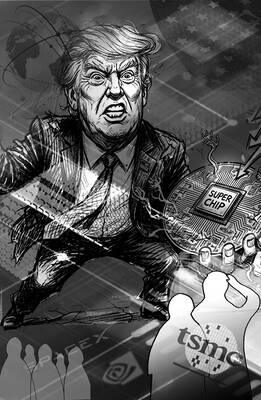
The White House’s decision to take a 9.9 percent stake in Intel Corp is looking like very shrewd business indeed. Since the government bought in at US$20.47 a share last August, the US chipmaker’s surging stock price has delivered the US a US$43 billion return. One of the reasons the investment has so far proved so sound is that the White House has made sure of it. According to The Wall Street Journal, Howard personally pushed deals on Intel’s behalf with some of the most lucrative clients imaginable. They include Nvidia Corp, the company at the heart of the AI
A single photograph can cut through a lot of noise, but it can also be used to misrepresent the truth. At the very least, it can concentrate the mind on something that requires further investigation. On Monday last week, Ma Ying-jeou Foundation CEO Tai Hsia-ling (戴遐齡) and former National Security Council secretary-general King Pu-tsung (金溥聰) held a news conference in which they showed a photograph of former foundation CEO Hsiao Hsu-tsen (蕭旭岑), now Chinese Nationalist Party (KMT) deputy chairman. In the image Hsiao is seated next to Xiamen Taiwan Businessmen Association chairman Han Ying-huan (韓螢煥). The two men were holding
I first met Professor Ray Jiing (井迎瑞) as a film and documentary student at Shih Hsin University’s (SHU) Department of Radio Television and Film in 1988. The following year, he went on to become the director of the Chinese Taipei Film Archive — forerunner of the Taiwan Film and Audiovisual Institute (TFAI). Over his eight-year tenure, Jiing rescued and restored over 200 classic Taiwanese films. In 1997, he established the Graduate Institute of Studies in Documentary and Film Archiving at Tainan National University of the Arts (TNNUA), and I joined the program in his third cohort of students. Beyond a
President William Lai Ching-te’s (賴清德) May 20 second-anniversary address was not just a routine policy review; it was damage control. US President Donald Trump’s remarks — that he did not want to see anyone move toward independence and that the delivery of a major Taiwan arms package could depend on the progress of US-China relations — unsettled Taiwan’s public and created an opening for opposition parties to question whether Taiwan was being treated as a bargaining chip in Washington’s dealings with Beijing. Lai’s speech was designed to close that opening. The address covered the expected ground: sovereignty, cross-strait relations, defense spending,


 RSS
RSS