


Yesterday marked Armed Forces Day, and for several days Taiwanese, especially private businesses, have been holding activities to show their support to the military and veterans.
The sense of camaraderie, which showed how the military and civilians are part of the same family, was touching.
Yesterday was also the day that I removed for the last time the uniform that I have worn for 34 years. I had chosen this particular day to bring my military career to a close.
When I graduated from high school and joined the army as an officer 30 years ago, women were very much a minority in the military — most of them were officers, and you could not find any female soldiers.
Ministry of National Defense statistics show that last year, 14 percent of officers and soldiers were women. Nowadays you can see female personnel training or on guard duty at any time. The increase in women promoted to the rank of general has been particularly noticeable.
This all demonstrates the efforts the armed forces have made toward removing gender stereotypes, and it is a measure of the military’s progress.
When I was at the military academy, I recall having to sign a receipt in a paper notebook to receive our uniforms. After I graduated and became an army major, we were given our own uniform cards, which we would still need to sign by hand. Some years when we applied for new uniforms, they were not available.
Ten years ago, when I was training at the National Defense University National War College as a lieutenant colonel, I visited an army logistics unit and saw that its warehouse management had been fully computerized and that the distribution system had been standardized. I saw how such a huge organization as the military was still able to keep up with the times.
Nowadays there is an app for you to order uniforms, accessories and consumables, allowing you to choose an outlet convenient to collect them.
China has been using civilian drones to fly near Republic of China (ROC) military camps on outlying islands, using footage of soldiers shooting at them to ridicule our armed forces to make Taiwanese question their own military. This is exactly what the Chinese Communist Party (CCP) wants.
After inquiring, I found that the two soldiers on Kinmen’s Erdan Islet (二膽) who fired at the drones were not on duty at the time, but they had their wits about them and used the tools at their disposal to disperse the intruders. I was reassured to hear that they were indeed later commended for their actions by the ministry.
I hope that Taiwanese will not be misled by the CCP’s machinations, and that they will not allow it to succeed in undermining morale.
We should all have more faith in the military, having seen how it assessed the drone situation in the context of cross-strait tensions and the equipment available, and drew up a new contingency plan to counter the CCP’s gray zone tactics.
I am no longer in active service, but I have decided to continue to make a modest contribution to national security by serving in the reserves. The military is a big family: My experience working with it, through good times and bad, and the companionship we shared have left an indelible impression. My commanding officer’s parting words were: “We will always be family.”
I would like to pass this sentiment on to those who continue to serve and support Taiwan’s national defense, and take the opportunity to say to my brothers and sisters in the ROC military: Keep up the good work. Happy Armed Forces Day.
Chang Ling-ling is a colonel in the armed forces reserves.
Translated by Paul Cooper

A gap appears to be emerging between Washington’s foreign policy elites and the broader American public on how the United States should respond to China’s rise. From my vantage working at a think tank in Washington, DC, and through regular travel around the United States, I increasingly experience two distinct discussions. This divergence — between America’s elite hawkishness and public caution — may become one of the least appreciated and most consequential external factors influencing Taiwan’s security environment in the years ahead. Within the American policy community, the dominant view of China has grown unmistakably tough. Many members of Congress, as
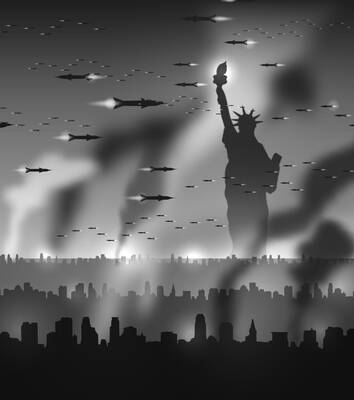
After declaring Iran’s military “gone,” US President Donald Trump appealed to the UK, France, Japan and South Korea — as well as China, Iran’s strategic partner — to send minesweepers and naval forces to reopen the Strait of Hormuz. When allies balked, the request turned into a warning: NATO would face “a very bad” future if it refused. The prevailing wisdom is that Trump faces a credibility problem: having spent years insulting allies, he finds they would not rally when he needs them. That is true, but superficial, as though a structural collapse could be caused by wounded feelings. Something
Former Taipei mayor and Taiwan People’s Party (TPP) founding chairman Ko Wen-je (柯文哲) was sentenced to 17 years in prison on Thursday, making headlines across major media. However, another case linked to the TPP — the indictment of Chinese immigrant Xu Chunying (徐春鶯) for alleged violations of the Anti-Infiltration Act (反滲透法) on Tuesday — has also stirred up heated discussions. Born in Shanghai, Xu became a resident of Taiwan through marriage in 1993. Currently the director of the Taiwan New Immigrant Development Association, she was elected to serve as legislator-at-large for the TPP in 2023, but was later charged with involvement
Out of 64 participating universities in this year’s Stars Program — through which schools directly recommend their top students to universities for admission — only 19 filled their admissions quotas. There were 922 vacancies, down more than 200 from last year; top universities had 37 unfilled places, 40 fewer than last year. The original purpose of the Stars Program was to expand admissions to a wider range of students. However, certain departments at elite universities that failed to meet their admissions quotas are not improving. Vacancies at top universities are linked to students’ program preferences on their applications, but inappropriate admission


 RSS
RSS