


China has multiple territorial and maritime disputes with many nations. However, its most important disputes are with Taiwan and India.
These disputes are not merely territorial, but hegemonistic and expansionist in nature. They are also part of China’s larger design to establish global supremacy and a Sino-centric world order.
Annexation of Taiwan at the earliest moment is China’s priority ambition. The People’s Republic of China (PRC) wants to illegally annex the island nation despite never having ruled it.
Taiwan is the very antithesis of the China’s propaganda that communism is the best form of governance. Taiwan’s prowess in chip manufacturing makes capturing it an attractive economic and technological proposition.
Taking Taiwan also means defeating the US and showing the latter’s inability to withstand Chinese military might, making China a complete superpower.
The fall of Taiwan would also irrevocably break the first island chain, enabling the unhindered global deployment of the People’s Liberation Army Navy, preventing direct military contact with China.
In that eventuality, China would become unassailable, transforming from a nation consigned to defending itself, to an outbound nation that can dominate the seas.
In this context, Taiwan should never be allowed to fall, unless the world is prepared for a Sino-centric global order.
Defeating India in a military conflict is China’s alternate priority. Beijing knows that India is emerging as the global alternative to China if it is allowed to grow unimpeded. Hence, it must hand India a military defeat and show it as incapable and weak.
Even a small military victory over India would enhance the PRC’s influence in South Asia and promote its unhindered entry into the Indian Ocean region. It would also enable expansion of Chinese control south of the Himalayan crest line. This would lead to the eventual outflanking of the Pacific from the west and solve the “Malacca dilemma.”
Thus far, China has been dealing with Taiwan and India separately. It has created conditions such that both these democracies do not combine and form a united front. That many countries, including India, do not formally recognize Taiwan is a political hindrance to forming a united front against China. The physical distance separating India and Taiwan has also been an inhibitor.
However, with the contemporary global conditions of enhanced electronic and digital connectivity, faster means of transportation and increased feasibility of people-to-people contact, separation between Taiwan and India could be bridged to enable a joint strategic push against China.
India and Taiwan must find new ways to enhance political, diplomatic, economic, cultural and military linkages, which must go beyond mere cooperation. Most importantly, Taiwan and India must target the moves and weaknesses of the PRC together.
India and Taiwan must establish an informal yet all-encompassing strategic cooperative system. The starting point of such a system is that both countries are democracies. These values have to be spearheaded and reinforced through political contact and exchange. In an electronic world, the emphasis must be on digital rather than physical contact. Mechanisms must therefore be explored to reinforce political support and views on multiple levels. India must enable Taiwan to expand and enter international political platforms, even if it means entering through the back door.
It is in the interest of India and the international order that annexation of Taiwan either militarily or politically becomes a goal too far for China. At the outset, political exchanges between India and Taiwan must be increased so that the latter is not politically isolated. The US has achieved this through recent visits by the US House of Representatives speaker and congressional delegations.
Visits by Indian politicians and parliamentary exchanges must be more visible. While a few steps have already been taken in this direction, they have to be more frequent.
As Chinese offensive military capabilities increase, so must Taiwan proportionally increase its defensive capabilities. This can be achieved by two methods: First, Taiwan must be militarily strengthened to make it into a porcupine as Ukraine has done against Russia. A joint intelligence collection and sharing system would be the initial step in this direction.
India, with its huge military training and other capabilities, could directly contribute to Taiwan’s defense preparation. Military-to-military cooperation must commence.
An indirect method would also be effective. In an era of multi-domain operations, any action by China against India or Taiwan should trigger a joint and reciprocal response in different domains. This would mean that China could be constantly faced with a multiple-front situation in multiple domains.
In the current environment, the US, Japan, South Korea, the Philippines and Vietnam would be valuable international partners. The Quadrilateral Security Dialogue (Quad) platform should be used to strengthen Taiwan. If China expects the Quad to be an Asian NATO, it should be realized.
India also has the capability to provide strategic depth to Taiwan — and it need not only be military in nature. It would involve an increase in economic, science, technology, commerce and education cooperation, and exchange programs.
These exchanges could also weaken China’s global economic influence, so exchanges in as many domains as possible would be valuable to both nations.
The nuclear domain also needs to be exploited. There is a lot of scope for India-Taiwan nuclear cooperation. This should develop along the same lines as how China-Pakistan, or China-North Korea nuclear and missile cooperation was developed.
China has five major instabilities: Taiwan, Tibet, Xinjiang, Hong Kong and Mongolia. It is time that Taiwan and Tibet are conflated. A major information, human rights and “lawfare” campaign needs to be launched. The “one China” policy must also be contended and dropped from international lexicon.
Strategic ambiguity regarding the global vision of “one China” has already commenced and must persist. Taiwan must be enabled to incrementally achieve recognition as an independent state. At the same time, the autonomy and independence of Tibet should be progressed.
The human rights situation in Xinjiang and the concentration camps established there needs greater focus. All these issues should force China to look inward. India can be influential in this regard.
It has also now been established that China is weakening economically. Its growing economic fragility, especially in the finance and real-estate sectors, is causing unrest among its population. This also needs to be viewed alongside the country’s human rights issues, and taken up through all available fora.
It is also high time that efforts are made to break the “Great Firewall” that China has built. If Taiwan and India join hands, a lot can be achieved.
In the absence of formal diplomatic relations between Taiwan and India, there could be certain difficulties, but that should not deter the two nations from cooperating. Both countries should learn to play in the gray zone.
By starting with the expansion of people-to-people contact through academic and cultural exchanges, the cooperation portfolio could slowly be widened.
It is also not necessary that all activities be visible in the public domain. Much can be achieved virtually and behind the scenes. Innovative ways to enhance political, economic, diplomatic and military cooperation with Taiwan must be found to tackle a common threat: China.
Lieutenant general P.R. Shankar PVSM, AVSM, VSM is the former director general of artillery in the Indian army. He is currently a professor at the Indian Institute of Technology Madras, and writes extensively on strategic and geopolitical affairs.
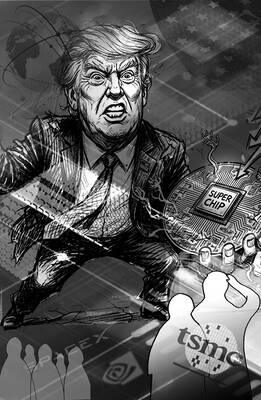
The White House’s decision to take a 9.9 percent stake in Intel Corp is looking like very shrewd business indeed. Since the government bought in at US$20.47 a share last August, the US chipmaker’s surging stock price has delivered the US a US$43 billion return. One of the reasons the investment has so far proved so sound is that the White House has made sure of it. According to The Wall Street Journal, Howard personally pushed deals on Intel’s behalf with some of the most lucrative clients imaginable. They include Nvidia Corp, the company at the heart of the AI
In a Taiwanese university classroom, a lecturer asks in English: “Can anyone give me an example from Taiwan?” Students look down. No one answers. After class, one student writes on the course platform in Mandarin: “I understood the concept, but I didn’t know how to answer in English.” That moment highlights a key issue in Taiwan’s English-medium instruction (EMI) reform: It is not just about more English-taught courses, but whether students can learn, participate and belong. EMI expansion is part of the Bilingual 2030 policy and the Ministry of Education’s BEST Program, aiming to improve English ability, support EMI teaching
The Ministry of the Interior, working with the navy and coast guard, is organizing Taiwan’s first joint exercise simulating escort tankers carrying liquefied natural gas (LNG) and oil through a Chinese blockade. The drills simulate fuel transport along three maritime corridors leading toward Japan, the Philippines and the US. Deputy Minister of the Interior Sawyer Mars (馬士元) said that a blockade of the Taiwan Strait would amount to “almost a 100 percent blockade of the regional energy supply.” Minister of National Defense Wellington Koo said planning to counter a blockade is standard practice in Taipei. While the exercise is limited in
A single photograph can cut through a lot of noise, but it can also be used to misrepresent the truth. At the very least, it can concentrate the mind on something that requires further investigation. On Monday last week, Ma Ying-jeou Foundation CEO Tai Hsia-ling (戴遐齡) and former National Security Council secretary-general King Pu-tsung (金溥聰) held a news conference in which they showed a photograph of former foundation CEO Hsiao Hsu-tsen (蕭旭岑), now Chinese Nationalist Party (KMT) deputy chairman. In the image Hsiao is seated next to Xiamen Taiwan Businessmen Association chairman Han Ying-huan (韓螢煥). The two men were holding


 RSS
RSS