


By the end of this year, the G7 aim to launch an “open, cooperative international Climate Club” to foster coordinated action to achieve the Paris climate agreement’s maximum-warming target of 1.5°C without leaving anyone at a competitive disadvantage. Although we have been hearing calls for international climate action for decades, there is good reason to think that this time will be different.
The Climate Club is the brainchild of German Chancellor Olaf Scholz, whose proposal is based on four premises. First, international climate action needs to be broad-based and consistent, with all club members aiming for the same objectives. Second, countries should be allowed to pursue these common objectives in their own ways, as long as everyone abides by “a uniform measurement of carbon dioxide content of products and materials.” Third, developing countries should receive support to achieve the common objective. And, lastly, having to compete against cheaper, more carbon-intensive methods should not put “climate policy pioneers” at a disadvantage in the global marketplace.
This proposal might sound like a rehash of past policies, but it fundamentally shifts the focus in policy design. Historically, we have viewed climate policy in only two dimensions: the climate and the economy. This has led to a focus on ideas like global carbon pricing, which makes a lot of sense in strictly economic terms. Polluters emit excessive amounts of carbon dioxide into the atmosphere, because the costs are imposed on society. The solution therefore is to ensure that polluters pay.
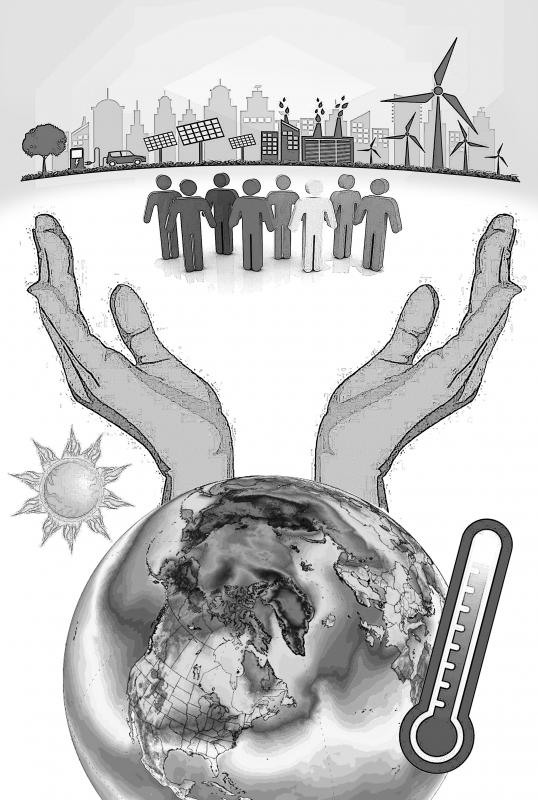
Illustration: Constance Chou
The problem is that citizens often oppose such policies, especially if there is no mechanism to compensate those who are disadvantaged by the higher costs, such as low-income households that cannot afford basic goods at environmentally friendly prices, or those working in carbon-intensive sectors. Moreover, the costs associated with carbon pricing are not just economic, but also social. Even if the proceeds from a carbon tax are spent on the poor and the displaced, fossil fuel-reliant communities might collapse, and some people might feel as though they are no longer shaping their own futures.
These were some of the lessons of the 2018-2019 French “yellow vest” protests, which erupted in response to a modest increase in the tax on diesel fuel. A similar problem has long plagued the global climate-policy debate. Low and middle-income countries resent being asked by rich, industrialized countries — the biggest emitters historically — to pay more for the energy they need for development. To acknowledge these potential ramifications is to move from an abstract two-dimensional world to a three-dimensional one that is closer to the reality we inhabit.
While the two-dimensional world of economic models can be measured in terms of GDP and carbon prices, the real world requires different metrics to account for the full meaning of any policy. To that end, one of us (Snower) and Katharina Lima de Miranda have proposed a metric with the acronym SAGE: solidarity, agency, gain, environment.
Here, solidarity refers to the extent of social inclusion and cohesion, agency refers to people’s ability to shape their own lives, and gain and environment refer to traditional measures of economic output and environmental sustainability respectively. A solidarity score increases when there is more social trust, generosity and so forth, and an agency score increases when people report greater confidence in their ability to achieve worthwhile goals. By broadening the scope beyond GDP growth, SAGE allows us to recouple the links between economic policies and social well-being.
As a new way to discuss and evaluate climate policies, the SAGE model can help us understand why some past climate policies have not worked. Traditional carbon pricing, for example, has often failed the solidarity test, by creating winners and losers (economically and socially), as well as the agency test, by ignoring people’s voices in the process.
One of the yellow vests’ grievances, for example, was that the unaffordability of French urban life forced many workers to live outside the cities, where limited public transit options forced them to drive to work. The protesters felt a lack of solidarity and agency, because they had little choice in where they lived or how they got around.
Only by accounting for people’s social needs — alongside economic and environmental needs — will we be able to advance viable policy reforms. That brings us back to the G7’s proposed club model. If correctly implemented, it can accommodate social factors alongside economic and environmental factors, succeeding where similar past efforts have failed.
The Climate Club would promote “cooperation between countries that want to press ahead with the social and economic transformation needed to tackle climate change,” Scholz said.
The result, in practice, would be a partnership in which participants commit to ambitious, well-defined climate goals, as well as to the specific domestic measures that are required to reach those goals. Scholz’s team acknowledges that wealthy countries that have emitted the most carbon historically are in a different position than others. They refer to “common, but differentiated responsibilities and respective capabilities” — one of the core principles of the 1992 UN Framework Convention on Climate Change. The Climate Club thus appreciates the different demands that a common set of goals places on different countries, and that this calls for “intensive cooperation on industrial transformation and capacity-building.”
By encouraging countries to shape their climate policies in accordance with their socioeconomic realities, the Climate Club is well-positioned to avoid some of the problems that led to the yellow vest protests. However, to succeed, it must be maximally ambitious (aiming for the 1.5°C target), maximally inclusive and maximally permissive in the policy pathways that it opens up. It is this flexibility that will help developed and developing countries work together, listen to one another’s perspective, and learn from it. If it works, the club could create a worldwide ripple effect, offering much-needed hope that the fight against climate change can be won.
Avram Alpert is a fellow at The New Institute and a lecturer at Princeton University. Dennis Snower is president of the Global Solutions Initiative, president emeritus of the Kiel Institute for the World Economy, and a non-resident fellow at the Brookings Institution.
Copyright: Project Syndicate
A gap appears to be emerging between Washington’s foreign policy elites and the broader American public on how the United States should respond to China’s rise. From my vantage working at a think tank in Washington, DC, and through regular travel around the United States, I increasingly experience two distinct discussions. This divergence — between America’s elite hawkishness and public caution — may become one of the least appreciated and most consequential external factors influencing Taiwan’s security environment in the years ahead. Within the American policy community, the dominant view of China has grown unmistakably tough. Many members of Congress, as
The shifting geopolitical tectonic plates of this year have placed Beijing in a profound strategic dilemma. As Chinese President Xi Jinping (習近平) prepares for a high-stakes summit with US President Donald Trump, the traditional power dynamics of the China-Japan-US triangle have been destabilized by the diplomatic success of Japanese Prime Minister Sanae Takaichi in Washington. For the Chinese leadership, the anxiety is two-fold: There is a visceral fear of being encircled by a hardened security alliance, and a secondary risk of being left in a vulnerable position by a transactional deal between Washington and Tokyo that might inadvertently empower Japan
After declaring Iran’s military “gone,” US President Donald Trump appealed to the UK, France, Japan and South Korea — as well as China, Iran’s strategic partner — to send minesweepers and naval forces to reopen the Strait of Hormuz. When allies balked, the request turned into a warning: NATO would face “a very bad” future if it refused. The prevailing wisdom is that Trump faces a credibility problem: having spent years insulting allies, he finds they would not rally when he needs them. That is true, but superficial, as though a structural collapse could be caused by wounded feelings. Something
Former Taipei mayor and Taiwan People’s Party (TPP) founding chairman Ko Wen-je (柯文哲) was sentenced to 17 years in prison on Thursday, making headlines across major media. However, another case linked to the TPP — the indictment of Chinese immigrant Xu Chunying (徐春鶯) for alleged violations of the Anti-Infiltration Act (反滲透法) on Tuesday — has also stirred up heated discussions. Born in Shanghai, Xu became a resident of Taiwan through marriage in 1993. Currently the director of the Taiwan New Immigrant Development Association, she was elected to serve as legislator-at-large for the TPP in 2023, but was later charged with involvement


 RSS
RSS