


One reason scientists are so fascinated with black holes is that they grab hold of the fabric of time and space, slowing time to a crawl as matter swirls toward a point of no return. That black holes play tricks with time was what captured the imagination of Lia Medeiros, a postdoctoral fellow at the Institute for Advanced Study, and part of the team that used an array of eight telescopes to create the first image of matter swirling around the supermassive black hole at the center of the Milky Way.
Medeiros was still a high-school student when she first read that black holes distort time — and decided to find a way to make studying them her life’s work.
Not only does time slow down near a supermassive black hole, but theoretically, inside it, time and space would somehow switch places. Efforts to understand black holes could lead scientists to a more encompassing understanding of the rest of our universe, and of its still-mysterious origin.
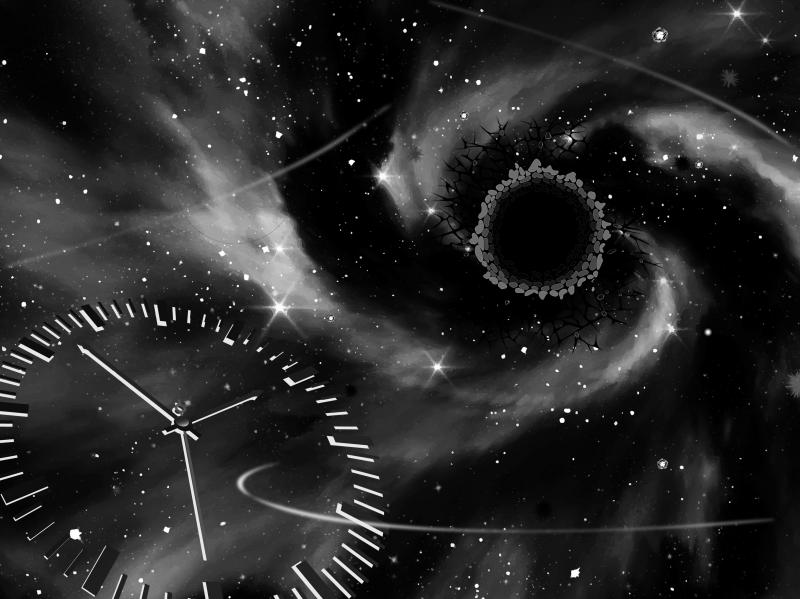
Illustration: Louise Ting
The ambitious black hole imaging project is called the Event Horizon Telescope because it is meant to peer as closely as possible at the boundary beyond which even light cannot escape the black hole’s gravitational pull. Eight telescopes positioned around the world work together to create each image.
In 2019, the same team unveiled a similar bright doughnut of matter swirling around a much bigger, but more distant supermassive black hole in the center of a galaxy called M87.
While both images took years of work and a team of more than 300 scientists, our own galaxy’s black hole presented a bigger challenge. While the black hole itself has a mass equivalent to 4 million suns, the glowing donut in the image spans a relatively tiny region of space, smaller than the size of Mercury’s orbit. It is also 27,000 light years away and shrouded in a thick haze of gas and dust.
Medeiros said that to take their photo, they picked a particular wavelength in the radio spectrum that penetrated this thick wall of dust — similar to the way X-rays penetrate the human body.
MIND-BLOWING
As one of the theorists on the team, she helped figure out which wavelength would get them closest to the actual event horizon of the black hole, which is named Sagittarius A because it is in the constellation Sagittarius, although it is vastly farther away than the stars that make up the shape.
A mass of 4 million suns is mind-blowing, but this black hole is not a freak of nature. That appears to be typical of the hearts of all but the tiniest galaxies. And yet nobody is quite sure when or how they formed.
That is, it is not known whether Sagittarius A got so big by consuming 4 million stars, or whether it was born from a lump in the primordial matter of the universe, after which stars began to light up around it. Or perhaps black holes and galaxies take shape together.
Our black hole is relatively quiet, which is why it was so hard to get a photo of anything up close to it.
Team member Feryal Ozel of the University of Arizona called it “our gentle giant.”
Other black holes, far away, are engaged in much more violent, visible activity. The action of stars getting ripped up and pulled into the event horizon creates light that shines at us from the far reaches of the cosmos, and gives us a glimpse back to an earlier phase in the evolution of the universe.
QUIET PHASE
Our black hole is in a quiet phase right now, said Avi Loeb, a professor of astrophysics at Harvard.
That is because it has consumed most of the material within its range.
However, it could burst into new activity when our galaxy merges with our neighbor, Andromeda, shaking things up and bringing new stars and matter close enough to be pulled inside.
That will not happen for another several billion years.
Black holes, like the origin of the universe, are considered singularities because time and space become curved to infinity. When cosmologists talk about the Big Bang, they extrapolate our expanding universe backward in time until everything becomes infinitely dense and space infinitely curved. The mass of the universe would get packed into an infinitely small pinpoint.
However, many physicists see this as a sign that what is really happening can only be described with laws of physics that are yet to be discovered.
It is at the Big Bang and in black holes that the laws of physics start to falter — their behavior cannot be described by Einstein’s relativity, which works at large scales, or quantum mechanics, which rules things on microscale.
While it is said that nature abhors a vacuum, Princeton University cosmologist James Peebles says that physicists abhor singularities.
“We hope the universe has a similar distaste,” said Peebles, who won a Nobel Prize in physics in 2019.
When you extrapolate back in time, you start to calculate “arbitrarily high temperature, arbitrarily high space curvature ... that’s a bad thing, we think,” he said.
Bad, that is, meaning that it means our laws of physics are not complete, but good in that it leaves the door open for new theories that could be more revealing, more complete, and even useful to us here on Earth.
Faye Flam is a Bloomberg Opinion columnist covering science. She is host of the “Follow the Science” podcast.
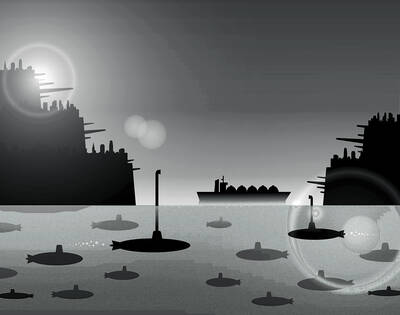
In the event of a war with China, Taiwan has some surprisingly tough defenses that could make it as difficult to tackle as a porcupine: A shoreline dotted with swamps, rocks and concrete barriers; conscription for all adult men; highways and airports that are built to double as hardened combat facilities. This porcupine has a soft underbelly, though, and the war in Iran is exposing it: energy. About 39,000 ships dock at Taiwan’s ports each year, more than the 30,000 that transit the Strait of Hormuz. About one-fifth of their inbound tonnage is coal, oil, refined fuels and liquefied natural gas (LNG),

To counter the CCP’s escalating threats, Taiwan must build a national consensus and demonstrate the capability and the will to fight. The Chinese Communist Party (CCP) often leans on a seductive mantra to soften its threats, such as “Chinese do not kill Chinese.” The slogan is designed to frame territorial conquest (annexation) as a domestic family matter. A look at the historical ledger reveals a different truth. For the CCP, being labeled “family” has never been a guarantee of safety; it has been the primary prerequisite for state-sanctioned slaughter. From the forced starvation of 150,000 civilians at the Siege of Changchun
The two major opposition parties, the Chinese Nationalist Party (KMT) and the Taiwan People’s Party (TPP), jointly announced on Tuesday last week that former TPP lawmaker Chang Chi-kai (張啟楷) would be their joint candidate for Chiayi mayor, following polling conducted earlier this month. It is the first case of blue-white (KMT-TPP) cooperation in selecting a joint candidate under an agreement signed by their chairpersons last month. KMT and TPP supporters have blamed their 2024 presidential election loss on failing to decide on a joint candidate, which ended in a dramatic breakdown with participants pointing fingers, calling polls unfair, sobbing and walking
In the opening remarks of her meeting with Chinese President Xi Jinping (習近平) in the Great Hall of the People in Beijing on Friday, Chinese Nationalist Party (KMT) Chairwoman Cheng Li-wun (鄭麗文) framed her visit as a historic occasion. In his own remarks, Xi had also emphasized the history of the relationship between the KMT and the Chinese Communist Party (CCP). Where they differed was that Cheng’s account, while flawed by its omissions, at least partially corresponded to reality. The meeting was certainly historic, albeit not in the way that Cheng and Xi were signaling, and not from the perspective


 RSS
RSS