


The US Department of State’s 2021 Country Reports on Human Rights Practices, released on Tuesday last week, called Taiwan’s criminal libel laws a “human rights issue” that the government should address.
The report said that journalists in Taiwan face online abuse and are subject to criminal lawsuits due to the Criminal Code, which contains “provisions that allow the subjects of unfavorable press coverage to press criminal and civil charges directly against journalists and media outlets for defamation,” the Central News Agency reported on Thursday last week.
Fear of legal repercussions from reporting facts that could be viewed as harmful to someone’s reputation means that sources often speak anonymously to journalists in Taiwan, and reporters omit key facts. This results in reporting that frequently lacks substance, is anecdotal or reads like hearsay.
Reporters Without Borders last year ranked Taiwan 43rd out of 180 countries for media freedom — down two spots from the previous ranking — and said that “Taiwan’s journalists are suffering from a very polarized media environment dominated by sensationalism and the pursuit of profit,” and “few concrete measures have been taken to improve journalists’ editorial independence and encourage media to raise the quality of the public debate.”
Self-censorship extends beyond reporters to society at large, as people limit dissenting public opinions to general statements or use fake social media accounts. There have even been cases of private citizens getting hit with defamation lawsuits after leaving unflattering reviews about businesses online.
Many Taiwanese might say that public insults and targeted speech should not be considered “free speech,” and lawsuits dealing with libel or defamation should be handled as civil cases. Few defamation lawsuits in Taiwan result in jail time, but it is worrisome that the law calls for “up to two years imprisonment” for defamation, particularly when the law is ambiguously worded and could be subjectively interpreted.
There is no published list of what a person can or cannot say about another person in Taiwan. Instead, the law simply says that an offense has occurred if a defendant is found “pointing out or disseminating a fact that will injure the reputation of another.” That means a person’s freedom is at the mercy of a judge’s opinion.
What if someone has an argument with their neighbor and takes them to court on the grounds that “mean things were said” in front of other people? A judge could decide that the plaintiff’s reputation was harmed, and potentially sentence a person to two years in jail over it.
Libel laws exist for legitimate reasons. For instance, a restaurant owner should be able to file a civil case against someone who tells others that their chef poisons the food.
However, calling someone names for supporting a particular political candidate is an opinion that should not be subject to criminal charges.
There are innumerable such cases every year in Taiwan. It is a waste of public funds and other resources. Physical assault, sexual abuse, theft, fraud — such cases should be a court’s priority, not ones in which feelings were hurt.
Taiwan has made great progress in repealing the criminalization of adultery and recognizing same-sex marriage rights. Reform of libel and defamation laws should be next on lawmakers’ agendas.
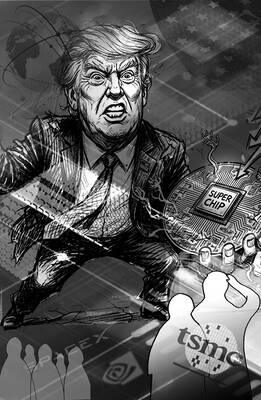
The White House’s decision to take a 9.9 percent stake in Intel Corp is looking like very shrewd business indeed. Since the government bought in at US$20.47 a share last August, the US chipmaker’s surging stock price has delivered the US a US$43 billion return. One of the reasons the investment has so far proved so sound is that the White House has made sure of it. According to The Wall Street Journal, Howard personally pushed deals on Intel’s behalf with some of the most lucrative clients imaginable. They include Nvidia Corp, the company at the heart of the AI
The Ministry of the Interior, working with the navy and coast guard, is organizing Taiwan’s first joint exercise simulating escort tankers carrying liquefied natural gas (LNG) and oil through a Chinese blockade. The drills simulate fuel transport along three maritime corridors leading toward Japan, the Philippines and the US. Deputy Minister of the Interior Sawyer Mars (馬士元) said that a blockade of the Taiwan Strait would amount to “almost a 100 percent blockade of the regional energy supply.” Minister of National Defense Wellington Koo said planning to counter a blockade is standard practice in Taipei. While the exercise is limited in
A single photograph can cut through a lot of noise, but it can also be used to misrepresent the truth. At the very least, it can concentrate the mind on something that requires further investigation. On Monday last week, Ma Ying-jeou Foundation CEO Tai Hsia-ling (戴遐齡) and former National Security Council secretary-general King Pu-tsung (金溥聰) held a news conference in which they showed a photograph of former foundation CEO Hsiao Hsu-tsen (蕭旭岑), now Chinese Nationalist Party (KMT) deputy chairman. In the image Hsiao is seated next to Xiamen Taiwan Businessmen Association chairman Han Ying-huan (韓螢煥). The two men were holding
I first met Professor Ray Jiing (井迎瑞) as a film and documentary student at Shih Hsin University’s (SHU) Department of Radio Television and Film in 1988. The following year, he went on to become the director of the Chinese Taipei Film Archive — forerunner of the Taiwan Film and Audiovisual Institute (TFAI). Over his eight-year tenure, Jiing rescued and restored over 200 classic Taiwanese films. In 1997, he established the Graduate Institute of Studies in Documentary and Film Archiving at Tainan National University of the Arts (TNNUA), and I joined the program in his third cohort of students. Beyond a


 RSS
RSS