


Ukrainian Prime Minister Denys Shmyhal recently called payments for Russian energy “blood money,” underscoring the increasingly untenable moral position of the West. Leading global democracies express outrage over the atrocities committed by Russian forces in Ukraine, but provide Moscow with hundreds of billions of dollars it can put toward its military efforts.
Bloomberg Economics estimates that, due to higher prices, Russia is on track to earn US$320 billion from its energy sales this year, up more than one-third from last year. This disconnect will become politically unsustainable, particularly given a prospective Russian offensive in eastern Ukraine likely to be jaw-dropping in its brutality.
Western policymakers are struggling with ways to punish Russia amid significant energy market uncertainty. For a way out of this dilemma, they should draw on policy innovations from a decade ago, designed largely in reaction to Iran’s nuclear pursuits.
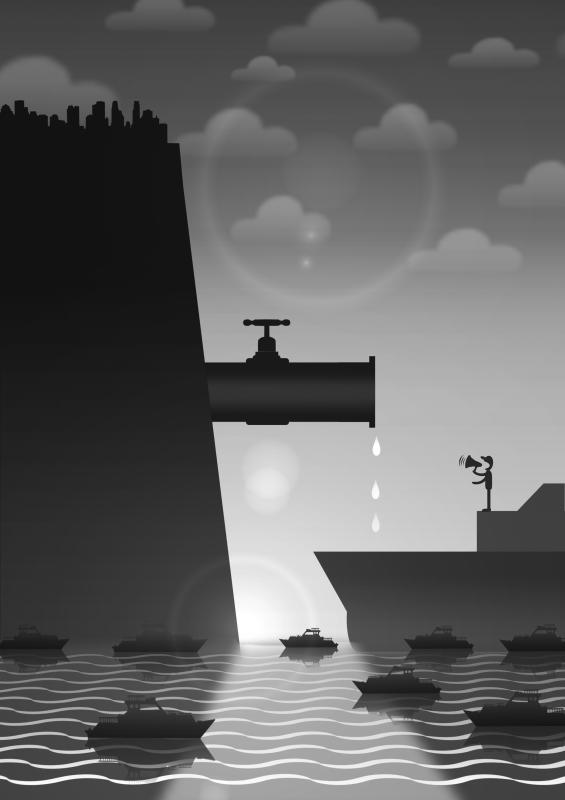
Illustration: Yusha
The wave of sanctions against Moscow is still cresting. In response to Ukrainian entreaties, major oil-trading houses such as Vitol and Trafigura announced they would carry out existing contractual obligations, but not take on any new business related to Russian oil. Earlier this month, the EU and Japan agreed independently to ban the purchase of Russian coal.
European officials have acknowledged they would continue to discuss further curtailment of Russian energy imports, although member states are divided about what costs to bear in their quest to increase pressure on Russian President Vladimir Putin.
While most of the focus has been on European imports of natural gas, the purchase of Russian oil would be the next shoe to drop. Focusing on oil, while difficult, is easier and can have a greater impact than concentrating on gas.
Historically, Russia made US$4 in oil export revenues for every US$1 it made from selling natural gas abroad. (This ratio of oil-to-gas dollars dropped to three-to-one last year because of extremely high natural gas prices.) Targeting oil sales is going for the Russian jugular.
Moreover, given that the market for oil is global and it is a commodity easily shipped from one location to another, managing a European (but not global) ban on Russian oil sales should be less painful. At least in theory, Russian oil shunned by Europe could make its way to other markets, displacing that of non-Russian producers which would work its way to Europe, minimizing the pain at the pump.
For some, this fungibility of oil is a drawback rather than a virtue of a potential ban on European imports. India is aggressively purchasing Russian oil shunned by other buyers. In a virtual meeting last week, US President Joe Biden reportedly counseled Indian Prime Minister Narendra Modi not to increase India’s dependence on Russian energy.
In this view, the steep discounts offered by Russia to lubricate the sales mean that a European ban would somewhat reduce — but not staunch — revenue flows to Moscow. As a result, particularly if China were to buy more Russian oil, the main impact of a European ban would be to absolve EU countries from directly funding the war effort, rather than to cripple Russia financially.
For others, the main concern over a European ban on Moscow’s oil has to do with its consequences for the global economy, not with its impact on Russia. Europe buys about one-half of Russia’s crude oil and petroleum products. An abrupt disruption of these flows could jolt energy markets, given uncertainty about how quickly, fully and seamlessly the oil market would rejigger oil-trade flows.
OPEC secretary-general Mohammed Barkindo told EU officials on Monday last week that “it would be nearly impossible to replace a loss of this magnitude” when speaking of a potential removal of Russian oil exports from the market.
The price of oil is down from earlier spikes, mostly thanks to a huge release from the US Strategic Petroleum Reserve and from COVID-19-induced slowdowns in China’s economy, leading to revisions of China’s expected oil demand this year. Prices could shoot back up if more Russian oil comes off the market. The Oxford Institute for Energy Studies estimates that disrupting one-half of Russia’s oil exports, about the amount Europe purchases every day, could push oil prices to US$160 per barrel by the summer.
These reservations about a ban on Russian oil purchases are valid, but they would not annul a deep unease over continuing energy relationships with Russia as its forces assault eastern Ukraine.
Fortunately, there are more options than doing nothing or risking the state of the global economy. One, already embraced by Europe to some extent, is to declare a ban on imports of Russian energy that would phase in over the course of the coming months or the remainder of the year. In addition to the new ban on coal, Germany said it might stop purchases of Russian oil by the end of the year.
Another option under consideration is creating an escrow account into which a portion of the proceeds of any sale of Russian oil would go, above some price viewed as sufficient to motivate continued Russian sales.
Such measures might seem insufficiently ambitious or too self-serving in the weeks ahead, putting pressure on political leaders to do more.
The US, too, would be urged to do more, even though the Biden administration already terminated US purchases of Russian energy. Members of the US Congress are speaking about “secondary sanctions” — penalties on third parties (such as corporations or banks) that continue transactions with Russia in a way that strengthens some specified element of the state. Energy purchases fall firmly into that category.
Uncertainty is always a challenge for policymakers, but in this instance the uncertainty is epic, particularly in the face of rising emotions over Russia’s atrocities and accusations of genocide.
When faced with scenarios that are plausible but widely divergent, good policymakers often ask whether there are tools or strategies that might prove useful if either situation materializes. This time should be no different.
US policymakers are fortunate that their country is a sanctions superpower. This superlative applies not only in the sense that the US uses sanctions more often and more aggressively than any other power. It has also experimented with sanctions, employing creative ideas in the past that serve as suggestions for the future.
Secondary sanctions have generally been associated with US overreach and allied outrage, as they are often seen as an example of the US using its economic power when its diplomacy has failed to bring others on board. This need not be the case.
The secondary sanctions that have been used to dissuade countries and companies from buying Iranian oil might offer some useful lessons for today. The sanctions incorporated into the US National Defense Authorization Act (NDAA) in 2012 proposed a series of mechanisms that allowed policymakers to calibrate the pressure put on Iranian oil flows depending on the state of the market and political realities.
In 2012, Arab revolutions were sweeping the Middle East, and oil prices had been hovering near US$100 for a couple of years. With the high prices and the world still moving out of the Great Recession, officials in then-US president Barack Obama’s administration and elsewhere were reluctant to isolate Iran, one of the world’s largest suppliers of crude, from the global oil market without some significant safeguards.
The defense authorization law recognized this and required that the administration make periodic reports to Congress about the state of the oil market. The president had to provide regular determinations whether oil markets were sufficiently supplied to continue with sanctions. (Given Saudi cooperation to stabilize oil markets and booming shale oil production in the US at the time, the administration never needed to use the provision to pause sanctions.)
In addition, the act created what became known as “significant reduction exemptions” from the sanctions. The Obama administration could employ these waivers for countries that had made progress in significantly reducing dependence on Iranian oil.
This package allowed the White House great discretion and led to exemptions for some of the US’ treaty allies, such as Japan and South Korea, as well as for non-allies including China and India. The legislation also included the usual national-security waiver, which gives the executive branch the option to declare that suspending sanctions in a particular case would be in the national interest.
As pressure grows in Washington for more economic penalties on Russia, and for secondary sanctions in particular, Congress would be wise to consider these innovations from 2012. They could give the Biden administration the flexibility needed to diminish reliance on Russian energy.
Imagine, for instance, that Biden and Modi had discussed sanctions provisions like those used with Iran in the 2012 NDAA. Biden could have allayed any (legitimate) fears that tightening oil markets could spiral out of control, by assuring the prime minister that he had necessary tools to ratchet back any US sanctions if oil markets seemed too tight.
Rather than giving Modi the stark choice between secondary sanctions or the full severing of India’s energy relationship with Russia, Biden could have elicited a more gradual and more realistic Indian move away from Russia.
Sanctions are often called a “blunt instrument.” They do not need to be.
Meghan O’Sullivan is a Bloomberg Opinion columnist. She is a professor of international affairs at Harvard University’s Kennedy School, the North American chair of the Trilateral Commission, and a member of the board of directors of the Council on Foreign Relations and the board of Raytheon Technologies. She served on the US National Security Council from 2004 to 2007. This column does not necessarily reflect the opinion of the editorial board or Bloomberg LP and its owners.
Chinese actor Alan Yu (于朦朧) died after allegedly falling from a building in Beijing on Sept. 11. The actor’s mysterious death was tightly censored on Chinese social media, with discussions and doubts about the incident quickly erased. Even Hong Kong artist Daniel Chan’s (陳曉東) post questioning the truth about the case was automatically deleted, sparking concern among overseas Chinese-speaking communities about the dark culture and severe censorship in China’s entertainment industry. Yu had been under house arrest for days, and forced to drink with the rich and powerful before he died, reports said. He lost his life in this vicious
A recent trio of opinion articles in this newspaper reflects the growing anxiety surrounding Washington’s reported request for Taiwan to shift up to 50 percent of its semiconductor production abroad — a process likely to take 10 years, even under the most serious and coordinated effort. Simon H. Tang (湯先鈍) issued a sharp warning (“US trade threatens silicon shield,” Oct. 4, page 8), calling the move a threat to Taiwan’s “silicon shield,” which he argues deters aggression by making Taiwan indispensable. On the same day, Hsiao Hsi-huei (蕭錫惠) (“Responding to US semiconductor policy shift,” Oct. 4, page 8) focused on

George Santayana wrote: “Those who cannot remember the past are condemned to repeat it.” This article will help readers avoid repeating mistakes by examining four examples from the civil war between the Chinese Communist Party (CCP) forces and the Republic of China (ROC) forces that involved two city sieges and two island invasions. The city sieges compared are Changchun (May to October 1948) and Beiping (November 1948 to January 1949, renamed Beijing after its capture), and attempts to invade Kinmen (October 1949) and Hainan (April 1950). Comparing and contrasting these examples, we can learn how Taiwan may prevent a war with
In South Korea, the medical cosmetic industry is fiercely competitive and prices are low, attracting beauty enthusiasts from Taiwan. However, basic medical risks are often overlooked. While sharing a meal with friends recently, I heard one mention that his daughter would be going to South Korea for a cosmetic skincare procedure. I felt a twinge of unease at the time, but seeing as it was just a casual conversation among friends, I simply reminded him to prioritize safety. I never thought that, not long after, I would actually encounter a patient in my clinic with a similar situation. She had


 RSS
RSS