


There is no way of knowing whether Russian President Vladimir Putin has spent the past decade preparing for Russia’s invasion of Ukraine, but it is known that US President Joe Biden warned that the Ukrainian crisis was around the corner and that he was ready for a meeting with Putin in what would have been a last-ditch effort at diplomacy over the Ukraine tensions.
Biden issued a stark warning, vowing that it would be “a disaster for Russia” if it invaded Ukraine. However, when Washington started sounding the alarm about Russia’s impending attack, Europeans were in no mood to listen, with one EU diplomat even describing Biden’s warning as “warmongering.”
The US got the intelligence right, and Biden was certainly not making a false claim. As early as December last year, the Biden administration authorized a US$200 million military assistance package for Ukraine.
In the months before the invasion, White House officials began working on a strategy to counter Putin. They made multiple trips to meet their European counterparts, while Biden made regular telephone calls to European leaders, sharing confidential information.
By engaging in negotiations and mediations, the US has formed a democratic defense alliance with its European partners. While Ukrainians’ fierce resistance has played a significant role in derailing the Kremlin’s invasion, the US’ crucial role in diplomacy cannot be ignored.
The US-led alliance has dealt a significant blow to Russia, making Putin admit that inflation and unemployment would rise in his country.
However, the fly in the ointment is China.
The New York Times reported that prior to the Beijing Winter Olympics in early February, Chinese President Xi Jinping (習近平) met with Putin and asked him to delay the invasion until after the Games had finished.
Despite China’s vehement denial, there is sufficient evidence of China’s alignment with Russia.
On the opening day of the Olympics, the two powerful autocrats issued a joint statement, saying that “friendship between the two states has no limits, no forbidden areas of cooperation.”
They promised to stand with each other, to endorse each other’s respective territorial ambitions in Taiwan and Ukraine, and to collaborate against the West.
Another example came on the day before the invasion, when a Chinese Ministry of Foreign Affairs spokesperson told a news conference that the US is responsible for the Ukraine tensions.
When the invasion had begun and the UN voted on a resolution to condemn Russia’s actions, China unsurprisingly abstained.
These events and their inherent logic shed light on the March 18 talks between Biden and Xi, regardless of the their interpretation by Chinese state media and pro-China media in Taiwan.
After the two-hour talks, which were initiated by Washington, the US and China released their respective statements.
The White House issued a terse readout saying that Russia would pay a steep price for its unprovoked invasion of Ukraine and reinforced Biden’s warning of serious consequences if China provided material aid to Putin’s war effort.
It ended with: “The President reiterated that US policy on Taiwan has not changed, and emphasized that the United States continues to oppose any unilateral changes to the status quo.”
The Chinese readout selectively quoted Biden’s remarks, not mentioning one word of his warning, and accentuated that Biden “does not support ‘Taiwan independence.’”
The talks were not primarily about Taiwan, and it is obvious that Xi was using the opportunity to put words in Biden’s mouth to facilitate a bid for the extension to his own rule.
After the talks, international media unanimously pointed out that the US and China were “singing different tunes” and “coming up with their own interpretations.”
The odd thing was that a certain pro-China outlet in Taiwan used the readout issued by China’s Xinhua news agency and published a front page article under the headline: “Biden-Xi engaged in feverish talks of Taiwan, Biden: US does not support Taiwan independence.”
No fervent discussion happened in the first place, and the fact that the Taiwanese outlet used an even more tawdry title than Xinhua was contemptible.
Would Biden really say “no” to Taiwan independence?
On March 11, one week before the talks with Xi, Biden signed the Department of State, Foreign Operations, and Related Programs Appropriations Act, which includes a ban on the use of any maps by the US Department of State and its foreign operations that “inaccurately” depict Taiwan as part of China.
The act stipulates that “none of the funds made available by this act should be used to create, procure, or display any map that inaccurately depicts the territory and social and economic system of Taiwan and the islands or island groups administered by Taiwan authorities.”
Consequently, any US map published by a state department-affiliated agency must mark Taiwan in a different color than China.
Asked about the US’ stance on Taiwan’s status in November last year following a telephone call with Xi, Biden said: “They have to decide — Taiwan, not us. We are not encouraging independence.”
In light of these events, is Biden really “against” Taiwan independence?
It is no surprise that Xinhua barks for the Chinese Communist Party, but it is a shame that pro-China media in Taiwan are doing the same.
Chin Heng-wei is a political commentator.
Translated by Rita Wang
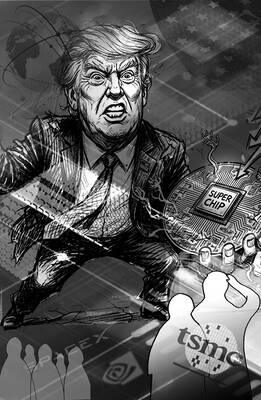
The White House’s decision to take a 9.9 percent stake in Intel Corp is looking like very shrewd business indeed. Since the government bought in at US$20.47 a share last August, the US chipmaker’s surging stock price has delivered the US a US$43 billion return. One of the reasons the investment has so far proved so sound is that the White House has made sure of it. According to The Wall Street Journal, Howard personally pushed deals on Intel’s behalf with some of the most lucrative clients imaginable. They include Nvidia Corp, the company at the heart of the AI
A single photograph can cut through a lot of noise, but it can also be used to misrepresent the truth. At the very least, it can concentrate the mind on something that requires further investigation. On Monday last week, Ma Ying-jeou Foundation CEO Tai Hsia-ling (戴遐齡) and former National Security Council secretary-general King Pu-tsung (金溥聰) held a news conference in which they showed a photograph of former foundation CEO Hsiao Hsu-tsen (蕭旭岑), now Chinese Nationalist Party (KMT) deputy chairman. In the image Hsiao is seated next to Xiamen Taiwan Businessmen Association chairman Han Ying-huan (韓螢煥). The two men were holding
I first met Professor Ray Jiing (井迎瑞) as a film and documentary student at Shih Hsin University’s (SHU) Department of Radio Television and Film in 1988. The following year, he went on to become the director of the Chinese Taipei Film Archive — forerunner of the Taiwan Film and Audiovisual Institute (TFAI). Over his eight-year tenure, Jiing rescued and restored over 200 classic Taiwanese films. In 1997, he established the Graduate Institute of Studies in Documentary and Film Archiving at Tainan National University of the Arts (TNNUA), and I joined the program in his third cohort of students. Beyond a
A recent report concerning a student who is suing his teacher posed the question in its headline: Does failing a student in two subjects constitute bullying? The college student in Chiayi County apparently sought NT$2 million (US$63,603) in state compensation, but a court dismissed the case. The first reaction of many might have been to ask: What has happened to students nowadays? Some say that teachers have lost their authority, while others say students are overindulged. Some even start reminiscing over the days when “whatever the teacher says goes.” However, the real issue might be overlooked if emotional reactions like that are the


 RSS
RSS