


Step up military recruitment
I am writing regarding the articles titled “Dual-language defense report released” and “Retired officer outlines path to extending service term” (both on Nov. 10, page 3).
Though these articles are imparting some important steps that the Taiwanese military has and should take, the fact that the military is communicating better with its allies and acquiring up-to-date equipment does not matter, because there is still a huge staffing problem.
Who will maintain, operate and use this new equipment if the military cannot recruit more personnel?
It is also important to note that it was a huge mistake getting rid of mandatory military service without a plan to fill the void that this created. More money and time should be spent making a military career something that youth see as a good choice.
A Taiwanese Foreign Legion should also be formed. This unit should be modeled after the French Foreign Legion. Many foreigners would jump at the chance to serve in the Taiwanese military, especially if it leads to citizenship. It is also imperative that a reasonable mandatory military service is reinstated. Taiwan should emulate the Israeli system. In other words, both men and women should serve for at least two years.
Taiwanese people need to start taking national defense more seriously. Otherwise, Taiwan will just be a province of the People’s Republic of China.
Paul Garrelfs
Toronto, Canada
KMT’s sexist comments
The video recording of Minister of Health and Welfare Chen Shih-chung (陳時中) singing in a bar with his mask off was clearly recorded on June 15 last year, long before any of the recent pandemic prevention measures were in place, and yet certain people have sought to twist the facts and say that the scene happened when the nation was under level 3 restrictions.
A certain Chinese Nationalist Party (KMT) legislator added to the issue by making extremely sexist comments.
KMT Legislator Lai Shyh-bao (賴士葆) said that a woman in the clip “had long hair, so must have been an escort of some sort.” This was an extremely sexist assumption, as if to say that any woman seen in a hotel environment must be there simply to look pretty and ask the right questions.
It is a tired stereotype. Other people grow their hair long, it is a personal choice whether you do or not. What if there had been a man there with long hair?
Of course, there is little surprise that a sexist comment would emanate from the mouth of a member of the KMT. Remember when former KMT chairman Wu Den-yih (吳敦義) called then-Presidential Office secretary-general Chen Chu (陳菊) a “fat sow”?
Or how about when former Kaohsiung mayor Han Kuo-yu (韓國瑜) said that “a man’s life is his lower body; a woman’s life is her upper body,” suggesting that a woman’s strength was directed primarily at her need to apply makeup over long drawn-out periods.
These are just two examples of the chauvinism that appears to be ingrained in the party culture.
Lai has yet to apologize, neither has the KMT released any statement criticizing him for his lies. The party gets zero points for sexual equality.
Lai Yen-cheng
Taipei
Justice for Chinese officials
I note with amusement the spokesperson of China’s Taiwan Affairs Office stating that certain Taiwanese officials would face criminal charges presumably if China seized control of Taiwan.
I would suggest that when the Chinese Communist Party (CCP) is overthrown in China and democracy and freedom reign in the country, many current CCP figures, including President for Life Xi Jinping (習近平), should find themselves before the International Court of Justice on numerous charges of crimes against humanity.
These people would be aware of this of course and know that the only way to protect themselves from criminal charges is to maintain their abhorrent totalitarian regime in situ.
However, hopefully one day, justice will knock on their door.
Gavan Duffy
Queensland, Australia
A gap appears to be emerging between Washington’s foreign policy elites and the broader American public on how the United States should respond to China’s rise. From my vantage working at a think tank in Washington, DC, and through regular travel around the United States, I increasingly experience two distinct discussions. This divergence — between America’s elite hawkishness and public caution — may become one of the least appreciated and most consequential external factors influencing Taiwan’s security environment in the years ahead. Within the American policy community, the dominant view of China has grown unmistakably tough. Many members of Congress, as
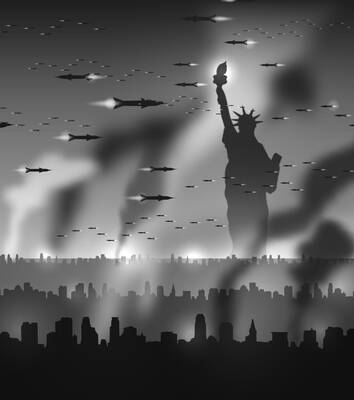
After declaring Iran’s military “gone,” US President Donald Trump appealed to the UK, France, Japan and South Korea — as well as China, Iran’s strategic partner — to send minesweepers and naval forces to reopen the Strait of Hormuz. When allies balked, the request turned into a warning: NATO would face “a very bad” future if it refused. The prevailing wisdom is that Trump faces a credibility problem: having spent years insulting allies, he finds they would not rally when he needs them. That is true, but superficial, as though a structural collapse could be caused by wounded feelings. Something
Former Taipei mayor and Taiwan People’s Party (TPP) founding chairman Ko Wen-je (柯文哲) was sentenced to 17 years in prison on Thursday, making headlines across major media. However, another case linked to the TPP — the indictment of Chinese immigrant Xu Chunying (徐春鶯) for alleged violations of the Anti-Infiltration Act (反滲透法) on Tuesday — has also stirred up heated discussions. Born in Shanghai, Xu became a resident of Taiwan through marriage in 1993. Currently the director of the Taiwan New Immigrant Development Association, she was elected to serve as legislator-at-large for the TPP in 2023, but was later charged with involvement
Out of 64 participating universities in this year’s Stars Program — through which schools directly recommend their top students to universities for admission — only 19 filled their admissions quotas. There were 922 vacancies, down more than 200 from last year; top universities had 37 unfilled places, 40 fewer than last year. The original purpose of the Stars Program was to expand admissions to a wider range of students. However, certain departments at elite universities that failed to meet their admissions quotas are not improving. Vacancies at top universities are linked to students’ program preferences on their applications, but inappropriate admission


 RSS
RSS