


The past few months have made for a strange chapter in Taiwan’s hydrological history, as reservoirs parched as recently as June are overflowing due to the heavy rains of the past few weeks.
During the recent unprecedented low water levels in reservoirs nationwide, the government mobilized a special task force to assist in clearing out sediment clogging the reservoirs in the hope that this would increase storage capacity.
Taiwan’s reservoirs have changed over the past two decades. The 921 Earthquake of 1999 loosened soil in the mountains, causing landslides; Typhoon Mindulle in July 2004 dumped torrential rainfall in central Taiwan, causing the highest levels of sedimentation Taichung’s Deji Reservoir (德基水庫) had ever seen; the next month, Typhoon Aere drenched Taoyuan with 970mm of rain in a single day, causing landslides upstream of the Shihmen Reservoir (石門水庫), filling it with sediment and reducing its storage capacity by 27 million tonnes; Typhoon Morakot in 2009 hit southern Taiwan, unleashing 17 million cubic meters of sediment into the Nanhua Reservoir (南化水庫), reducing its water capacity by more than one-third.
When I first visited Nanhua Reservoir in 2016, managers there told me that this event had been a severe blow for the reservoir. Taiwan Water Corp (Taiwater) had commissioned National Chiao Tung University Disaster Prevention and Water Environment Research Center to examine the sediment it accumulated and perform 3D imaging of the reservoir’s bottom.
The simplest way to restore capacity levels when turbidity currents — sediment-laden dense flows along the reservoir bottom — appear, or when the water is sediment-laden but approaching capacity level, is to open up the bottom outlets and release the water at high pressure.
The costliest method would be to dredge the upper and middle reaches of the river during a water shortage and to send the dredged sediment by truck to a landfill. Sediment is of no use or value, and the reservoirs are all at high altitudes, making transportation difficult, costing NT$250 to NT$400 (US$8.92 to US$14.28) per tonne to transport, with no means to recoup the money. Other problems include public disturbance from laden trucks shuttling back and forth, and landfills being difficult to find.
In March 2017, I accompanied President Tsai Ing-wen (蔡英文) to the Zengwen Reservoir (曾文水庫) to observe the Water Resources Agency’s work in the three most silted-up reservoirs — Shihmen, Zengwen and Nanhua — for sediment bypassing projects that routed incoming sediment around or through the dam to minimize sediment deposition. At almost NT$10 billion for the work, it was an expensive way to control sediment accumulation.
For more than a decade, the Shihmen, Zenghua, Nanhua and Mudan (牡丹水庫) reservoirs have been using sand dredgers to extract sediment. Taiwater rates have remained low for a long time. To increase profit, the company has been improving this process, with the rate of solids per weight increasing from 10 percent to almost 30 percent.
The second time I visited the Nanhua Reservoir, it was full, and I advised management to make use of the capacity to open the bottom outlets and flush out the sediment using pressure from the water’s weight.
Taiwater’s annual plan for 2017 was to flush out 100,000 tonnes of sediment from the Nanhua Reservoir, and I asked my colleagues to open the gates and flush out 1 million tonnes over a 24-hour period, regardless of the cost, so long as the reservoir was almost at full capacity. Consequently, the Nanhua Reservoir was able to expunge as much as 6.7 million tonnes over the course of the year, the most on record.
I told my colleagues that this was the new way forward. So long as the extraction rate was sufficiently high, and it was conducted when there was plentiful rainfall and the water levels were high, increasing the speed at which the sediment would be flushed out, there would be an opportunity to achieve a balance between the amount of sediment coming in and the amount being flushed out.
Taiwan is likely to experience a lot of rain this year, and all the major reservoirs plan to increase the deployment of dredgers. They should at the same time open the bottom outlets to flush out sediment, rather than let the dams overflow. This will extend the lives of the dams.
Kuo Chun-ming is chairman of the Chinese Taiwan Water Works Association and a former president of Taiwan Water Corp.
Translated by Paul Cooper
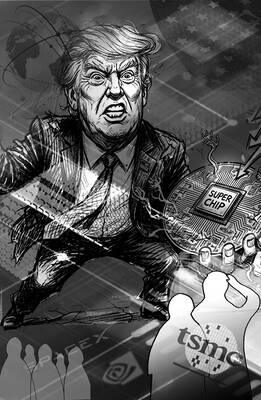
The White House’s decision to take a 9.9 percent stake in Intel Corp is looking like very shrewd business indeed. Since the government bought in at US$20.47 a share last August, the US chipmaker’s surging stock price has delivered the US a US$43 billion return. One of the reasons the investment has so far proved so sound is that the White House has made sure of it. According to The Wall Street Journal, Howard personally pushed deals on Intel’s behalf with some of the most lucrative clients imaginable. They include Nvidia Corp, the company at the heart of the AI
A single photograph can cut through a lot of noise, but it can also be used to misrepresent the truth. At the very least, it can concentrate the mind on something that requires further investigation. On Monday last week, Ma Ying-jeou Foundation CEO Tai Hsia-ling (戴遐齡) and former National Security Council secretary-general King Pu-tsung (金溥聰) held a news conference in which they showed a photograph of former foundation CEO Hsiao Hsu-tsen (蕭旭岑), now Chinese Nationalist Party (KMT) deputy chairman. In the image Hsiao is seated next to Xiamen Taiwan Businessmen Association chairman Han Ying-huan (韓螢煥). The two men were holding
I first met Professor Ray Jiing (井迎瑞) as a film and documentary student at Shih Hsin University’s (SHU) Department of Radio Television and Film in 1988. The following year, he went on to become the director of the Chinese Taipei Film Archive — forerunner of the Taiwan Film and Audiovisual Institute (TFAI). Over his eight-year tenure, Jiing rescued and restored over 200 classic Taiwanese films. In 1997, he established the Graduate Institute of Studies in Documentary and Film Archiving at Tainan National University of the Arts (TNNUA), and I joined the program in his third cohort of students. Beyond a
President William Lai Ching-te’s (賴清德) May 20 second-anniversary address was not just a routine policy review; it was damage control. US President Donald Trump’s remarks — that he did not want to see anyone move toward independence and that the delivery of a major Taiwan arms package could depend on the progress of US-China relations — unsettled Taiwan’s public and created an opening for opposition parties to question whether Taiwan was being treated as a bargaining chip in Washington’s dealings with Beijing. Lai’s speech was designed to close that opening. The address covered the expected ground: sovereignty, cross-strait relations, defense spending,


 RSS
RSS