


When the first reports surfaced of a mysterious disorder that was afflicting dozens of US diplomats in Cuba, Mike Beck’s reaction was one of recognition and relief.
Beck, a retired US National Security Agency (NSA) counterintelligence officer, was at his home in Maryland, scrolling through the day’s news on his computer when he spotted the story, and remembers shouting out to his wife.
“I got excited because I thought: ‘Well, it’s coming out now that it’s not a mirage,’” Beck said. “I felt bad for the victims, but thought: ‘Now I’m no longer one of one. I’m one of many.’”
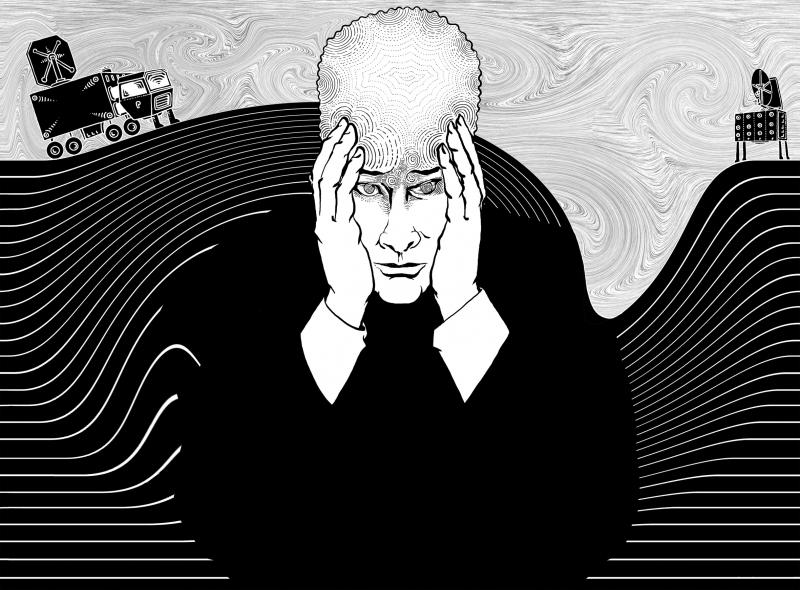
Illustration: Mountain People
Beck had been forced into retirement in late 2016 by a rare early-onset, non-tremor form of Parkinson’s disease, and he had evidence, supplied by the NSA and the CIA, that he could have been the victim of a deliberate attack from a microwave weapon.
After years of lonely struggle, he now feels vindicated.
In December last year, the National Academy of Sciences published a report finding that the scores of CIA and US Department of State officials affected by “Havana syndrome” in Cuba, China and elsewhere were most likely suffering the “effects of directed, pulsed radio frequency energy.”
After years of playing down the reports and failing to provide proper medical care for the victims, Washington is now clearly alarmed at the implications of the attacks.
‘PATTERN’
The Democratic and Republican leadership on the US Senate Select Committee on Intelligence on Friday last week put out a statement, saying: “This pattern of attacking our fellow citizens serving our government appears to be increasing.”
The statement came the day after the White House said that it was looking into “unexplained health incidents” after reports that two of its own officials had been targeted in the Washington area.
The CIA and state department have launched task forces to investigate, and it was reported last week that the Pentagon had launched its own inquiry into suspected microwave attacks on US troops in the Middle East.
Last month, US National Security Council Senior Director for the Western Hemisphere Juan Gonzalez in an interview with CNN’s Spanish-language service voiced concern over the lingering risk to US diplomats from microwave weapons in Cuba.
What is so striking about Beck’s case is that its origins were two decades earlier — and that it produced official confirmation more than eight years ago that such weapons had been developed by the US’ adversaries.
That raises more questions about why the CIA and state department were so reluctant to believe their own officers could have been targeted by such weapons when cases appeared in Cuba and then China in 2018, and elsewhere around the world.
“The reality is that this has been an intelligence community issue for decades,” said Mark Zaid, a lawyer representing Beck and Havana Syndrome victims.
An NSA statement declassified in 2014 for Beck’s work injury compensation case stated: “The National Security Agency confirms that there is intelligence information from 2012 associating the hostile country to which Mr Beck traveled in the late 1990’s, with a high-powered microwave system weapon that may have the ability to weaken, intimidate or kill an enemy, over time, and without leaving evidence.”
“The 2012 intelligence information indicated that this weapon is designed to bathe a target’s living quarters in microwaves, causing numerous physical effects, including a damaged nervous system,” it said.
Beck is still not allowed to name the hostile country he visited in 1996, but said he and a colleague, Charles “Chuck” Gubete, had gone to make sure a US diplomatic building under construction was not bugged.
“It was a sensitive assignment,” Beck told reporters. “So we knew what we were getting into from the standpoint of the hostile country being a critical threat environment.”
On arrival, he and Gubete were detained at the airport, and then put up in adjoining rooms in a budget hotel after their release.
On their second day on the project, they expanded their sweep to a neighboring building and came across what he calls “a technical threat to the equity we were there to protect.”
They reported the device to their superiors and left it in place.
The next day, they were passed a message from a local translator working with the Americans that the host country authorities, in Beck’s words, “had seen what we did and that was not a good thing.”
The next day, Beck said: “I woke up and I was really, really groggy. I was not able to wake up routinely. It was not a normal event. I had several cups of coffee and that didn’t do a thing to get me going.”
The symptoms passed by the time Beck and Gubete returned to the US.
However, 10 years later, when Beck was in the UK, on secondment to the British General Communications Headquarters, he came down suddenly with crippling symptoms.
“The right side of my body started freezing up. I was limping and I couldn’t move my arm,” he said.
He was referred to a neurologist, who diagnosed Parkinson’s.
At the time, Beck was 45.
SHOCK
Shortly afterward, he was visiting NSA headquarters and happened to bump into Gubete. Beck was shocked by what he saw.
“He was walking like an old man,” he said. “He was slumped over and walking really awkwardly. I went up to him and said: ‘What’s going on?’”
Within a few days, Gubete, 55 at the time, was diagnosed with the same form of Parkinson’s disease as Beck.
“I’ve worked in counterintelligence for the predominance of my career,” Beck said. “I thought this is not coincidental that we’re both presenting the same variant of Parkinson’s at the same time. This is not happenstance.”
The cause of their shared plight was a total mystery to Beck until 2012, when he saw US intelligence communications about a microwave weapon with potentially debilitating neurological effects developed by the country he and Gubete visited together.
He was able to get part of that intelligence declassified for his US Department of Labor claim in 2014, but by then it was too late for Gubete. He had died at home of a suspected heart attack the previous year.
Even with the declassified intelligence, the NSA leadership continued to oppose Beck’s claim, so he arranged a briefing by CIA experts who came to NSA headquarters in the spring of 2016.
“Their opinion was based upon information that they had — and that the NSA didn’t have access to — and they supported my affirmation that I had been attacked in the hostile country with a microwave weapon,” Beck said. “They said it was a ‘no-brainer’ that this medical condition was due to an attack.”
On Aug. 24, 2016, according to Beck and his lawyer, then-head of NSA security and counterintelligence Kemp Ensor sent an e-mail to then-NSA chief of staff Liz Brooks supporting Beck’s account.
The NSA did not respond to a request for comment.
There are still many unanswered questions about the Beck case. Gubete had a family history of Parkinson’s, and any causal effect between microwave radiation and the disease, which differs from the more recent cases, is unknown.
However, it is clear from the Beck case that when the wave of Havana syndrome injuries began in 2016, US intelligence agencies knew much more that they admitted to.
It took a three-year campaign by CIA and state department employees targeted by the attacks to have their illnesses taken seriously, to receive proper treatment and for the mysterious attacks to be properly investigated.
“That it’s taken me three years to get treatment is disgraceful, ethically and morally,” said Marc Polymeropoulos, a former senior officer in the CIA’s clandestine service. “You make a pact when you join the Central Intelligence Agency — particularly in the operations side, the silent service. They asked me to do some really unusual and risky things over the years, in some pretty bad places, but you always had a pact with your leadership that if you got jammed up, they would have your back.”
Polymeropoulos was visiting Moscow in 2017, as deputy chief of operations of the CIA’s Europe and Eurasia Mission Center, when he experienced crippling symptoms of an attack.
“I was woken up in the middle of the night with an incredible case of vertigo,” he said. “My head was spinning, incredible nausea, I felt like I had to go to the bathroom and throw up. It was just a terrifying moment for me. I had tinnitus which was ringing in my ears, and the vertigo was really what was incredibly debilitating and I really wasn’t sure what was happening. I couldn’t stand up. I was falling over.”
“Since that incident, I have had a headache 24/7 for three years, and there’s a mental health challenge in this, too,” Polymeropoulos said. “I was able to work for two hours every morning, but then I’d be spent. Even having a conversation like this, I would be exhausted after that.”
RUSSIA SUSPECTED
He is convinced that Russia is behind the attacks, and also says he is certain that Russia is the unnamed country in the Beck case.
In 1996, the US was in the process of tearing down the top two stories of its Moscow embassy because the building was so full of bugging devices. Four new floors were constructed with the aim of creating a secure environment.
CIA Director William Burns last month told the US Congress that he was taking the problem seriously and that he had appointed a senior officer to run a task force “ensuring people get the care they deserve and need, and also making sure we get to the bottom of this.”
Polymeropoulos, who is now being treated at Walter Reed military hospital and is pushing for other CIA victims to get similar treatment, said he was cautiously optimistic.
“Under Bill Burns, there seems to be a sea change. We have to see actions now, not just words, but I have hope,” he said.
Meanwhile, a quarter-century after his ill-fated trip to a hostile nation, Beck is still fighting for workers’ compensation.
The labor department has turned down his claim, but the one-year window for appeal is still open.
“I’m not suing anyone,” he said. “I’m just looking for what’s right out of this.”

The term “assassin’s mace” originates from Chinese folklore, describing a concealed weapon used by a weaker hero to defeat a stronger adversary with an unexpected strike. In more general military parlance, the concept refers to an asymmetric capability that targets a critical vulnerability of an adversary. China has found its modern equivalent of the assassin’s mace with its high-altitude electromagnetic pulse (HEMP) weapons, which are nuclear warheads detonated at a high altitude, emitting intense electromagnetic radiation capable of disabling and destroying electronics. An assassin’s mace weapon possesses two essential characteristics: strategic surprise and the ability to neutralize a core dependency.
Chinese President and Chinese Communist Party (CCP) Chairman Xi Jinping (習近平) said in a politburo speech late last month that his party must protect the “bottom line” to prevent systemic threats. The tone of his address was grave, revealing deep anxieties about China’s current state of affairs. Essentially, what he worries most about is systemic threats to China’s normal development as a country. The US-China trade war has turned white hot: China’s export orders have plummeted, Chinese firms and enterprises are shutting up shop, and local debt risks are mounting daily, causing China’s economy to flag externally and hemorrhage internally. China’s
During the “426 rally” organized by the Chinese Nationalist Party (KMT) and the Taiwan People’s Party under the slogan “fight green communism, resist dictatorship,” leaders from the two opposition parties framed it as a battle against an allegedly authoritarian administration led by President William Lai (賴清德). While criticism of the government can be a healthy expression of a vibrant, pluralistic society, and protests are quite common in Taiwan, the discourse of the 426 rally nonetheless betrayed troubling signs of collective amnesia. Specifically, the KMT, which imposed 38 years of martial law in Taiwan from 1949 to 1987, has never fully faced its
When a recall campaign targeting the opposition Chinese Nationalist Party (KMT) legislators was launched, something rather disturbing happened. According to reports, Hualien County Government officials visited several people to verify their signatures. Local authorities allegedly used routine or harmless reasons as an excuse to enter people’s house for investigation. The KMT launched its own recall campaigns, targeting Democratic Progressive Party (DPP) lawmakers, and began to collect signatures. It has been found that some of the KMT-headed counties and cities have allegedly been mobilizing municipal machinery. In Keelung, the director of the Department of Civil Affairs used the household registration system


 RSS
RSS