


China constantly seeks out ways to complain about perceived slights and provocations as pretexts for its own aggressive behavior. It is both victimization paranoia and a form of information warfare that keeps the West on the defensive. True to form, China objected even to the innocuous reference to Taiwan at April 16’s summit meeting between US President Joe Biden and Japanese Prime Minister Yoshihide Suga.
Neither leader’s prepared remarks even mentioned Taiwan, out of deference to the Japanese side. Biden’s opening statement was modest: “Prime Minister Suga and I affirmed our ironclad support for US-Japanese alliance and for our shared security. We committed to working together to take on the challenges from China, and on issues like the East China Sea, the South China Sea, as well as North Korea to ensure a future of a free and open Indo-Pacific.”
Yet, a Reuters story the day before the meeting was headlined: “Biden, Suga Poised to Present a United Front on Taiwan as China Steps Up Pressure.” Citing “a senior US administration official, who spoke on the condition of anonymity,” it said the two leaders “are expected to agree on a joint statement on the Chinese-claimed, but democratically ruled island at Biden’s first in-person meeting with a foreign leader.”
They did agree on a statement, but it said only this about Taiwan: “We underscore the importance of peace and stability across the Taiwan Strait and encourage the peaceful resolution of cross-strait issues.”
Given the heightened tensions over China’s escalating threats and military moves against Taiwan and the implications for Japan’s own security, it might be characterized as minimally resolute language. The formulation is virtually identical to a US-Japan statement 16 years earlier when the threat from China was not nearly as pronounced as it is today. In February 2005, then-US secretary of state Condoleezza Rice and secretary of defense Donald Rumsfeld hosted their defense and foreign affairs counterparts in the US-Japan Security Consultative Committee (the “2 plus 2” meeting). That produced a terse call for the two governments to “encourage the peaceful resolution of issues concerning the Taiwan Strait through dialogue.”
White House officials seemed eager to characterize last month’s similarly anodyne statement as a groundbreaking event in US-Japan-Taiwan relations. It was the first time a Japanese prime minister joined a US president in mentioning Taiwan since Tokyo and Washington officially recognized the People’s Republic of China in 1972 and 1979, respectively.
On cue, Beijing responded to the boilerplate preference for “peace and stability” with its ritualistic protest: “Taiwan, Hong Kong and Xinjiang belong to China’s internal affairs. The East China Sea and the South China Sea concern China’s territorial integrity and maritime rights and interests. These matters bear on China’s fundamental interests and allow no interference. We express strong concern and firm opposition to relevant comments in the Joint Leaders’ Statement.”
Given the current widespread concern that the Taiwan flashpoint could suddenly explode into a US-China conflict in Japan’s backyard, is such vacuous language the strongest deterrent message the two allies could muster? Far more tepid than Washington’s own supportive statements and actions on Taiwan under both the administrations of former US president Donald Trump and Biden, it reflects Japan’s continuing public reticence on dealing with Beijing.
Close economic relations with China obviously inhibit Japan from challenging its powerful and hostile neighbor, but as Beijing’s encroachment on the Japanese-administered Senkaku Islands (Diaoyutai Islands, 釣魚台) repeatedly demonstrates, a posture of self-imposed restraint invites China to escalate its moves — a lesson that aggressive powers taught the world in the 20th century.
On the Senkakus, Tokyo recognized the need for strategic clarity to provide deterrence against Chinese adventurism. It urgently sought, and received, a public commitment that the US security guarantee would extend to those uninhabited rocks.
Yet, when it comes to Taiwan and its 24 million democratic inhabitants with shared values and cultural and historical bonds, Japan shies away from joining with the US in an open commitment to resist Chinese aggression. The joint ambiguity simply encourages Beijing to keep pushing the military envelope — with a strategic miscalculation or accident just waiting to happen.
Tokyo has good reason to know Taiwan’s strategic significance in the region, having occupied it as a colony for 50 years under Imperial Japan. The island played a critical role in launching the Japanese Empire’s war in the Pacific. On Dec. 7, 1941, the day it bombed Pearl Harbor with planes from carriers at sea, Japan attacked the Philippines with aircraft flown from Formosa — which US general Douglas MacArthur dubbed the “unsinkable aircraft carrier.”
Throughout World War II, Japan’s forces used Taiwan as a staging area and logistics base for its military campaigns in Southeast Asia. It would be an incalculably valuable asset for China to pursue its current ambitions to control the entire South China Sea, and to threaten democratic Japan as well.
At the joint press conference, neither of the two US reporters on whom Biden called chose to ask about the subject at hand, conveniently shifting the discussion instead to gun control and Iran. The first Japanese journalist selected, on the other hand, went right to the heart of the matter before the two leaders.
He asked Suga: “Both governments consider that peace and stability of Taiwan is of great importance, and that has been the agreement between the two countries. What kinds of exchange of views were conducted on this matter at today’s meeting? In order to deter contingency in the straits, what can Japan do, and what can Japan do when actual contingency occurs in the Taiwan straits? Did the prime minister explain to President Biden what Japan can do under such circumstances?”
Suga replied: “As we engaged in an exchange of views over the regional situation, we also discuss[ed] the circumstances in Taiwan... I refrain from mentioning details, since it pertains to diplomatic exchanges, but there is already an agreed recognition over the importance of peace and stability of the Taiwan Strait between Japan and the United States, which was reaffirmed on this occasion.”
Only the participants know whether the almost hour’s delay in starting the news conference related to the two sides’ last-minute negotiations over the language on Taiwan, but it is reasonable to assume that Washington would welcome a more full-throated Japanese posture on the critical need for democratic Taiwan to survive and thrive. Enthusiastic domestic press coverage of the event suggests that the Japanese people support a more forward-looking official policy on Taiwan. Enactment of a Japanese version of the US’ Taiwan Relations Act would be a good place for Tokyo to start.
Joseph Bosco, who served as China country director in the office of the US secretary of defense, is a fellow of the Institute for Taiwan-American Studies and a member of the Global Taiwan Institute’s advisory committee.
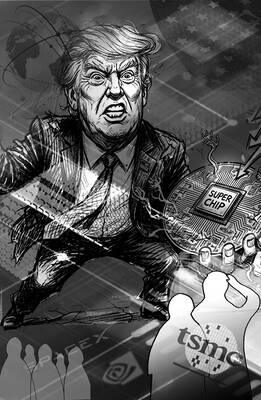
The White House’s decision to take a 9.9 percent stake in Intel Corp is looking like very shrewd business indeed. Since the government bought in at US$20.47 a share last August, the US chipmaker’s surging stock price has delivered the US a US$43 billion return. One of the reasons the investment has so far proved so sound is that the White House has made sure of it. According to The Wall Street Journal, Howard personally pushed deals on Intel’s behalf with some of the most lucrative clients imaginable. They include Nvidia Corp, the company at the heart of the AI
The Ministry of the Interior, working with the navy and coast guard, is organizing Taiwan’s first joint exercise simulating escort tankers carrying liquefied natural gas (LNG) and oil through a Chinese blockade. The drills simulate fuel transport along three maritime corridors leading toward Japan, the Philippines and the US. Deputy Minister of the Interior Sawyer Mars (馬士元) said that a blockade of the Taiwan Strait would amount to “almost a 100 percent blockade of the regional energy supply.” Minister of National Defense Wellington Koo said planning to counter a blockade is standard practice in Taipei. While the exercise is limited in
A single photograph can cut through a lot of noise, but it can also be used to misrepresent the truth. At the very least, it can concentrate the mind on something that requires further investigation. On Monday last week, Ma Ying-jeou Foundation CEO Tai Hsia-ling (戴遐齡) and former National Security Council secretary-general King Pu-tsung (金溥聰) held a news conference in which they showed a photograph of former foundation CEO Hsiao Hsu-tsen (蕭旭岑), now Chinese Nationalist Party (KMT) deputy chairman. In the image Hsiao is seated next to Xiamen Taiwan Businessmen Association chairman Han Ying-huan (韓螢煥). The two men were holding
In a Taiwanese university classroom, a lecturer asks in English: “Can anyone give me an example from Taiwan?” Students look down. No one answers. After class, one student writes on the course platform in Mandarin: “I understood the concept, but I didn’t know how to answer in English.” That moment highlights a key issue in Taiwan’s English-medium instruction (EMI) reform: It is not just about more English-taught courses, but whether students can learn, participate and belong. EMI expansion is part of the Bilingual 2030 policy and the Ministry of Education’s BEST Program, aiming to improve English ability, support EMI teaching


 RSS
RSS