


A High Court judge on March 23 denied bail for former Hong Kong legislator Andrew Wan (尹兆堅) and sent him back to Lai Chi Kok prison.
“Keep going,” Wan shouted as he was led away by guards. “The Department of Justice will be judged by heaven.”
Wan was one of 36 democracy advocates denied bail and being kept in custody more than one month after being arraigned on charges of conspiracy to commit subversion for organizing an unofficial primary election.
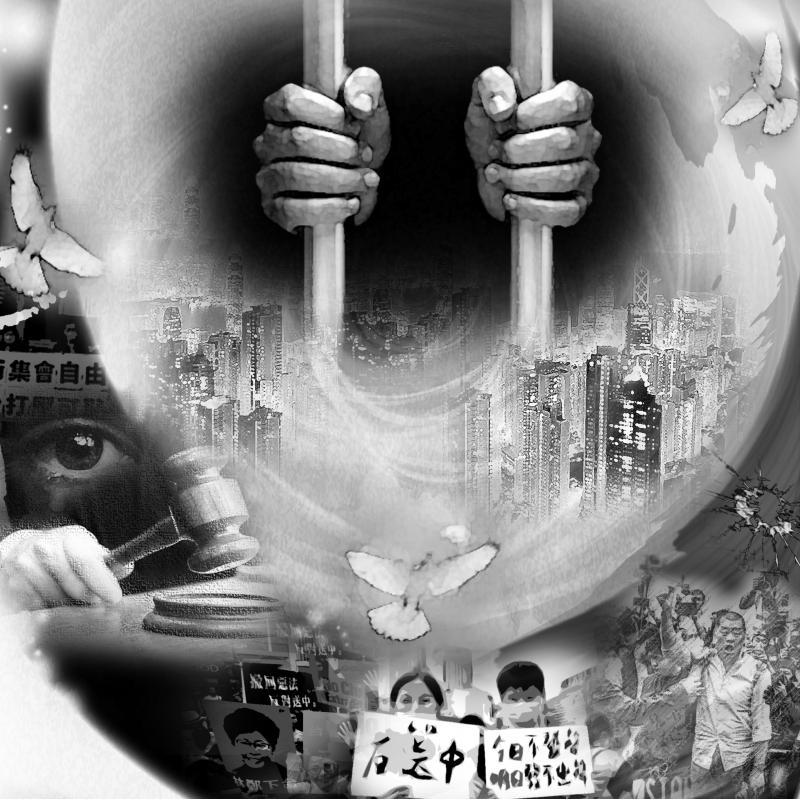
Illustration: Kevin Sheu
Forty-seven were charged overall, in the biggest crackdown on the territory’s opposition since a National Security Law was imposed by China in June last year. Only 11 have been granted bail. The next appearance in court for all the defendants is scheduled for May 31.
The legal saga has stunned many in Hong Kong, who say it is a dramatic display of how the legislation is radically altering the territory. The sweeping law punishes acts of subversion, secession, terrorism or colluding with foreign forces by up to life in prison.
The bail process is ongoing.
In a hearing on Wednesday last week, former Hong Kong legislator Claudia Mo (毛孟靜), also a former journalist, was denied in her second attempt to seek bail.
The hearings started at West Kowloon Magistrates’ Courts on March 1. Over the next four days, the defendants were subjected to more than 40 hours of hearings, denied a change of clothes throughout and initially denied a shower. Ten were taken to hospital, some suffering from physical exhaustion.
At least 12 of the 47 announced on social media that they would no longer be involved in politics and some resigned their positions. Some deleted their Facebook pages, including four members of the pro-democracy Civic Party.
In an open letter published on Friday last week, the four called for the party to disband.
“Please forgive us for our withdrawal from the party and our proposal for dissolution,” they wrote in the letter. “Everyone’s peace and safety is what we care about deeply in our hearts.”
Several district councilors, who deal with local issues such as public transport links and garbage collection, also said publicly that they would quit.
They include Gary Fan (范國威), who said on Facebook that he was in remand and could no longer perform his district councilor duties.
Fan in a March 17 post added that it was his “lifetime aspiration” to participate in politics and “improve people’s livelihoods, strive for democracy, speak up for social justice.”
In the courtroom next door to the marathon hearings, at times some of the defendants’ families and supporters wept as they watched the proceedings via live video link.
Legal experts and government critics say the arduous proceedings are part of a campaign to crush Hong Kong’s democracy movement after protests in 2019, which shook the territory and presented the Chinese Communist Party with its most serious popular challenge since the Tiananmen Square uprising in 1989.
Leaders in Beijing and Hong Kong have said the protests plunged the territory into an unprecedented crisis and posed a grave security risk.
Hong Kong Chief Executive Carrie Lam (林鄭月娥) on Thursday last week said that the national security legislation “has effectively restored stability in our society and helped Hong Kong get out of the shadow of violence.”
The defendants’ ordeal is highly unusual in Hong Kong, one active judge and two retired judges said.
The territory long took pride in the independence of its British-style judicial system. Now, the current and former judges said, the bail proceedings — herding opposition figures into a single courtroom for days, and depriving them of sleep and other basic rights — have marked a dramatic departure from the common law tradition of Hong Kong, developed over 156 years of British rule.
“I think what has happened is most unsatisfactory in terms of both the treatment of the defendants and the efficiency of the process,” said Simon Young (楊艾文), a barrister and law professor at the University of Hong Kong. “We can ask whether it was necessary to charge everyone at the same time and process them all together.”
“It was appalling what went on,” one of the retired Hong Kong judges said. “A judge is a master of his courtroom. He has full discretion on sensible timing and the right to request the people appearing before him are being properly looked after. I just cannot fathom how this was allowed to go so terribly wrong.”
Some in the territory supported the way the case was handled and backed the denial of bail for many of the defendants.
“It is enshrined in Article 42 of the National Security Law that defendants shall not be granted bail unless the court is convinced that they will not continue to commit offenses against the National Security Law,” pro-Beijing Hong Kong Legislator Holden Chow (周浩鼎) said. “The court rightly handled the entire legal procedure and the bail arrangement for these accused, in accordance with the law.”
Article 42 of the legislation states: “No bail shall be granted to a criminal suspect or defendant unless the judge has sufficient grounds for believing that the criminal suspect or defendant will not continue to commit acts endangering national security.”
That provision establishes a high threshold for defendants to demonstrate they would not break the law if granted bail. It is a departure from the Hong Kong Bill of Rights Ordinance, which states that detaining defendants should not be the general rule, except where there are clear risks of a defendant committing further offenses or absconding.
Where there is a conflict, the national security legislation supersedes all local laws in effect in Hong Kong.
The application of the legislation means defendants could spend months in custody before trials begin.
One active judge said that the bail hearings were reminiscent of “show trials” used by China and other autocracies to publicly humiliate and ultimately break political opponents. The judge, who sits in the magistrates court, spoke on condition of anonymity.
“In China, it’s far worse, but worse is coming in Hong Kong,” said Jerome Cohen, a professor at New York University and an expert in Chinese law.
Hong Kong authorities over the past year have disqualified democracy advocates from public office and snuffed out protests, and they have jailed prominent democracy advocates such as Joshua Wong (黃之鋒) and media tycoon Jimmy Lai (黎智英).
Lai on Friday last week was sentenced to a total of 14 months in prison for two separate charges of unauthorized assembly.
China is also overhauling the territory’s electoral system to ensure only people it deems “patriots” can govern Hong Kong.
The Chinese government did not respond to questions.
The Hong Kong Department of Justice, which decides who is to be prosecuted, said in a statement that as a general principle, “prosecutions would only be commenced if there is sufficient admissible evidence to support a reasonable prospect of conviction and if it is in the public interest to do so.”
The conduct of the bail hearing drew an unusual response from the Hong Kong Judiciary, the independent institution responsible for upholding the rule of law.
The judiciary said that it was “reviewing the overall arrangements of handling cases involving a large number of litigants and observers at all levels of courts.”
It directed Reuters to a statement it made on March 5, released the day after the four-day bail proceedings, in which it said Hong Kong Chief Justice Andrew Cheung (張舉能) had ordered the review.
The appraisal was being done “with a view to adopting improvement measures,” including with regard to scheduling of hearings and court sitting hours, the judiciary said.
Cohen said that the March 5 statement revealed “the enormous, unprecedented challenges that the prosecution inflicted on the courts in this case.”
The 47 face charges of conspiracy to commit subversion for organizing and taking part in a primary election in July last year to select the pro-democracy candidates most likely to win a seat in the Hong Kong Legislative Council in an election scheduled for September last year.
The charge sheet alleges that the defendants tried to bring about the dissolution of the Legislative Council so as to paralyze the operations of the government, and ultimately force the Hong Kong chief executive to resign.
Beijing and Hong Kong authorities regarded the democracy movement’s primary-election strategy as unacceptable.
Hong Kong Secretary for Security John Lee (李家超), called it a “premeditated plan to sink Hong Kong into an abyss.”
In July last year, the Hong Kong government announced that it was postponing the election because of the COVID-19 pandemic. Last week, it set the election for Dec. 19.
The courtroom ordeal started at about noon on March 1, as the 47 defendants were taken into court by about a dozen police officers in olive-green uniforms, and seated on plastic chairs inside a glass dock and two long wooden benches just outside it.
The long rectangular room — with beige wood paneling, high ceilings and Hong Kong’s red bauhinia flower emblem — was packed with the defendants and their lawyers.
Relatives of the defendants, journalists and some foreign diplomats watched a live video link in the courtroom next door.
Hong Kong Chief Magistrate Victor So (蘇惠德) sat in black robes behind a desk.
Before proceedings started, some were jovial. Defendant Gwyneth Ho (何桂藍), a former journalist, sang a few notes of a pop song when a microphone was passed around to be tested.
“Wife, I love you,” said another defendant, Lam Cheuk-ting (林卓廷), a senior Democratic Party member.
The mood changed quickly.
Almost immediately, the prosecution requested an adjournment of three months to allow for further investigations. Lead prosecutor Maggie Yang (楊美琪), acting director of public prosecutions at the Hong Kong Department of Justice, asked that the defendants be held in custody during that time.
The defendants, initially arrested in January and released on bail, were originally scheduled to report to police earlier this month. Instead, they were summoned one month early.
Paul Harris, a senior lawyer and head of the Hong Kong Bar Association, who was representing a former legislator, asked the judge why the defendants had been charged if investigations were so far from completion. That was unusual, legal experts said.
Yang said more time was required to examine evidence. This included further investigation of 400 digital devices, among them computers and mobile phones, local media reported.
Stand News, a news Web site, reported that Yang said police had finished inspecting just 130 of the devices.
So granted the request for a three-month adjournment and began the slow process of hearing defendants’ pleas for bail.
By 10pm, 10 hours after proceedings started, bail applications for only six of the defendants had been heard.
Prince Wong (黃子悅), 23, one of the youngest defendants, was slumped in her seat. Mo, one of the oldest at 64, had her head on her lap.
The submissions went deep into the night. At 1:44am everyone in the court was startled by a loud bang.
Defendant Clarisse Yeung (楊雪盈), a pro-democracy district councilor, was sprawled on the floor after fainting. Medics were called. So adjourned the hearing as Yeung was taken on a stretcher to an ambulance and hospital.
A post on Facebook later said that she was found to have low blood pressure and vomited, but otherwise was fine.
Soon afterward, three other defendants — Mike Lam (林景楠), Roy Tam (譚凱邦) and Leung Kwok-hung (梁國雄) — were also taken to hospital, although it was not clear for what. Each was later discharged.
At about 2:45am, the judge ended proceedings for the day.
The defendants were taken to various detention centers across the territory, but just hours later, starting at 8am, they were taken in handcuffs back to the courtroom in batches, wearing the same clothes. Some pumped their fists and gave “V for victory” salutes.
The bail submissions continued at a slow pace. Twelve hours later, at about 8pm, the judge allowed some defendants who had already made their submissions to leave the court early to rest.
Some time after 10pm, So rejected a request that families be allowed to bring a change of clothes for the defendants. Granting such a request was “a bit difficult,” he said, as it would have to go through established procedures for those in detention.
The Hong Kong Judiciary said in its statement that it was not in a position to comment on “the arrangements for defendants while remanded in custody as they do not fall within the purview of the Judiciary.”
The court finally adjourned at about 10:35pm, with the judge allowing the defendants to shower in the morning.
So did not respond to questions sent to the Hong Kong Judiciary.
In the past, bail hearings in Hong Kong have tended to be swift, with defendants, other than those facing serious crimes such as murder, usually granted bail on the presumption of innocence, jurists said.
After another night in jail, the defendants were brought back to the courtroom on Wednesday morning for a third day.
Jeremy Tam (譚文豪), a former Hong Kong legislator who has deleted his Facebook page, made a tearful plea for bail. Some relatives and journalists wiped their eyes with tissues.
In an audio message recorded before the bail hearings, Jeremy Tam sounded wistful.
“Everyone, please don’t worry about me. I will get used to life within the walls,” he said.
His comments were posted on March 14 on the Facebook page of a diner he runs.
“I hope everyone will continue to support Three Meals Hong Kong,” Jeremy Tam said, referring to the Hong Kong-style diner, which opened in December last year. “I will deliver takeaway meals to you all again soon.”
Jeremy Tam’s lawyer did not respond to questions.
Outside, on the eighth floor of the courthouse, veteran democracy advocate Lee Cheuk-yan (李卓人) sat dejected.
“It’s very sad,” he said of his colleagues facing charges. “They’ve given up everything they’ve fought for.”
Lee Cheuk-yan was himself in court that week in a separate case in which he was charged with unauthorized assembly stemming from a protest in 2019.
He was sentenced in that case and for a second charge of unauthorized assembly on Friday last week, and given a total of 14 months in jail.
Back in the courtroom, during the recess, some of the defendants seemed dazed.
Former Democratic Party chairman Wu Chi-wai (胡志偉) sat, head in hands, in a corner. Others flipped despondently through the pages of pro-democracy newspaper the Apple Daily, in which they were the headline.
Joshua Wong, one of the most prominent young democracy advocates, moved about whispering in the ears of lawyers and other advocates.
Two other defendants, Owen Chow (鄒家成) and Lester Shum (岑敖暉), were taken to hospital later that night. Details about their medical conditions could not be obtained.
Some Hong Kong democracy advocates say they fear the territory’s legal system is beginning to resemble the administration of justice on the mainland, where the Chinese Communist Party controls the courts and forces some high-profile defendants to read out public confessions. The tactic was used in Mao Zedong’s (毛澤東) purges and during the anti-corruption campaign of Chinese President Xi Jinping (習近平).
One of those ensnared in the anti-graft drive was former People’s Liberation Army general Guo Boxiong (郭伯雄), who was jailed for life in 2016 on charges of taking bribes from people seeking promotions. Footage of the trial that was later released showed him reading out a confession saying that his case had been dealt with “completely correctly.”
International rights groups say dissidents on the mainland are regularly jailed on national security grounds, including subversion. They have little legal recourse in the courts, and are sometimes subjected to ill treatment and torture during detention, the groups say.
The Chinese government has denied accusations of torture and says it abides by the rule of law.
Closed courts have been commonplace for politically sensitive cases in China, including in the aftermath of the 1989 Tiananmen Square Massacre.
The trials last month of Canadians Michael Kovrig and Michael Spavor, who were charged with spying for overseas interests after being arrested in 2018, were held behind closed doors. The trials lasted a matter of hours. No verdict has been handed down in either case.
Kovrig and Spavor were arrested in China soon after Canadian police detained Huawei Technologies Co chief financial officer Meng Wanzhou (孟晚舟) on a US warrant.
Diplomats from 26 nations were prevented from attending the Kovrig trial in Beijing. Canada and the US have criticized the proceedings as lacking transparency, and have called for an immediate end to their detention.
In the aftermath of the Hong Kong bail hearing, some of the defendants remained defiant.
“I have become a prisoner sitting in the dock of this political case under the national security law,” Ho wrote in a post on her blog, called: “Note from prison — how do I view myself in my current position?”
“Freedom of speech is the most important thing, and I will persist with it,” wrote Ho, who added that she was not able to change her clothes for five days.
Under the national security legislation, the Hong Kong chief executive effectively has the power to appoint judges to hear security cases, while trials for “complex” cases can be moved to the mainland, although that has not happened so far.
Security officials can also now search premises, seize electronic devices, conduct surveillance and freeze assets without court authorization, significantly expanding police powers.
“You see the sword of Damocles” that the mainland government “has over courts in Hong Kong,” Cohen said. “If they don’t like the way these cases are handled, they’ll just take them into China.”
At 1pm on Thursday March 4, the fourth day of hearings, the bail submissions were finally completed. Outside the courtroom, supporters began chanting “release all political prisoners.”
It had been the longest bail hearing since Hong Kong’s handover from the UK to China in 1997.
Just before 8pm, the judge delivered his decision.
So granted bail to 15 of the 47 defendants. Yang, the public prosecutor, immediately appealed the decision to release some of the defendants.
So granted Yang’s appeal —and ordered all the defendants back into custody.
There were gasps in the adjacent court, where the relatives sat. Some started crying, others shouted.
Elsa, the foster mother of one of the defendants, social worker Hendrick Lui (呂智恆), knelt on the floor outside the court and wailed after hearing that Lui had been granted bail, only for it to be immediately revoked and for him to be taken back into custody.
“The rule of law is dead,” she screamed.
Prince Wong and Mo, the youngest and eldest female defendants, were both denied bail. So was Ho.
The next day, the public prosecution dropped its objections to bail for four defendants, Yeung, Lawrence Lau (劉國昌), Lui and Mike Lam, and they were released on bail.
The Hong Kong Department of Justice did not say why the objections were dropped, but the bail hearings are still continuing.
Jeremy Tam on March 13 appeared at the Hong Kong High Court for another bail hearing. Judge Esther Toh (杜麗冰) overturned a decision by the lower court to grant him bail.
After the ruling, Jeremy Tam looked toward his wife in the gallery and made a heart shape with his hands, then shook his head slowly.
He is now one of the 36 defendants who remain behind bars until their next scheduled court appearance on May 31, with no indication of when their trial might start.
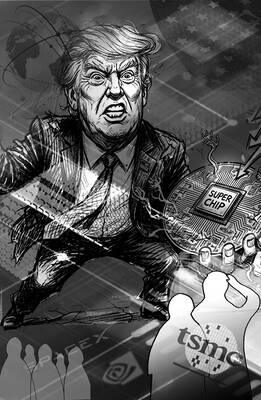
The White House’s decision to take a 9.9 percent stake in Intel Corp is looking like very shrewd business indeed. Since the government bought in at US$20.47 a share last August, the US chipmaker’s surging stock price has delivered the US a US$43 billion return. One of the reasons the investment has so far proved so sound is that the White House has made sure of it. According to The Wall Street Journal, Howard personally pushed deals on Intel’s behalf with some of the most lucrative clients imaginable. They include Nvidia Corp, the company at the heart of the AI
A single photograph can cut through a lot of noise, but it can also be used to misrepresent the truth. At the very least, it can concentrate the mind on something that requires further investigation. On Monday last week, Ma Ying-jeou Foundation CEO Tai Hsia-ling (戴遐齡) and former National Security Council secretary-general King Pu-tsung (金溥聰) held a news conference in which they showed a photograph of former foundation CEO Hsiao Hsu-tsen (蕭旭岑), now Chinese Nationalist Party (KMT) deputy chairman. In the image Hsiao is seated next to Xiamen Taiwan Businessmen Association chairman Han Ying-huan (韓螢煥). The two men were holding
I first met Professor Ray Jiing (井迎瑞) as a film and documentary student at Shih Hsin University’s (SHU) Department of Radio Television and Film in 1988. The following year, he went on to become the director of the Chinese Taipei Film Archive — forerunner of the Taiwan Film and Audiovisual Institute (TFAI). Over his eight-year tenure, Jiing rescued and restored over 200 classic Taiwanese films. In 1997, he established the Graduate Institute of Studies in Documentary and Film Archiving at Tainan National University of the Arts (TNNUA), and I joined the program in his third cohort of students. Beyond a
President William Lai Ching-te’s (賴清德) May 20 second-anniversary address was not just a routine policy review; it was damage control. US President Donald Trump’s remarks — that he did not want to see anyone move toward independence and that the delivery of a major Taiwan arms package could depend on the progress of US-China relations — unsettled Taiwan’s public and created an opening for opposition parties to question whether Taiwan was being treated as a bargaining chip in Washington’s dealings with Beijing. Lai’s speech was designed to close that opening. The address covered the expected ground: sovereignty, cross-strait relations, defense spending,


 RSS
RSS