


The COVID-19 pandemic has given the world the opportunity to reappraise many assumptions about how prepared we are to deal with major catastrophes, about where our priorities lie and how we go about our business.
The magnitude of its impact has also raised the awareness that climate change is going to radically change our lives, and demands not only a robust global response, but also a local one, which should have begun in earnest many years ago.
Urban greening is no longer about providing public access to green spaces to enhance the physical and mental health of residents, mitigate the heat island effect of metropolitan areas, or to provide green corridors to facilitate the maintenance of a robust, functioning natural ecology within the urban landscape.
With the new challenges they face, researchers and urban planners have begun completely rethinking cities, questioning the office as the primary site of work, and designing ways to integrate green spaces in densely populated areas and introduce higher resilience to climate change.
Much research has concentrated on US and European cities in temperate climates and does not cater to the particular demands of sub-tropical Asian cities, but there is increasing awareness of the need to localize international best practices derived from research into urban planning and climate change responses.
In Taiwan, the severity, frequency and irregularity of natural disasters, such as typhoons, landslides and flooding, would only increase with climate change, so resilience — defined as the ability to maintain or resume desired functions following a disturbance, to adapt to change and to transform systems that obstruct adaptive capacity — must be built more robustly into the system.
One study, published in the journal Global Environmental Change and titled “Urban greenspace as a climate change adaptation strategy for subtropical Asian cities,” looks at three Asian cities: Hanoi, Fukuoka in Japan and Taipei.
The study was not a competition to find out which city had done “best,” but it did single Taipei out as doing a lot right, for structural, social and political reasons: the flourishing democracy; the skillsets held by individuals and how they were able to engage with institutions; the specific goals set by policymakers; and the level of engagement in the process by civil society and local communities. It cited consultations with local representatives, public hearings, opportunities for communities to propose policy white papers to the city government and access to online data through the creation of e-platforms, as with the Taipei Garden City initiative.
Another major factor was the importance of what it called “champions,” individuals from civil society, academia, industry and the government who have the vision and awareness of how to facilitate and coordinate a climate change adaptation strategy.
However, the authors of the study said that a reliance on key individuals to coordinate the process is no substitute for competencies at the institutional level, and that elevating the effort to a national, rather than local, level would require significant multidisciplinary expertise.
“The lack of mechanisms for holistically and systematically governing, planning and managing natural elements across a city region to regulate the climate has been a major obstacle for enhancing the resilience of Taipei to climate change-related stresses,” said Shih Wan-yu (石婉瑜), one of the authors and an associate professor of Urban Planning and Disaster Management at Ming Chuan University.
The study also said that more needs to be done to systematically protect Taipei’s green spaces from encroaching urban development.
Climate change challenges should be seen as an opportunity to reimagine our cities and our relationship with the natural world. While there is much to take heart from in the study, policymakers at all levels of government should heed the warnings it outlines.
A gap appears to be emerging between Washington’s foreign policy elites and the broader American public on how the United States should respond to China’s rise. From my vantage working at a think tank in Washington, DC, and through regular travel around the United States, I increasingly experience two distinct discussions. This divergence — between America’s elite hawkishness and public caution — may become one of the least appreciated and most consequential external factors influencing Taiwan’s security environment in the years ahead. Within the American policy community, the dominant view of China has grown unmistakably tough. Many members of Congress, as
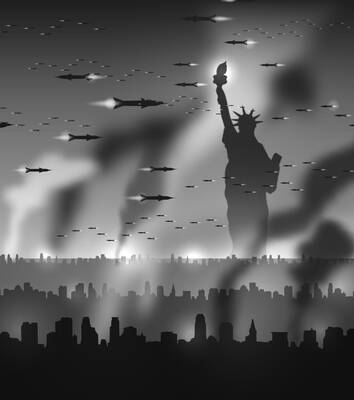
After declaring Iran’s military “gone,” US President Donald Trump appealed to the UK, France, Japan and South Korea — as well as China, Iran’s strategic partner — to send minesweepers and naval forces to reopen the Strait of Hormuz. When allies balked, the request turned into a warning: NATO would face “a very bad” future if it refused. The prevailing wisdom is that Trump faces a credibility problem: having spent years insulting allies, he finds they would not rally when he needs them. That is true, but superficial, as though a structural collapse could be caused by wounded feelings. Something
Former Taipei mayor and Taiwan People’s Party (TPP) founding chairman Ko Wen-je (柯文哲) was sentenced to 17 years in prison on Thursday, making headlines across major media. However, another case linked to the TPP — the indictment of Chinese immigrant Xu Chunying (徐春鶯) for alleged violations of the Anti-Infiltration Act (反滲透法) on Tuesday — has also stirred up heated discussions. Born in Shanghai, Xu became a resident of Taiwan through marriage in 1993. Currently the director of the Taiwan New Immigrant Development Association, she was elected to serve as legislator-at-large for the TPP in 2023, but was later charged with involvement
Out of 64 participating universities in this year’s Stars Program — through which schools directly recommend their top students to universities for admission — only 19 filled their admissions quotas. There were 922 vacancies, down more than 200 from last year; top universities had 37 unfilled places, 40 fewer than last year. The original purpose of the Stars Program was to expand admissions to a wider range of students. However, certain departments at elite universities that failed to meet their admissions quotas are not improving. Vacancies at top universities are linked to students’ program preferences on their applications, but inappropriate admission


 RSS
RSS