


On Thursday last week, President Tsai Ing-wen (蔡英文) congratulated US President Joe Biden and US Vice President Kamala Harris on their inauguration. Representative to the US Hsiao Bi-khim (蕭美琴) attended the inauguration on Wednesday last week after receiving a formal invitation from the Joint Congressional Committee on Inaugural Ceremonies — the first time such an invitation has been extended to a Taiwanese representative since 1979. In Taiwan this has been interpreted as a major breakthrough, and a sign of the friendly ties between Taipei and the new US administration.
If using diplomacy to gauge the Taiwan-US relationship, in the past the diplomatic protocol surrounding the relationship has been highly abnormal, despite the countries being close allies. Yet, there really was no need to be shackled by rigid, self-imposed diplomatic etiquette, which only obstructed the further warming of ties.
After the US and the People’s Republic of China established formal diplomatic relations in 1979, Taipei and Washington established a set of rules for their new relationship, including prohibiting Taiwan’s president, vice president, premier and ministers of foreign affairs and national defense from visiting Washington.
Former US president Barack Obama added an additional rule, banning Taiwan’s representatives to the US from setting foot inside the US Department of State.
In 2015, the Obama administration’s department spokesperson also rebuked the raising of the Republic of China (ROC) national flag during a ceremony at Twin Oaks, the former ROC embassy building in Washington.
The Obama administration then introduced new restrictions, including a ban on the display of the ROC flag within US government departments.
When Taiwanese and US officials meet, they must do so furtively in the conference suite of a nearby hotel or a coffee shop. The unfair treatment is a constant kick in the teeth to Taiwanese diplomats posted to the US.
High-level US officials have been restricted from traveling to Taiwan; this means that when mid-ranking officials visit Taiwan it is seen as a major event.
On March 16, 2018, then-US president Donald Trump promulgated the Taiwan Travel Act. The act eased restrictions and paved the way for separate visits last year by then-US secretary of health and human services Alex Azar and then-US undersecretary of state for economic growth, energy and the environment Keith Krach — the most senior US officials to visit Taiwan since Washington’s switch of diplomatic allegiance in 1979.
Exchanges between high-ranking officials have yet to be normalized. Despite the extremely friendly nature of the Taiwan-US relationship, the continued lack of high-level exchanges provides Taiwan little reassurance. It is a strange way to treat a “close friend.”
Washington’s self-imposed restrictions afforded Beijing the ability to manipulate the situation over the past few decades. This has meant that the issue of Taiwan-US contact has become a pawn for Washington and Beijing.
Building on the gradual lifting of restrictions by the Trump administration, on Jan. 9, then-US secretary of state Mike Pompeo announced the removal of restrictions on contacts between senior US government officials and their Taiwanese counterparts.
Pompeo said Washington would no longer “appease the communist regime in Beijing.”
It was a significant moment for Taiwan.
The Taiwan Assurance Act of 2020, which Trump signed into law at the end of last year, required Pompeo to instruct his department to review guidance governing Taiwan-US relations within 180 days of the act being signed into law, and issue a report to the US Congress with proposed updated guidelines.
Therefore, by lifting Taiwan-US contact restrictions, Pompeo was simply adhering to his obligations under the act and giving his successor some wiggle room.
When Biden administration nominee for secretary of state Antony Blinken testified at his congressional confirmation hearing on Tuesday last week, in addition to expressing a positive view of Taiwan, Blinken revealed that he received Tsai when she was a Democratic Progressive Party candidate running for president in 2015 and after Tsai was elected president, in his capacity as deputy US secretary of state. He said he had several conversations with Tsai.
“I want to see that process through to conclusion if it hasn’t been completed, to make sure that we’re acting pursuant to the mandate in the [Taiwan Assurance] act that looks at creating more space for contacts,” he added.
Hsiao’s invitation to Biden’s inauguration, taken together with Blinken’s language at the confirmation hearing, indicates that the Biden administration is willing to adopt a large chunk of the Trump administration’s Taiwan policy.
While in office, Pompeo pushed back against China and acted as a guarantor to Taiwan — Beijing viewed him as an outright enemy. Chinese Ministry of Foreign Affairs spokeswoman Hua Chunying (華春瑩) disseminated lies at the ministry’s regular news conferences.
On Thursday last week, Hua announced that China would be imposing sanctions on Pompeo and 28 other Trump administration officials.
Hua’s tirade was evidence that Washington is hitting Beijing where it hurts and the current course of conduct is correct.
Referring to China’s sanctions, former US national security adviser John Bolton jokingly said he would wear them like a badge of honor.
Beijing’s tactic of trying to humiliate Trump’s former officials will not only prove ineffective, all it will do is to further cement the bipartisan consensus against the Chinese Communist Party (CCP) in Washington.
The Biden administration’s decision to continue with the Trump administration’s anti-CCP policies is a reaction to Beijing’s continued external expansion during the past four years.
Taiwan-US exchanges are motivated not just by Taiwan’s important geostrategic position, but also due to a number of shared values that bind the two nations together.
The normalization of arms sales to Taiwan during the Trump era shows that Washington no longer regards Taiwan as partly a “China problem.” This is a significant conceptual change.
The strengthening of the Taiwan-US partnership is also due to a belief in Washington that Taiwan is a country worth investing in, and therefore in the US national interest. It is certainly not because the US views Taiwan as a chip to be traded away in some sort of transaction with Beijing.
Once the US and China have completely “decoupled” from one another, the Taiwan-US relationship would be able to normalize.
Whether Biden employs Trump-esque bombast or develops a more low-key relationship with Taiwan, as Biden said in his inauguration speech, his administration would seek to mend the US’ relations with its international allies.
This would not just be limited to Europe: the Indo-Pacific region presents the greatest challenge for the US. Since Taiwan is on the front line of the China threat, it would be a good place to start.
Upgrading the Taiwan-US relationship could include exchanges by high-level officials on both sides, which could be normalized in the same way that the Trump administration has normalized arms sales to Taiwan. Where a need is identified, meetings and exchange visits should take place.
Hsiao’s invitation to Biden’s inauguration could act as a springboard for further interaction. Contact with Taiwan should not be determined by a need to appease or to anger Beijing, but because it is in the US’ national interest and because it is right.
In her congratulatory message to Biden and Harris, Tsai said she is looking forward to a fruitful partnership with the US administration to defend liberal democracy, peace and stability in the Asia-Pacific region, and promote growth and prosperity.
This indicates that Tsai wants Taiwan to play a more active role within Biden’s multilateral administration.
Tsai clearly hopes that under Biden, it would be possible to smash the glass ceiling holding back the Taiwan-US relationship, and that its progress would no longer be dictated by threats and intimidation from Beijing, so that it can move forward on a stable track.
The task faced by Biden is not just to unite his own nation, but to unite the whole world under a new form of global US leadership that relies on the assistance and cooperation of its allies. The Taiwan-US relationship will serve as a litmus test for the US’ interaction with its democratic allies around the world.
Translated by Edward Jones
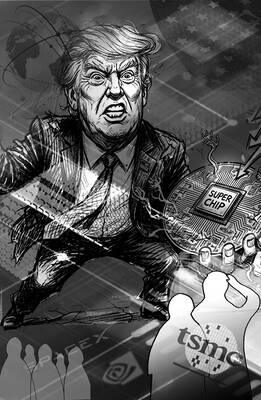
The White House’s decision to take a 9.9 percent stake in Intel Corp is looking like very shrewd business indeed. Since the government bought in at US$20.47 a share last August, the US chipmaker’s surging stock price has delivered the US a US$43 billion return. One of the reasons the investment has so far proved so sound is that the White House has made sure of it. According to The Wall Street Journal, Howard personally pushed deals on Intel’s behalf with some of the most lucrative clients imaginable. They include Nvidia Corp, the company at the heart of the AI
In a Taiwanese university classroom, a lecturer asks in English: “Can anyone give me an example from Taiwan?” Students look down. No one answers. After class, one student writes on the course platform in Mandarin: “I understood the concept, but I didn’t know how to answer in English.” That moment highlights a key issue in Taiwan’s English-medium instruction (EMI) reform: It is not just about more English-taught courses, but whether students can learn, participate and belong. EMI expansion is part of the Bilingual 2030 policy and the Ministry of Education’s BEST Program, aiming to improve English ability, support EMI teaching
A single photograph can cut through a lot of noise, but it can also be used to misrepresent the truth. At the very least, it can concentrate the mind on something that requires further investigation. On Monday last week, Ma Ying-jeou Foundation CEO Tai Hsia-ling (戴遐齡) and former National Security Council secretary-general King Pu-tsung (金溥聰) held a news conference in which they showed a photograph of former foundation CEO Hsiao Hsu-tsen (蕭旭岑), now Chinese Nationalist Party (KMT) deputy chairman. In the image Hsiao is seated next to Xiamen Taiwan Businessmen Association chairman Han Ying-huan (韓螢煥). The two men were holding
The Ministry of the Interior, working with the navy and coast guard, is organizing Taiwan’s first joint exercise simulating escort tankers carrying liquefied natural gas (LNG) and oil through a Chinese blockade. The drills simulate fuel transport along three maritime corridors leading toward Japan, the Philippines and the US. Deputy Minister of the Interior Sawyer Mars (馬士元) said that a blockade of the Taiwan Strait would amount to “almost a 100 percent blockade of the regional energy supply.” Minister of National Defense Wellington Koo said planning to counter a blockade is standard practice in Taipei. While the exercise is limited in


 RSS
RSS