


When a team of international scientists set out to count every tree in a large swathe of west Africa using artificial intelligence (AI), satellite images and one of the most powerful supercomputers, their expectations were modest. Previously, the area had registered as having little or no tree cover.
The biggest surprise is that the part of the Sahara that the study covered, roughly 10 percent, “where no one would expect to find many trees,” actually had “quite a few hundred million,” said Martin Brandt, assistant professor of geography at the University of Copenhagen.
Trees are crucial to our long-term survival, as they absorb and store the carbon dioxide emissions that cause global heating, but scientists still do not know how many there are.
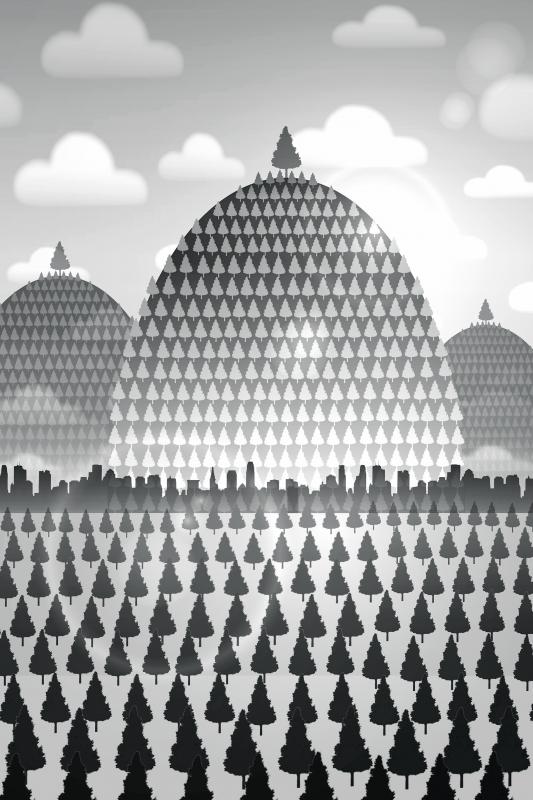
Illustration: Yusha
Much of the Earth is inaccessible, either because of war, ownership or geography. Now scientists, researchers and campaigners have a raft of more sophisticated resources to monitor the number of trees on the planet.
Satellite imagery has become the biggest tool for counting the world’s trees, but although forested areas are relatively easy to spot from space, the trees that are not neatly gathered in thick green clumps are overlooked.
Which is why assessments so far have been “extremely far away from the real numbers,” Brandt said. “They were based on interpolations, estimations and projections.”
The most recent attempt at a global tally of trees was in 2015, when researchers, using a combination of satellite data and ground measurements, estimated there were just more than 3 trillion trees. This was a dramatic increase from the previous estimate of 400 billion in 2009, which was based on satellite imagery alone.
The research by Brandt and his colleagues in west Africa promises a more accurate picture. In a collaboration with NASA’s Goddard Space Flight Center, they were able to use satellite images from DigitalGlobe, previously available only to commercial entities, which were high enough resolution to make out individual trees and measure their crown size.
TRAINING MACHINES
Using AI deep learning, and one of the most powerful supercomputers — Blue Waters at the University of Illinois — the team was able to count individual trees from space for the first time.
They manually marked nearly 90,000 trees across a variety of terrain, so the computer could “learn” which shapes and shadows indicated the presence of trees. This enabled them to count every tree with a crown size of at least 3m2 in an area of 1.3 million square kilometers comprising mostly the Sahara, but also the semiarid Sahel area along the southern edge of the desert and a sliver of the subhumid zone beneath that.
Overall, they detected more than 1.8 billion trees.
Those in the Sahara tended to be clustered around human settlements. Arid areas had on average 9.9 trees per hectare, rising to 30.1 in semiarid zones and 47 in the southernmost subhumid rim of the patch being studied. There were just 0.7 trees per hectare in areas classified as “super-arid.”
“Most maps show these areas as basically empty,” Brandt said. “But they’re not empty. Our assessment suggests a way to monitor trees outside of forests globally, and to explore their role in mitigating degradation, climate change and poverty.”
Keeping the planet’s arboreal accounts is key to understanding the effect trees are having on the planet’s health. If the number of trees can be mapped, so can the amount of carbon they store.
The most high-profile world tree map is released annually by Global Forest Watch. Launched by the World Resources Institute (WRI) in 2014, it uses data from NASA Landsat satellites — which do not have as high resolution as commercial equivalents — to keep tabs on what it diplomatically calls “tree cover loss.”
Previously, information on the changing shapes of forests was collated every five years or so by the UN Food and Agriculture Organization, which had to take the numbers on trust from individual countries. The WRI’s aim was to make assessing deforestation data transparent.
Weekly alerts are generated for reductions in forest size in the tropics.
“Cambodia basically said they had no deforestation, but there’s been so much,” said Fred Stolle, deputy director of WRI’s forest program. “The car industry is getting bigger and bigger and we need tires. Rubber grows well in the tropics, and so Cambodia has an enormous amount of deforestation to plant new rubber trees.”
Alerts have also appeared for Ghana, where destruction of primary forests jumped by 60 percent from 2017 to 2018 — the biggest rise anywhere in the tropics.
However, there is one aspect of the WRI map that Stolle said means the picture is incomplete.
While the satellites easily show where trees have been cut down, “new tree growth is much more difficult to see,” he said. “So while Global Forest Watch sees a lot of the deforestation, it doesn’t see much of the reforestation.”
Brandt expects that the higher resolution technology offered by the commercial satellites will become widely available in the coming years, helping to bridge this gap.
Another organization tracking deforestation is environmental nonprofit Canopy, founded in 1999 by its now executive director, Nicole Rycroft.
It traces back supply chains for companies, because “there’s no need to cut down 100-year-old trees to make pizza boxes or T-shirts, or for the trees to come from land inhabited by indigenous communities,” Rycroft said.
SCRUTINIZING SUPPLY CHAINS
Using information from a range of scientific sources, Canopy has packaged the raw data and satellite imagery into an interactive tool called ForestMapper, to help companies switch to sustainable supply chains. They can scan the map, which includes information on forest carbon density, endangered species, tree loss and projected deforestation over the coming decade.
“We’re the applied science side, making the data user-friendly,” Rycroft said.
As well as highlighting risky supply chains, Canopy helps manufacturers find more sustainable sources, including recycled fibers, “so we don’t just shift the problem from one backyard to somebody else’s,” she said.
“We work with 320-odd fashion brands,” she added. “Including guys like H&M, Zara and Uniqlo, right down to luxury designers like Stella McCartney, and as you can imagine, there’s a wide range of motivations within those companies, but they’re all committed.”
Seven years ago, few in the industry even knew that “200 million trees were disappearing into rayon and viscose every year, and some of it from orangutan and grizzly bear habitats, really high carbon forest ecosystems,” she said.
Now, “52 percent of global viscose production is verified by ourselves as being at low risk of originating from high carbon or high biodiversity forests,” she added. “There’s still 48 percent of the supply chain to go, but in a relatively short space of time we’ve seen the global supply chain fundamentally starting to transform how they source.”
Hotspots on the map include Southeast Asia, Indonesia, Vietnam, Laos and Brazil. Working with local non-governmental organizations and campaigners, Canopy drills down into the regional detail. Some eucalyptus plantations in Indonesia, for example, are growing on high-carbon peatlands that need restoring.
“And we’ve recently discovered that koala habitat in Australia has been logged for fabric production,” Rycroft said.
The same scrutiny applies to other supply chains, such as cardboard.
“Which are the forests that provide the 3 billion trees that disappear into food wrappings, pizza boxes or the packaging that lands on our doorsteps from e-retailers? Is it coming from a sustainably managed plantation? Is there recycled content? Or is it coming from a high-carbon value forest?” she said.
What is hardest to monitor is the illegal clearing of the vast, as yet unknown numbers of trees that exist outside forests.
Brandt’s team is close to submitting another research paper, for which they have scanned 10 times the area covered by their initial study.
As well as forests, individual trees are “valuable in mitigating climate change, providing a variety of ecosystems and services to people, and until now, it was impossible to map them,” Brandt said.
A gap appears to be emerging between Washington’s foreign policy elites and the broader American public on how the United States should respond to China’s rise. From my vantage working at a think tank in Washington, DC, and through regular travel around the United States, I increasingly experience two distinct discussions. This divergence — between America’s elite hawkishness and public caution — may become one of the least appreciated and most consequential external factors influencing Taiwan’s security environment in the years ahead. Within the American policy community, the dominant view of China has grown unmistakably tough. Many members of Congress, as
The Hong Kong government on Monday gazetted sweeping amendments to the implementation rules of Article 43 of its National Security Law. There was no legislative debate, no public consultation and no transition period. By the time the ink dried on the gazette, the new powers were already in force. This move effectively bypassed Hong Kong’s Legislative Council. The rules were enacted by the Hong Kong chief executive, in conjunction with the Committee for Safeguarding National Security — a body shielded from judicial review and accountable only to Beijing. What is presented as “procedural refinement” is, in substance, a shift away from
The shifting geopolitical tectonic plates of this year have placed Beijing in a profound strategic dilemma. As Chinese President Xi Jinping (習近平) prepares for a high-stakes summit with US President Donald Trump, the traditional power dynamics of the China-Japan-US triangle have been destabilized by the diplomatic success of Japanese Prime Minister Sanae Takaichi in Washington. For the Chinese leadership, the anxiety is two-fold: There is a visceral fear of being encircled by a hardened security alliance, and a secondary risk of being left in a vulnerable position by a transactional deal between Washington and Tokyo that might inadvertently empower Japan
After declaring Iran’s military “gone,” US President Donald Trump appealed to the UK, France, Japan and South Korea — as well as China, Iran’s strategic partner — to send minesweepers and naval forces to reopen the Strait of Hormuz. When allies balked, the request turned into a warning: NATO would face “a very bad” future if it refused. The prevailing wisdom is that Trump faces a credibility problem: having spent years insulting allies, he finds they would not rally when he needs them. That is true, but superficial, as though a structural collapse could be caused by wounded feelings. Something


 RSS
RSS